While the plan for funding water has moved forward at the Capitol, last night the money for that plan seemed to stall.
Last night on the House floor, a major piece of legislation that would put $2 billion towards water projects in a growing, thirsty state met fierce resistance, ultimately falling victim to a legislative maneuver that effectively sank it.
While the legislation to create a water infrastructure bank that would give out loans for water development and conservation projects continues to move forward at the Capitol, the actual money for that bank (contained in separate legislation) proved to be a trickier issue Tuesday night.
KUT political reporter Ben Philpott sat down with StateImpact Texas’ Mose Buchele, who covered the hearing, to talk about what happened, and what happens next:
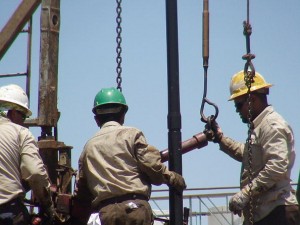
The rise of drilling techniques like hydraulic fracturing, or "fracking," has led to new economic prosperity in Texas. (Photo of a Cabot natural gas drill at a fracking site in Pennsylvania.)
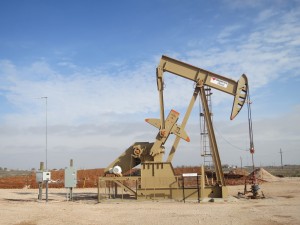
The impact of the recent boom in shale drilling is hard to miss in some remote Texas towns, where hotels and homebuilders scramble to keep up with the influx of oil and gas workers.
But the most significant effect from the boom may be seen in the state’s coffers. Taxes on oil and gas production have soared past estimates from the state’s comptroller’s office for fiscal 2012. And with production expected to continue to rise over the next several years, the economic benefits will continue.
James LeBas, a fiscal consultant who also works as a lobbyist for the Texas Oil and Gas Association, estimates that oil and gas interests paid about $12 billion in taxes in Texas in fiscal 2012, up from $9.25 billion in 2011 and $7.4 billion in 2010. That included taxes on property, sales and production, as well as the franchise tax and indirect items like taxes on motor fuels.
“It would be unambiguously positive for the state fiscal situation and local [economies], if oil production continues to rise,” LeBas said. “For most of my lifetime, it has been falling.” Continue Reading →
Lawmakers discuss a point of order aimed at killing HB 11
It was possibly the most high profile piece of legislation at the capital this session. It had the backing of the governor, the state’s business community, and many environmental groups. But last night House Bill 11, the plan to pull $2 billion from the state’s rainy day fund to put to Texas water projects, could not muster the votes to gain approval in the Texas House of Representatives.
Backers of the bill felt pressure from all sides ahead of the vote. Tea Party budget cutters called it an example of irresponsible spending and pointed out that the bill would likely break state imposed spending limits. House Democrats made their support contingent on tapping the rainy day fund for education as well.
To navigate the impasse, bill supporters plotted a risky course.
The Texas legislature will consider major legislation to help the state's water woes this week.
Time is running out for Texas legislators as the 83rd legislative session nears its conclusion. This week will see plenty of activity on bills that deal with water, eminent domain and roads. In our weekly installment, we pick some of the energy and environment legislation we’re watching this week. Think we missed something? Feel free to add your suggestions in the comments below.
You Can Lead a Lege to Water …
This afternoon, major legislation on water planning and funding for Texas could be heard in both the House and the Senate. HB 4, by state Rep. Allan Ritter, R-Nederland, is one of the big water bills this session. It would create a water infrastructure bank and prioritization process for new projects and conservation. That bill has already passed in the House and could come up on the Senate floor today, a potentially significant step forward. Update: the bill passed in the Senate, 30-1.
The actual money for that plan is in another bill by Ritter, HB 11, which would take $2 billion from the state’s Rainy Day Fund to kickstart the water bank. That bill recently passed out of committee and will get a hearing on the House floor today. Update: the bill was sunk by a legislative maneuver. Read more here. Continue Reading →
SWEETWATER — About a year ago, talk began circulating in this West Texas town about a huge oil-producing formation called the Cline Shale, east of the traditional drilling areas around Midland.
Then the oilmen and their rigs arrived. Now homes and hotels are sprouting, “help wanted” signs have multiplied, and a major drilling company has cleared land to build an office and equipment yard.
“It is coming, and it is big,” said Greg Wortham, the mayor of Sweetwater, who also serves as executive director of the Cline Shale Alliance, a new economic development group.
The Cline Shale, thousands of feet underground in a roughly 10-county swath, is just one of many little-tapped shale formations in Texas and across the nation, geologists say. That means the potential for oil and gas discoveries is theoretically huge, and the reason is technology. The rock-breaking process known as hydraulic fracturing, coupled with the ability to drill horizontally underground, has allowed drillers to retrieve oil and gas from previously inaccessible areas.
Many shales will be too expensive or too small to develop, especially if oil prices fall or environmental regulations tighten. But in Texas, which is already the top oil-producing state, bullishness about a new era is pervasive. Continue Reading →
Photo Courtesy of Harvard Environmental Law and Policy Program.
Kate Konschnik is Policy Director for the Environmental Law and Policy Program at Harvard University and lead author of the study.
FracFocus, the online registry used by Texas and other states to disclose information about hydraulic fracturing, “creates obstacles to [regulatory] compliance” and seems “structurally skewed to delete” records, according to a report from Harvard Law School’s Environmental Law Program.
The website is an integral part of the way drillers disclose what chemicals they are putting in the ground as part of the the drilling process called hydraulic fracturing, or “fracking.” It’s been touted by Texas politicians and state regulators as a way for landowners and concerned citizens to determine how fracking is impacting the environment.
In Texas, drillers have been required to use FracFocus to disclose fracking ingredients since February 2012. But the report says FracFocus is not only unequipped to serve as a database for information, it finds that the site creates obstacles to regulatory compliance.
That might be because states are relying on the website to fill a role it was never intended to fill, says Kate Konschnik, head of Harvard’s Environmental Law and Policy Program and lead author of the study.
A helmet is carried in remembrance of a firefighter from the Abbott Volunteer Fire Department killed in a fertilizer plant explosion in West, Texas last week.
Firefighters, public officials and thousands of Texans gathered in Waco Yesterday at Baylor University for a memorial service to remember twelve firefighters and first responders that died in the line of duty while responding to a fire at a fertilizer plant in the small town of West last week. While fighting the fire, the plant exploded, killing 15 and destroying nearly 150 homes.
You can listen to the radio story above, and see images from the memorial service in the slideshow below by KUT photographer Jorge Sanhueza-Lyon:
Rick Auckerman / Texas A&M AgriLife Extension Service
Irrigation in freezing weather can damage crops and equipment, but many crops must be irrigated because of statewide drought conditions.
Recent rains helped pull more of the state out of drought- but 92 percent of Texas is still experiencing at least a moderate drought and in some of the state drought has worsened.
The U.S. Drought Monitor maps released Thursday morning show a slight decrease from last week in the percent of the state facing drought, but a four percent increase in the state currently under “extreme” drought.
The Northeast and far eastern portions of Texas received some relief with recent rains. The NOAA Climate Prediction Center estimates these regions, along with much of the Midwest, will see improvements in the coming months. Continue Reading →
Texas likes to be “business friendly” and as the state legislature considers bills to limit environmental regulation to keep it that way, some economists warn of the longer term consequences.
Dave Fehling / StateImpact Texas
Cattle ranch borders petrochemical plant in Calhoun County
“It’s not as simple as saying yeah, it’s a negative for everybody and everybody is going to move out of the state if we have more stringent regulation,” said Daniel Millimet, an environmental economist at Southern Methodist University in Dallas.
The idea that too much regulation can scare off business has been a main thrust of some of the state’s environmental regulators like David Porter, one of the three elected leaders of the Texas Railroad Commission. Speaking last October at oil and gas drillers conference in San Antonio, Porter contended that should Texas succumb to the stricter pollution regulation of the federal government, disaster would follow for the state’s booming drilling industry. Continue Reading →
Larry Joe Doherty on his ranch, where he use prescribed burning. If passed, two bills could make this practice easier.
Two bills promoting responsible prescribed burning received a public hearing in the House Agriculture and Livestock Committee Wednesday morning.
Both bills would indirectly influence the ease with which landowners could use this wildfire prevention technique on their land.
SB 702 by state Sen. Glenn Hegar, R-Katy, would establish standards for prescribed burners, as well as training, education and insurance for those doing the prescribed burning.
StateImpact seeks to inform and engage local communities with broadcast and online news focused on how state government decisions affect your lives. Learn More »