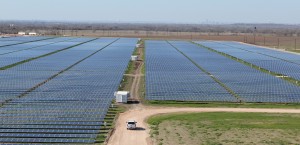
During his State of the Union address on Tuesday, President Obama doubled down on his vision for renewable energy, calling for more wind and solar power.
In Texas, the Legislature is less enthusiastic.
As the session progresses, renewable energy advocates are bracing to defend critical policies that have helped Texas become the leading wind-power state. The ascendancy of theTea Party, an abundance of cheap natural gas and tighter budgets have reduced the sway of the wind industry. Solar power advocates anticipate limited gains at best.
But Texas’s renewable energy push has “been eclipsed by the effect of fracking,” said Rep. Mark Strama, D-Austin, referring to the drilling technology that prompted the natural gas boom. Continue Reading →
At a commission meeting this morning, Pablos said that he had submitted his resignation this morning to Governor Rick Perry. Chair Donna Nelson then moved the commission into a planned closed session, noting to Pablos, “You kinda threw me with that.”
In a statement, Pablos did not offer a reason for his resignation, saying instead that “it has been a privilege and honor to serve the people of the Great State of Texas” and that “ensuring that Texas has a reliable supply of electricity has been a top priority for me.” He also noted that “ensuring universal access to telecommunication services on a state-wide basis has also been an important component of my work at the PUCT.”
Pablos’ resignation could be seen as a setback for advocates hoping to get more solar power on the Texas grid. Continue Reading →
In addition to the intensifying discussions of water infrastructure funding at the Capitol, an even more basic conversation is also getting under way: whether to restructure the Texas Water Development Board.
The board, created in 1957, is overseen by six part-time board members, who serve on a volunteer basis after being appointed by the governor. But state Sen. Troy Fraser, R-Horseshoe Bay, chairman of the Senate Natural Resources Committee, wants to change the structure to three full-time members, also appointed by the governor.
A flare burns in the Eagle Ford Shale in South Texas.
The drilling process known as “fracking” has opened up huge deposits of oil and gas in Texas and other parts of the country. It’s brought plenty of jobs – and profits – to the state. But it also requires something Texas has in short supply – water. Now the issue has caught the eye of the Texas legislature.
At a joint meeting of the House Natural Resources and Energy Committees Wednesday, a large group of lawmakers got an earful on the subject, with a meeting that lasted hours. Most of the testimony came from folks in the oil and gas industry, like Corey Pomeroy with the Texas Oil and Gas Association, who downplayed how much water fracking needs.
“The oil and gas industry accounts for less than once percent of Texas’ water in the exploration and production of oil and gas,” Pomeroy testified.
But under questioning by lawmakers, Pomeroy acknowledged that in certain locales, that percentage can be higher.
A young boy pushes his bicycle out of the Rio Grande after taking a swim with his family where New Mexico, Texas and Mexico all touch. Texas' conflicts with its neighbors over water have heated up during dry times.
As Texas begins a third year of drought, its conflicts over water with neighbors continue. One high-profile case against Oklahoma is on its way to the Supreme Court, Texas has filed a lawsuit against New Mexico, and is accusing Mexico of not sharing the water it should as well.
Hoping to bring a measure of calm to the water wars is State Rep. Lyle Larson, R-San Antonio, who filed a bill Tuesday that would create the Southwestern States Water Commission, a state-level group to work with neighbors like Arkansas, Louisiana, New Mexico and Oklahoma to secure water.
“The concept came up as we traveled around the state, about water that’s contiguous,” Larson says. “There’s an abundance of water that’s available that flows into the Gulf of Mexico, and no one’s capturing the economic benefit from it.” Continue Reading →
A footprint in the soft mud of the Rio Grande in Ciudad Juarez, Mexico.
State lawmakers and agency heads discussed Mexico’s lack of water contribution to the Rio Grande River, the state of the State Water Plan and invasive species at the House Natural Resources committee meeting at the Capitol yesterday.
It’s not the first time Mexico has run up this type of water deficit on the Rio Grande. Between 1992 and 2005, Mexico neglected to put more than 1.5 million acre feet of water into the river. That’s nearly twice the amount of water in Central Texas’ two largest reservoirs, Lakes Travis and Buchanan, combined. Mexico did eventually pay back that debt in water, however.
Without Mexico’s contribution to the Rio Grande, water supplies are running short here in Texas. Continue Reading →
A parking meter is marked off due to damage caused by beach erosion along route A-1-A impassable to vehicles on November 27, 2012 in Fort Lauderdale, Florida. Climate scientists predict sea levels in South Florida will rise by 1 foot by 2070, 2 feet by 2115, and 3 feet by 2150.
For those watching and waiting for President Obama to take action on climate change, last night’s State of the Union address may have been an encouraging start. “If Congress won’t act soon to protect future generations, I will,” the president said. “I will direct my Cabinet to come up with executive actions we can take, now and in the future, to reduce pollution, prepare our communities for the consequences of climate change, and speed the transition to more sustainable sources of energy.”
The reaction from some climate scientists who have been studying the issue for decades was overwhelmingly positive. “He made a really good point, that climate change is already affecting our lives today,” Dr. Katharine Hayhoe, Director of the Climate Science Center at Texas Tech University, tells StateImpact Texas. “[By] changing the risks of certain types of severe weather, like heat waves and floods, making storms stronger and sea level rise. So he brought the issue home to where we live, right now, today.”
While Hayhoe cautions that there’s “no one magic silver bullet” to address greenhouse gas emissions and man made climate change, she was encouraged by Obama’s calls for what she labels “sensible transitions:” increased renewable power, natural gas and a “race to the top” for energy efficiency. “The U.S. is one of the most wasteful countries in the world in terms of how we spend our energy,” she says. “It just makes sense to conserve what we’re already using.”
But she and other climate scientists add that aside from local, state and federal government action, there’s plenty individuals can do to turn the tide. Continue Reading →
US President Barack Obama addresses a crowd of supporters on stage on election night November 6, 2012 in Chicago, Illinois.
Even before the president’s State of the Union Address was over last night, some environmental and renewable energy groups were sending out congratulatory emails.
And while some observed that the president’s proposals lacked specifics, most agreed that he was sounding a bolder tone on global climate change.
“Climate change, it’s no longer a forbidden topic,” Michael Webber, co-chair of UT Austin’s Clean Energy Incubator and head of the Webber Energy Group told StateImpact Texas.
A fisherman walks from his fishing spot at the Tonkawa Falls area 10 January 2004 in Crawford, Texas. A new bill would require lakes with mercury contamination to post warning signs to fishermen.
“Right now there aren’t any signs at lakes with mercury contamination,” said Lucia Mendez, assistant committee clerk for the House Committee on Culture, Tourism and Recreation. She assisted in writing the bill.
Rep. Ryan Guillen, D-Rio Grande City, has filed a bill that will require, when financially possible, state agencies with authority over water bodies holding contaminated fish to post signage that warns fisherman of possible mercury contamination in fish and shellfish. Continue Reading →
The Sierra Club is going after several coal plants in Texas.
FAIRFIELD, Texas — Staring across a lake at the oldest coal-fired power plant in Texas, Mayor Roy Hill thinks back to the early 1970s, when his father helped bring the plant to the area.
“Quite honestly, this plant saved Fairfield,” Hill said. Should it close, he said, the economic impact would be “catastrophic.”
But closing Big Brown, as it is known, and two other 1970s-era coal plants in East Texas has emerged as a top goal of the Sierra Club. The group is escalating a campaign against the plants’ corporate owner, Dallas-based Energy Future Holdings, whose subsidiaries include the state’s largest power-generation company. Coal combustion produces mercury and other pollutants, and environmentalists say that the old plants are especially harmful to the climate and Texans’ health.
“We can’t fix the climate problem in the United States unless we fix what’s happening” at EFH, said Al Armendariz, who is leading the Sierra Club’s anti-coal push in Texas. The company, the club says, operates some of the nation’s dirtiest coal plants. Continue Reading →
About StateImpact
StateImpact seeks to inform and engage local communities with broadcast and online news focused on how state government decisions affect your lives. Learn More »