Photo by Flick user by Big Grey Mare ~ Back--But Barely/Creative Commons
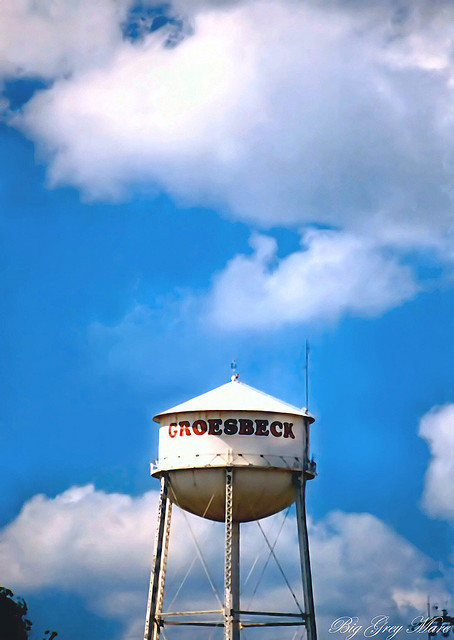
The Groesbeck Water Tower
You might recall the town of Groesbeck, a small community of just over 4,300 residents east of Waco. Like many small towns in Texas this year, Groesbeck has been struggling with how to supply its residents with water in the midst of record-breaking heat and drought. The town gets all of its water from the Navasota river, and by late fall the river was 44 inches below normal. In November, the Texas government said the town could run out of water in a few weeks. (It even made national news.)
Since then, things have turned around for Groesbeck. In late November, the town announced that they had literally bought a few more months of water. A three-mile pump was installed further up the river to bring in more water. And December rains have brought more relief, with over five inches falling last month. Continue Reading →
The change doesn’t amount to much, as residents are still only allowed to water with sprinklers or irrigation one day a week. But under the Stage 2 restrictions, you could only water from 3 a.m. until 8 a.m. and from 8 p.m. until 10 p.m. With Stage 1, those hours are extended a little, from 12 a.m. to 8 a.m. and from 8 p.m. to 12 a.m. one day a week. No sprinkler or irrigation watering is allowed between 8 a.m. and 8 p.m. So if you’re a night owl or early bird, you now have five more hours to water your lawn in San Antonio.
A Chevy Volt gets a charge in Austin. Photo by Nathan Bernier, KUT News.
It’s the first feel-good sustainability story of 2012. A man in Orlando, Florida installed solar panels on the roof of his home, sold the excess power back to the grid, and then used that money to make a down payment on a new Chevy Volt, the plug-in car that gets 60 miles to the gallon.
Now those solar panels are charging his new car.
Bob Stonerock has made $5,600 from selling excess power from his solar roof panels back to the grid over the last two years, the Orlando Sentinel reports, and used that cash to make a down payment on the Volt. The paper says Stonerock “estimates that he will be able to fuel the car almost exclusively from the electricity from the solar panels that power his vehicle-recharging station.”
But before you start attaching panels to your own roof, keep in mind that Stonerock’s solar success is in part due to some creative accounting. Continue Reading →
Reader CT was one of the first to ask “How about leaving that oil in the ground and seeking renewable energy sources?” Reader Dale096 agreed, saying “The extraction of this oil uses and pollutes unfathomable amounts of water and destroys vast tracts of Boreal forests. Invest in alternatives, leave fossil fuels in the history books.” Continue Reading →
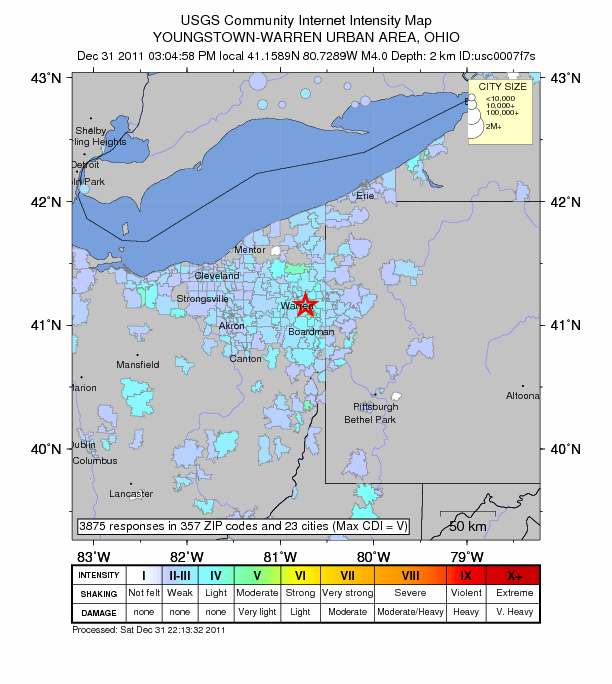
A map of the internet response to the Ohio earthquake, with its epicenter
What happened with the earthquake in Ohio over the weekend, and how is it linked to fracking? Here’s what we know:
The earthquake measured 4.0, the largest in Ohio this year.
The New York Times is reporting that Ohio officials say the earthquake wasn’t caused by fracking, but rather by injection wells disposing of used fracking fluid. These wells are used to send the wastewater from fracking (a mix of water, sand and chemicals) deep underground for disposal.
The Times is also reporting that officials in Ohio say dispoal operations will “remain halted in the Youngstown area until scientists could analyze data from the most recent of a string of earthquakes there.”
This is the eleventh earthquake in the Youngstown area this year, and the most intense one. The earthquakes have all taken place near an injection well that goes 9,200 feet deep, according to the Times, and “as been used for the disposal of millions of gallons of brine and other waste liquids produced at natural-gas wells.” Continue Reading →
But at the end of the year, a scientist in Austin has brought a little sun into the forecast. Meet Xiaoyang Zhu, a chemistry professor at the University of Texas, and director of the Energy Frontier Research Center.
For the last few years Zhu and his team have been working on a way to dramatically increase the amount of energy harvested from Solar technology. Now, they think they’ve done it. Continue Reading →
About StateImpact
StateImpact seeks to inform and engage local communities with broadcast and online news focused on how state government decisions affect your lives. Learn More »