Ah, manmade earthquakes. Something that certainly seems feasible, but just not right.
There’s been a spate of quakes in the Dallas-Fort Worth area over the last few years, scientifically linked by geologists to wells used for disposing of fracking fluids. The two latest quakes hit Dallas Saturday night, followed by a minor one Sunday evening. While damage from these quakes has been minimal (in many cases, nonexistent), they’re certainly getting folks attention.
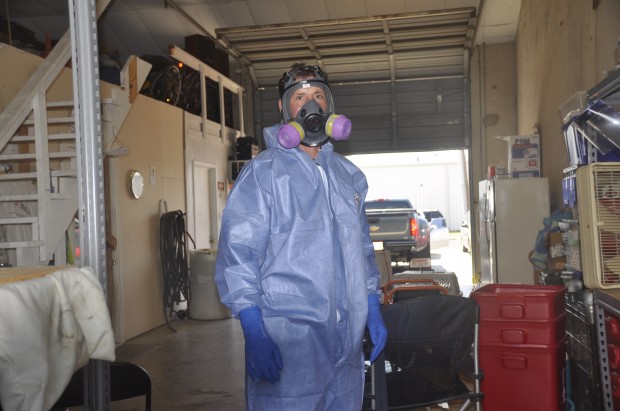
Kurt Flippin wears the full hazmat suit he uses while cleaning homes contaminated with methamphetamine residues. Flippin says he knows of scores of homes that are contaminated but have never been cleaned.
It was one of Kirk Flippin’s saddest cleanup jobs. He remembers standing in a driveway in Grapevine, Texas a few years back, throwing a little girl’s toys, clothes and dolls into a dumpster as she watched in dismay. “Why are all my toys in the dumpster?” the girl said to her Mom.
“Because a bad man used to live here,” her mother replied.
Flippin tossed the girl’s toys out because her family had unwittingly moved into a home previously occupied by a methamphetamine cook. The family realized something was wrong when their dog died. It was chemical poisoning, according to their veterinarian. The children became chronically ill with respiratory problems. They had their home tested for meth, but unable to foot the bill for a proper cleanup, the family was forced to move out and eventually the bank foreclosed on the home. They lost their house and most of their possessions, Flippin remembers.
Flippin is the owner of Texas Decon Environmental Services, a waste cleanup company that counts meth lab cleanup as one of its specialties. Flippin was called in by the bank to detoxify the home. The name of the bank and family are proprietary information that Flippin could not disclose.
There aren’t many meth-lab cleanup jobs in Texas for Flippin though, since there are no laws that require homeowners to clean their property after a meth lab has been broken up. In Texas, there aren’t even laws requiring landlords to disclose if an apartment was once a meth lab, according to David Leibowitz, a former Texas House Representative from San Antonio. Continue Reading →
A coal plant may have to stay running this winter.
Update: On October 30, ERCOT announced that they will not need to keep the coal power units running this winter for transmission and system reliability.
After a coal power plant said they’ll be shutting down some of their units over the winter, the group behind the Texas grid announced last week that it may pay them to keep running anyways.
But that group, the Electric Reliability Council of Texas (ERCOT), insists it’s not because the grid needs to “keep the lights on” for demand reasons. It’s because the transmission lines used by those coal power plants need to have a certain amount of juice running through them, or the grid won’t work correctly.
“The whole purpose of the transmission system is to get power from power plants to consumer loads,” explains Dan Woodfin, ERCOT’s Director of Grid Operations. “When a generator shuts down, that changes the power flows on that transmission system. So we have to make sure that we can get power from the remaining power plants to higher loads.”
The 3.1 earthquake that shook the Dallas area on Saturday night and the 3.4 quake near Irving were still small by any estimation. Small enough that the L.A. Times even had a little fun covering the quakes, running the headline “Not Everything is Bigger in Texas” on Sunday.
But even though the quakes were babies compared to the types that visit Los Angeles, U.S. Geological Survey records show that they were slightly more intense than most other earthquakes have been in Dallas.
A search of earthquakes within a hundred kilometer radius of the Dallas-Fort Worth Airport on the USGS Circular Area Earthquake Search showed that only one quake has been stronger than the 3.4 recorded in Irving (a 3.5 quake earlier this year that happened closer to Cleburne, Texas, a known hotspot for small earthquakes).
The most powerful quake ever measured in Texas was a 4.6 on the Richter scale, near Snyder, in 1978.
Of the 50 quakes that have been recorded in the area only 8 had been of magnitude 3.0 or higher until Saturday night. The area has still not seen a quake of 4.0 or higher, the level which seismologists consider dangerous.
Energy efficiency in Texas will become less of a priority under new state rules.
On Friday, the Public Utility Commission, which oversees much of the electricity market in Texas, voted to make energy efficiency less of a priority in the power-hungry state.
While Texas’ population and industry is booming, not enough new power generation is coming on line to meet energy needs during times of peak demand.
In 1999, the Texas legislature passed Senate Bill 7, which mandated that private utilities meet ten percent of their new demand through energy efficiency programs. That incentivized companies to provide energy efficiency discounts for things like insulation, and window and air conditioner upgrades to their customers. That was paid for by a small charge on every consumer’s bill. Those upgrades would also result in them using less power, and paying lower power bills.
Because of the initial program’s success, the lege took things a step further in 2007 with higher energy efficiency requirements and bonuses. Currently, private power companies must anwer for twenty-five percent of their new demand with reductions in use from energy efficiency upgrades. That number will grow to up to thirty percent next year.
Now that’s likely to change. The new rule by the Public Utility Commission (PUC) puts a cap on how much consumers can be charged for the efficiency program. And it exempts some industrial customers completely. Continue Reading →
After losing electrical power, the TPC petrochemical plant in Houston flares hydrocarbons over Cesar Chavez High School
Power outages are a significant threat to petrochemical plants and refineries in Texas and have proven vexing for some facilities to reduce. The outages can wreak havoc, posing a health and safety risk to workers and to people who live near the plants.
“The sound of a (petrochemical plant) losing electrical power produces a sinking feeling in your stomach. It is a loss of resonance and vibration that is odd and unmistakable,” wrote Donald Schneider, a chemical engineer in League City, Texas. Continue Reading →
About StateImpact
StateImpact seeks to inform and engage local communities with broadcast and online news focused on how state government decisions affect your lives. Learn More »