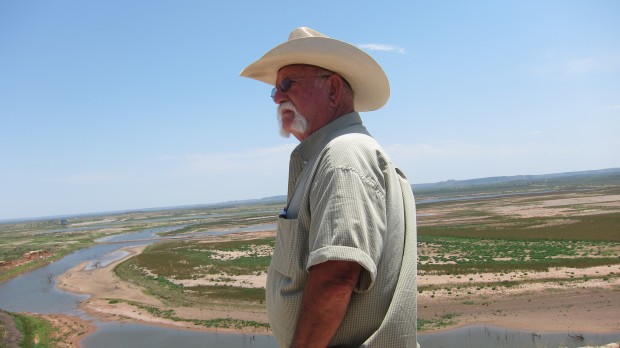
John Jacobs, Mayor of Robert Lee, says drought is "like a cancer."
It wasn’t until recently that John Jacobs started sleeping well again. The mayor of Robert Lee, a West Texas town of some thousand people, has spent the last few years grappling with the same issue facing all of Texas: How to find water for our people.
The great drought of 2011 was the driest and hottest period on record in the state. But it crept in slowly. “Drought is like a cancer,” Jacobs says. “It just slowly eats and eats and eats. Your water sources dry up, your businesses start drying up. Without water, people aren’t going to stay there. It’s just a slow, declining death.”
The story of Robert Lee is one that played out in other small towns across Texas last year, like Groesbeck and Spicewood Beach. Rivers and reservoirs dried up. Wells failed. And city governments with little cash rushed to finance lifelines.
For John Jacobs, a fourth-generation West Texan and lifelong resident of Robert Lee, the moment his town almost ran dry was actually a long time coming. But it still felt sudden. The town had brushes with running dry before. “But every time we’d go get in a bind, it would rain,” Jacobs remembers. “We’d catch water, and then we’d spend all that money for something else.”
Congratulations, McMullen County, Texas. You officially have the highest number of farmers per capita in the United States. More than half of the population there are farmers (374 out of 707 people). The data comes from the U.S. Census Bureau and you can visualize it all in a new interactive map built by Slate, Agriculture in the U.S. and Around the World.
The farming belt stretches from Texas up to North Dakota, where in some communities, farmers are about a third of the population. Contrast that with the coasts, Slate notes, and you’ll find “just one or two out of every 100 people work as farmers, even in rural areas.”
The famous Lucas Gusher blows out oil January 10, 1901 on Spindletop hill in Beaumont, Texas. Anthony Lucas's gusher, the first in Texas, sprayed over 100 feet above the derrick for nine days until the well was capped. But is oil facing a decline?
Tomorrow, 38 million acres of offshore drilling areas in the Gulf of Mexico will go on sale. Drillers are clamoring for the rights, but lurking in the background is a question: What happens if oil prices keep going down?
Just months ago, everyone was trying to figure out why prices were rising so high. But recently they’ve seen a significant turn downward, and seem poised to continue their plunge. For some answers on what falling prices mean for Texas’ energy economy, KUT’s Nathan Bernier spoke with Robert Dye, an economist with Comerica Bank. He says he’s concerned about the possibility of a slump in European business activity pushing oil below $70 a barrel and forcing Texas producers to scale back activity.
Q: What’s the big story about the Texas economy that’s happening right now that maybe the media is under-reporting?
A: Well, we all have to be aware of downside risks, particularly in this world of global interconnections, and so I do remain concerned about the crisis in Europe and the spreading recession there and slower growth in Asia. That can impact Texas a couple of ways directly: one is through technology and other exports, and the other, of course, is through oil prices and energy prices in general. A weaker global economy obviously puts some downward pressure on oil prices. We’ve seen oil prices now sag into the mid-80s for West Texas Intermediate. I think that is a number that can remain consistent with ongoing vigorous activity, but if it starts to fall much below that — I think below the 70-dollar barrel range — I would get concerned the drilling activity would slow down and we would see a cooler state economy. Certainly that remains to be seen. It’s not my expectation that oil prices fall that low, but in a cooler global environment we do have to watch out for that.
Q: What would be the consequences of oil dropping below 70 dollars a barrel?
A: Well, I think we would see rig counts go down, exploration and production programs being scaled back. And we would see that the very important energy sector for the state, I think, would become much less vigorous at least in the near term.
So how’s the app? It’s okay. Much of the content is static, like conservation tips and some facts about the group. The main page, however, shows real-time load on the grid (as of this writing, 45,226 MW) and the forecast peak demand for the day. It’s the same info (and graphic) from ERCOT’s home page, and in the age of flashy energy apps and devices like NEST, it feels a little behind the times.
There’s also a push notification feature, which will alert you when the grid is getting close to reaching peak demand. So users have the option of getting a push message from ERCOT that says “Turn up your thermostat 2 degrees before you leave home today.” The idea is for people to cut back on their energy use at those times, which typically occur between 3 and 7 p.m. during the summer. (Maybe they should stop charging their phones?) Continue Reading →
This Friday we’ll be bringing you a special report, Life By the Drop: Drought, Water and the Future of Texas, a collaboration of StateImpact Texas, KUT News, and Texas Monthly.
Life By the Drop is a close look at the state of water and drought in Texas, looking both to the past and the future for answers on how the state can manage a growing population amid a shrinking water supply.
On Friday at 3 p.m., KUT 90.5 FM will air a one-hour documentary on the drought, hosted by Texas Monthly editor Jake Silverstein and produced by KUT News and StateImpact Texas. The program will air again at 7 p.m. on Monday, and you’ll also be able to hear the entire documentary here and on other public radio stations throughout the state.
Starting next week, each day we’ll individually bring you one of the features from the documentary, including reports from NPR’s John Burnett, an interview with Texas state photographer Wyman Meinzer, and audio reports from StateImpact Texas and KUT News. We’ll also have some web extras here at StateImpact Texas, with audio slideshows, interviews and more.
And you can pick up a copy of the July issue of Texas Monthly to read the stories from “Life By the Drop” as well. It hits newsstands Thursday.
The sun sets behind two offshore oil platform rigs under construction in Port Fourchon, Louisiana, June 14, 2010, as cleanup continues on the BP Deepwater Horizon oil spill.
The sun is setting for drillers wanting a new piece of the Gulf. There’s one more day to bid on leases to drill offshore in the Gulf of Mexico.
The Department of the Interior’s Bureau of Ocean Energy Management, Regulation and Enforcement (BOEMRE) will hold a sale of nearly 38 million acres of offshore leases Wednesday.
Those leases run in an area from three to 230 miles off the coast, the BOEMRE says, and range anywhere from nine feet to more than two miles deep. The bureau estimates that there’s somewhere around 31 billion barrels of oil and 134 trillion cubic feet of natural gas waiting there that are “currently undiscovered and technically recoverable.” (But they say the actual production would likely be much less, resulting in 1 billion barrels of oil and 4 trillion cubic feet of natural gas.)
The sale goes down Wednesday, June 20th at the Mercedez-Benz Superdome. But bids must be submitted by mail no later than Tuesday. The Department says that the minimum bid for deepwater leases is $100 per acre. Once the leases are sold, it will mark the end of the government’s 2007 – 2012 Outer Continental Shelf Oil and Natural Gas Leasing Program.
2007 implosion of power plant to clear site for new homes
For developers of housing or commercial projects in Texas, bringing what had been contaminated, blighted lots back to life can be full of challenges, both legal and economic. But sometimes it works.
“Once you own the site, you have repercussions to that and potential liabilities,” says John Slavich, a Dallas lawyer.
TCEQ Easier, EPA Harder
Slavich has shepherded hundreds of Texas brownfield projects through an often daunting legal and regulatory maze. Most sites he worked on were ones overseen by the Texas Commission on Environmental Quality (TCEQ). He says he tries to avoid other, sometimes more toxic sites under control of the US Environmental Protection Agency (EPA).
For students at Stephen F. Austin High School’s Media Arts program, the one subject they all wanted to report on this year was the drought. As part of PBS Newshour’s Student Reporting Labs project, which pairs public media mentors with high school students learning reporting around the country, several Austin students produced four different videos on the drought.
The first video, above, looks at the impact of the Bastrop Complex fires that began on Labor Day weekend 2011. Those fires burned more than 1,500 homes, took 2 lives and were the sixth-worst fires in U.S. history. Students Audrey Kuhl, Samantha Melomo, Olivia Mendez, Connor Johnstone and Madison Fare traveled to Bastrop to see firsthand the destruction, and learn how citizens are rebuilding after the fires. That video won the award for “PBS Package of the Year” at the Reporting Labs awards ceremony in May.
If you were one of the sixty thousand people at the Austin City Limits festival last year, you may have been surprised to find acres and acres of lush, thick grass covering the grounds. To find out how the festival has learned to adjust to drought (and even create an oasis in the midst of it), students Cailyn Lewis, James Cumby, Ben Swisher, Catalina Lizaraga, Robin Livesay and Haley Barlow produced a video called “ACL & The Drought:”
Volunteer firefighter Jason Collard prepares to fight a running wildfire on April 19, 2011 in Strawn, Texas.
During Texas’ worst wildfire season on record last year, more than 16,000 emergency responders and firefighters came to the Lone Star State to help battle the blazes. Today the Texas Forest Service announced that they’re going to send some of their own to help fight the Little Bear Fire near Ruidoso, New Mexico. That fire has burned nearly 38,000 acres and is only 45 percent contained. So far, more than 200 homes have been lost, with damages estimated over $22.5 million.
“Following the fire season we had last year, this is an opportunity for Texas to give back to those who helped us,” Bob Koenig, chief response training coordinator for Texas Forest Service, said in a statement today.
Koenig and fourteen others will head to New Mexico this weekend.
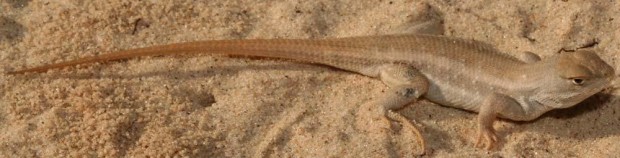
Photo Courtesy of the U.S. Fish and Wildlife Service.
The Dunes Sagebrush Lizard is being kept off of the endangered species list. For now.
The dunes sagebrush lizard is tiny, and brown, and hides in the dunes of East New Mexico and West Texas. And until recently, it seemed like it could threaten the drilling boom in the Permian basin as the U.S. Fish & Wildlife Service considered adding the lizard to the endangered species list.
But this week the oil and gas industry breathed a huge sigh of relief when it was announced that the lizard won’t be added. Thanks to a conservation plan brought forward by stakeholders in the region and approved by the state comptroller, Fish & Wildlife was convinced that the lizard would be just fine.
But how does the plan work? And what about it convinced Fish & Wildlife that it would be enough to save the lizard? For some answers, we turned to Dr. Benjamin Tuggle, the Southwest Regional Director for Fish & Wildlife.
Q: What is it about the Texas conservation plan that led to the lizard not being listed by the Fish and Wildlife Department?
A: Well, I wanna go back to where the habitat is. About two-thirds of the habitat was in New Mexico, and about one-third was in Texas. And we had the candidate conservation agreements and candidate conservation agreements with assurances that covered over 90 percent of the habitat that is in New Mexico. The remaining one third of that habitat that was critical for the survival of the species and also for the long-term sustainability of the species didn’t have any protection at all in Texas, and it was all on private lands.
StateImpact seeks to inform and engage local communities with broadcast and online news focused on how state government decisions affect your lives. Learn More »
 The story of Robert Lee is one that played out in other small towns across Texas last year, like Groesbeck and Spicewood Beach. Rivers and reservoirs dried up. Wells failed. And city governments with little cash rushed to finance lifelines.