The “supermoon” is seen from Mexico city on 05 May 2012. The full moon on this day, the biggest of the year, is at 352.947 Kms, the shortest distance to earth in the year.
The Supermoon, as seen from onboard Groupama Sailing Team during leg 6 of the Volvo Ocean Race 2011-12 on May 5, 2012 from Itajai, Brazil, to Miami, North America.
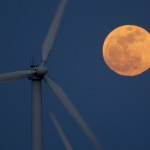
A perigee moon, or SuperMoon, rises behind wind turbines on May 5, 2012 near Palm Springs, California. The moon appears especially big and bright during this once-a-year cosmic event as the full moon is at its closest to the Earth in its elliptical orbit. The perigee side of its orbit is about 31,000 miles closer than the opposite, or apogee, side. The bright light of the full moon also hides all but the brightest meteors of the Eta Aquarid meteor shower, the remnant debris trail of Halley’s Comet.
A perigee moon, or supermoon, rises behind wind turbines on May 5, 2012 near Palm Springs, California. The moon appears especially big and bright during this once-a-year cosmic event as the full moon is at its closest to the Earth in its elliptical orbit. The perigee side of its orbit is about 31,000 miles closer than the opposite, or apogee, side. The bright light of the full moon also hides all but the brightest meteors of the Eta Aquarid meteor shower, the remnant debris trail of Halley’s Comet
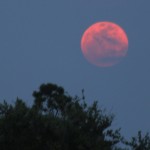
The “supermoon” is seen May 5, 2012 from Chevy Chase, Maryland. The biggest and brightest moon of the year is due to the moon being at its closest point to the earth during its orbit.
A haze obscured many views of the supermoon in Texas.
It was a bit cloudy when the Super Moon made its appearance.
As seen rising over the mexican american cultural center in Austin, Texas
Parts of Texas got a peek at one of the coolest lunar moments of the year last weekend. In the late hours of Saturday night, the earth was graced with a close-up of the moon when a full moon hit at the same time as the moon’s nearest orbit to earth (the technical term is perigee-syzygy, but “supermoon” is admittedly more fun). The moon was about thirty percent brighter and fourteen percent bigger, which made it the biggest full moon of the year.
Much of the East Coast got clouded out and couldn’t see the full lunar glory, and Central Texas was hit by severe thunderstorms right as the peak of the supermoon occured. But other parts of Texas were blessed with intermittently clear skies to witness the event. In the slideshow above, you can see images of the supermoon taken across Texas and other parts of the world. Discovery News also has a slideshow with photos submitted by readers.
Tiger prawns have recently invaded the Gulf of Mexico.
Tonight at the Cactus Cafe at the University of Texas at Austin, StateImpact Texas will host a discussion of invasive species in Texas. We’re calling it Invasive Species and Why We Love Them With Salt.
Some of the questions on tap: What do we mean by invasive species? How do they get here? What is their impact on the environment when they arrive? We’ll talk about these questions and also look at the ways we adapt to their presence, from making them into delicacies to hunting them for sport. And you’ll have the chance to ask questions and add thoughts of your own to the discussion.
And we’ll be doing it all over a pint (or two) of draft beer. Come join us tonight at the Cactus Cafe at 6 p.m. (doors at 5:30, and if you can’t make it in person, stay tuned later in the week for a recap of the event).
Views and Brews: Invasive Species and Why We Love Them With Salt
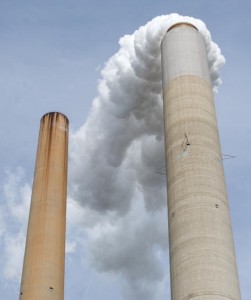
The lawsuit says Luminant has violated the Clean Air Act. (Pictured: the AEP coal plant in West Virginia.)
This week the Sierra Club filed a federal lawsuit against Energy Future Holdings Corp. and its subsidiary, Luminant Generation Company. The Sierra Club alleges that Luminant’s Big Brown coal-fired power plant has “thousands of ongoing air pollution violations” of the Clean Air Act. The plant is located approximately 65 miles northeast of Waco in Freestone County.
The Sierra Club says that the particular emission from the Big Brown power plant is excessive soot. Soot is particularly harmful, mentions the press release, because it “contributes to asthma, heart attacks, serious respiratory illnesses, and thousands of premature deaths every year.” They also say that it contains mercury and other toxic chemicals.
In an e-mail to Stateimpact Texas, Ashley Barrie of Luminant offered this response: “Luminant stands by its strong track record of exemplary compliance in meeting or outperforming all environmental laws, rules, and regulations.” She says that the Sierra Club’s suit is based on “unfounded accusations from a group that has made these same claims before.”
The Sierra Club says, though, that the data they used comes from Luminant’s own company records. They say that the “power plant violated its particulate matter, or smog, limits at least 370 times in the past three and a half years.”
This is not the first time that the Sierra Club has brought suit against Luminant for alleged violations at coal-fired power plants. One case from September of 2010 involving the Martin Lake power plant in Rusk County is still pending.
Daniel Ramirez, an intern at StateImpact Texas, reported this article.
This afternoon the BBC’s Newshourwill be broadcasting a special live 2-hour show with StateImpact Texas partner KUHF in Houston. Our very own Dave Fehling will join a live panel at the Port of Houston that will look at the question: Can America be energy independent by 2020?
Photo courtesy of nikki_flowers/Flickr Creative Commons
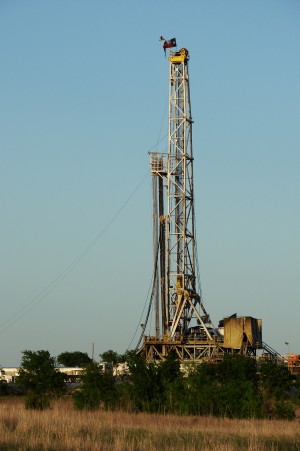
One of Texas' many oil rigs.
The commission says that 943 oil permits were completed this March, meaning that they’ve been built and are either scheduled to produce or already producing. That’s up from 518 oil completions during March 2011. Another 421 natural gas permits were completed the same month. Overall, Texas still accounts for about half of the active drilling in the U.S., producing some 417 million barrels of oil and over 7 trillion cubic feet of natural gas in the last twelve months.
Despite natural gas prices reaching a ten-year low, fracking for gas isn’t down over last year. Production is up almost twenty-five million Mcf (thousand cubic feet), and gas completions are especially active in the Haynesville Shale and North and South Texas.
Midland, San Antonio, and San Angelo were awarded the most oil and gas drilling permits – 750, 360, and 221, respectively – while East Central, East, and Deep South Texas got the least – 26, 41, and 56, respectively.
Here’s some more relevant data from the Commission’s report: Continue Reading →
A hydraulic fracking operation in the Barnett Shale.
The Department of Interior announced some new rules today for the drilling process known as hydraulic fracturing, or “fracking,” on federal lands. The rules require companies drilling in those areas to disclose what chemicals are used in the process, but the chemicals aren’t disclosed until the well has already been fracked. There are also two other parts of the rule that deal with well construction and water management.
Secretary of the Interior Ken Salazar said in a statement today that “as we continue to offer millions of acres of America’s public lands for oil and gas development, it is critical that the public have full confidence that the right safety and environmental protections are in place.”
America’s Natural Gas Alliance, a group that represents gas drillers, said they are still looking at the new rules, but that “at first glance it indicates that the Department of the Interior and, in particular the Bureau of Land Management, may not fully appreciate the significant regulatory steps already undertaken by states such as Colorado, Texas, Wyoming and others to oversee the safe and responsible development of natural gas through the use of hydraulic fracturing.”
The rules may not have much of an effect on drilling in Texas, because there are very few federal lands in the state, and the few that are here are mostly managed by the Forest Service and Military as opposed to the Bureau of Land Management. You can see a map of federal lands in Texas here.
La Nina is gone. Is it time to break out the umbrellas?
It’s official. The La Niña weather pattern, one of the big factors behind the Texas drought, has finally left, according to a report out this week from the National Weather Service’s Climate Prediction Center.
But will she come back? It’s a vital question, because the last two years we’ve seen back-to-back La Niñas. That resulted in the worst single-year drought on record in Texas.
This time, the National Weather Service is predicting La Niña won’t return. In today’s report, they say that “the current and evolving conditions, combined with model forecasts, suggest that La Niña is unlikely to re-develop later this year.” (Then again, forecasters predicted an abnormally dry winter for Texas, which thankfully didn’t turn out to be the case.)
At the same time, forecasters are predicting that the drought won’t go away completely anytime soon. Continue Reading →
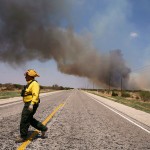
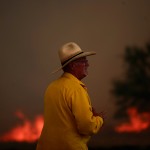
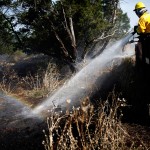
Lone Camp Volunteer Fire Department chief Charlie Sims leads his crew while fighting a wildfire on September 1, 2011 in Graford, Texas.
A volunteer firefighter reacts as a wildfire jumps a fire line while fighting a wildfire on September 1, 2011 in Graford, Texas.
Lone Camp Volunteer Fire Department fire fighter Ted Hale fights a wildfire on September 1, 2011 in Graford, Texas.
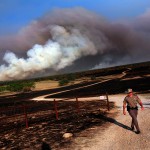
U.S. Forest Service firefighter Erik Rodriguez battles a running wildfire on April 19, 2011 in Strawn, Texas. More than 160 area homes were destroyed in the wildfires that have been fueled by dry conditions, high winds, and low humidity.
Volunteer firefighters battle a running wildfire on April 19, 2011 in Graford, Texas.
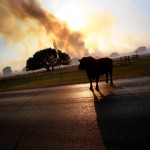
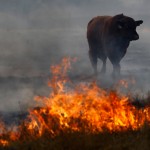
A bull tries to escape a running wildfire on April 19, 2011 in Graford, Texas.
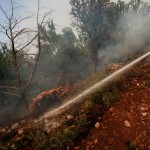
Fires burn in Graford, Texas on April 19, 2011.
A bull tries to escape a running wildfire on April 19, 2011 in Graford, Texas.
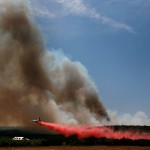
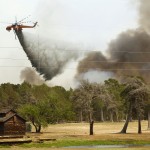
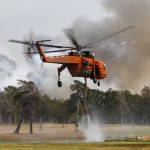
Emergency crews drop fire retardent slurry while battling a running wildfire that is threatning homes on April 19, 2011 in Strawn, Texas.
Emergency crews battle a running wildfire on April 19, 2011 in Strawn, Texas.
Emergency crews fly over a destroyed home while battling a running wildfire on April 19, 2011 in Strawn, Texas.
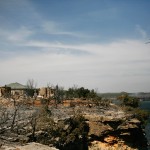
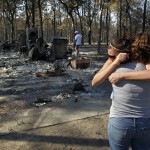
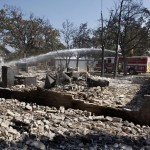
Remnants of burned down homes around the east side of Lake Bastop outside Bastrop. TX Tuesday September 6, 2011.
Firefighting helicopters dump water and flame retardant after loading up with water from a pond at Lost Pines Golf Club as they fight a fire in Bastrop State Park September 6, 2011 in Bastrop, Texas.
Firefighting helicopters load up with water from a pond at Lost Pines Golf Club as they fight a fire in Bastrop State Park September 6, 2011 in Bastrop, Texas.
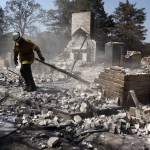
Fire fighters from the Coppell Fire Department hit hot spots on a burned down house with water as they go to the wildfire-affected areas September 7, 2011 in Bastrop, Texas.
Fire fighters from the Coppell Fire Department prepare to hit a burned down house with water as they go to the wildfire-affected areas September 7, 2011 in Bastrop, Texas.
Coppell Fire Department (Dallas, TX area) hit hot spots with water as they go to the wildfire affected areas around Bastrop. TX Wednesday September 7, 2011.
oppell Fire Department (Dallas, TX area) hit hot spots with water as they go to the wildfire affected areas around Bastrop. TX Wednesday September 7, 2011.
Coppell Fire Department (Dallas, TX area) hit hot spots with water as they go to the wildfire affected areas around Bastrop. TX Wednesday September 7, 2011.
The first wildfires of 2012 are still burning in West Texas, but the Texas Forest Service says they’re mostly contained at this point. It’s a good time to take a look back to the record season of wildfires last year. All told wildfires in 2011 burned nearly four million acres, almost three thousand homes, and took two lives. In the slideshow above, you can see up close the toll they took.
Courtesy of Dave Irving via Flickr Creative Commons
Feral hogs, an invasive species, are wreaking havoc across Texas.
StateImpact Texas will be invading a special session of KUT Radio Austin’s Views and Brews this Monday at the Cactus Cafe. It’s a regular panel hosted by KUT where we discuss the issues and art of our time, over beer (hence the “Brews” with the “Views”).
Our very own Mose Buchele will lead a discussion that will look at questions like: What do we mean by invasive species? How do they get here? What is their impact on the environment when they arrive? We’ll talk about these questions and also look at the ways we adapt to their presence, from making them into delicacies to hunting them for sport. And you’ll have the chance to ask questions and add thoughts of your own to the discussion.
On Monday, May 7th at 6 p.m. you can join us and hear from experts who hunt, study and yes, sometimes eat, invasive species. Doors open at 5:30. It’s free and open to the public, but seating is limited so we suggest getting there early.
Views and Brews: Invasive Species and Why We Love Them With Salt
Despite the fact that it’s been a relatively dry April for much of the state, particularly Central Texas, the slow improvement of the drought continues, though the news isn’t all good.
The latest numbers released today by the the National Drought Monitor show that parts of the state are still making their way out of drought. Less than nine percent of the state is in the worst stage of drought, “exceptional,” while 17 percent of the state is drought-free. A year ago, after a dismally dry winter, over 17 percent of the state was in the worst stage of drought.
But while there’s been some improvement in the past week or two, there’s also been a little bit of a turn back. While last week 63 percent of the state was in some stage of drought, this week that number’s gone up to nearly 67 percent.
StateImpact seeks to inform and engage local communities with broadcast and online news focused on how state government decisions affect your lives. Learn More »