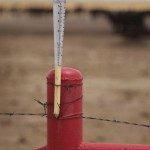
The current drought is wreaking havoc on crops, cattle and lawns. A five-part series in the Statesman this week looks at the extreme effects this dry period is having on Texans across the state. The hardest hit? Farmers and ranchers, with a total economic agricultural loss estimated to be $8.7 billion, according to the Texas A&M System’s AgriLife Extension Service. Will ranchers ever recover? Even if the drought ends next year, it doesn’t look good:
A U.S. Department of Agriculture report this month rates 96 percent of Texas pastureland in poor or very poor condition.
It’s not likely to get better any time soon, observers say. It’s going to take years. If ever. And there’s no telling how many of the state’s 149,000 beef producers will decide they’ve had enough.
“It’s just fighting depression,” said Casey. “For the first time in my life, it wasn’t fun to go out and feed the cows. And then every week I took a load of cattle to Fredericksburg, just a few at a time.”
It’s a little known fact: Texas is the only state that grows all four types of peanuts, and is second only to Georgia in peanut farming. Unfortunately, this year’s extreme drought is taking a toll on West Texas peanut farmers.
Scott Olson/Getty Images
Calvin Trostle is with Texas A&M Agrilife Extension in Lubbock, where most Texas peanuts are grown. This year, he’s seeing something he never has before. “This is a shock to us, to think that we could have an irrigated crop in the Texas High Plains fail,” he says, “but we’ve had some acres of peanuts out here that eventually, as we got further into the season, we saw we simply did not have enough water.”
Even with extra irrigation, peanut farmers were short 10 to 12 inches of water this year, and the crops are suffering. Plants that appeared healthy at first are turning out to have no peanuts under them. Jimbo Grissom grows peanuts south of Lubbock. His farm went 440 days without rain, and that’s come with a heavy cost.
“I’ve never seen one, even a lot of the people that live around here, have never seen a crop year like this one’s been. Even back in the ‘40s and ‘50s, whenever we had the Dust Bowl, it wasn’t even this dry,” he says.
The cost of extra water, combined with lower yields, adds up to prices that are about three times higher than last year. It won’t be long before higher bulk prices result in peanut butter costing more at the store. Continue Reading →
Gov. Rick Perry is set to unveil his jobs plan Friday, and the campaign says it will be strongly tied to U.S. energy production.
Photo courtesy of KUT News
Some observers see a little bit of Green under Rick Perry's Red State politics.
Perry had energy at the front of his mind several times at the most recent GOP debate. In New Hampshire this week, talking about how he would get the U.S. economy back on track, he advocated “opening up a lot of the areas of our domestic energy area.”
Answering a question on political gridlock in Washington, he said, “It’s time for energy independence.”
On how to insure uninsured Americans: “That’s why I lay out, without having any congressional impact at all, how to get our energy industry back to work.”
And on dealing with Chinese currency manipulation: “We’re sitting on this absolute treasure trove of energy in this country.”
It’s no surprise that Perry sees domestic oil drilling and energy development as central to America’s economic recovery. After all, says David Spence at the University of Texas’ Energy Management and Innovation Center, it’s worked pretty well in Texas. Continue Reading →
About StateImpact
StateImpact seeks to inform and engage local communities with broadcast and online news focused on how state government decisions affect your lives. Learn More »