The National Weather Service has new data on temperatures and rainfall out, and several Texas cities are either on track to or have already broken existing records for heat and drought:
Houston tied for its hottest year ever, and has had its second driest year ever, with only 21.6 inches of rain.
Austin had its hottest year ever, with an average temperature of 73 degrees. (The previous hottest year was in 2006 at 72.4 degrees.) Abilene also had its hottest year ever, at 68.7 degrees Fahrenheit for the year. (The previous hottest year was in 1933.)
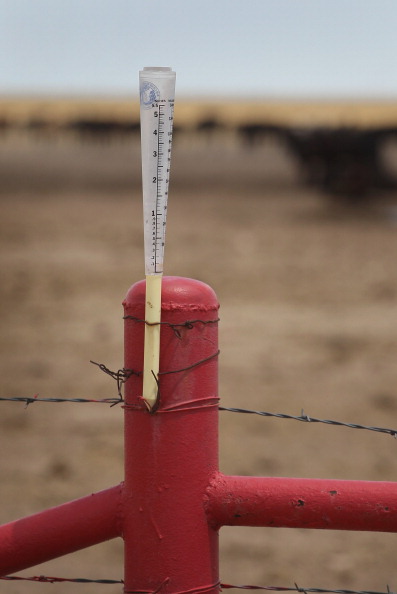
Midland and Lubbock are both breaking or tying records for hottest and driest years ever. Midland had only 4.5 inches of rain so far this year (the normal level is around 14 inches of rain), and an average temperature of 67.9 degrees. All of West Texas is 9-10 inches below normal or worse, and Midland has had only 24 days of rain over the last 444 days. Continue Reading →
With heat, tornadoes, drought, fires, extreme weather and flooding, the climate has certainly caught the world’s attention in 2011. While scientists debate just how much the world is warming and how much of that has to do with human impact, others are taking it upon themselves to reverse the changes through technology. Here are five schemes that may seem pie-in-the-sky at first, but could soon have a big impact on our planet:
Make it rain. What would China be without a five-year plan? The country recently announced a new one that will certainly get the attention of Texas: seeding the skies to grow more crops. “China will begin four regional programs to artificially increase precipitation across the country before 2015,” the state paper China Dailyreports. Sound fanciful? It’s not. Continue Reading →
The latest drought data from the National Drought Mitigation Center was released today. The numbers haven’t moved much since last week, and while they give cause for some hope, they also show just how far we have left to go:
41 percent of the state is in the “exceptional” stage of drought, the highest level. The good news is that those levels are down from nearly 88 percent just three months ago.
76 percent of Texas remains at the second highest level of drought, “extreme.” Those numbers have also improved somewhat, down from almost 97 percent three months ago.
The entire state — 100 percent of it — is still in a drought, 90 percent of it at a “severe” level or worse.
Look backwards and you can see just how intense this drought has been. A year ago today, none of the state was at the “exceptional” level and 85 percent of Texas was at the lowest level, “abnormally dry.”
The City of San Antonio cut the ribbon on six electric vehicle charging stations today. There are about 50 electric vehicles currently in use in the city,according to the San Antonio Express-News. The city covered the $10,000 total cost for the project through a Department of Energy grant. It takes about four hours to recharge a plug-in hybrid like the Chevy Volt.
There are already two solar charging stations at the airport, the Express reports, bringing the number of city charging stations to eight. The stations are free to use.
The Grinch promotes his movie in Universal City, California.
And the hits keep coming. There will be no oysters this year in Texas, USA Todayreports: “a monstrous bloom of toxic algae looming across the Texas coast has shut down oyster season.” Because of the drought, the paper reports, “the algae could cause nausea, vomiting and diarrhea in humans and is harmful to fish but not fatal to people.”
The ongoing Texas drought is responsible for billions of dollars in losses and counting. Here are just some of the things that we’ve lost in the drought:
Burgers. Beef prices are set to rise dramatically after a massive sell-off of cattle in Texas last year because of the drought, we reported recently. There are far fewer calves as a result, and what cattle is left has to be fed with grain that is also more expensive than before. This means higher prices at the market in the future. Continue Reading →
How do you convince people climate change is real? The answer until now has largely been one of science, data and facts. But an emerging voice in the scientific community is taking a different tack: emphasizing religious stewardship over statistics, and advocating awareness of climate change as a spiritual responsibility.
One emerging voice of the faith-inclined climate change community is climatologist Katharine Hayhoe, who also happens to be an evangelical Christian. Hers is a fascinating tactic, especially considering that only slightly more than half of white evangelicals believe in climate change, less than other denominations, according to a recent poll by the Public Religion Research Institute. Continue Reading →
Electricity transformer station in downtown Houston
Even in Texas, where it may seem the sky’s the limit for making fortunes in the energy business, there are rules. Or at least, there are rules when it comes to the price of one form of energy: electricity.
In this case, there is the rule called a “price cap” and it’s imposed by state regulators on the wholesale price of electricity (what retail providers pay for the electricity they then sell to you). Now, the state’s Public Utility Commission (PUC) may raise the cap, letting big power generating companies make more money during times of enormous demand. Continue Reading →
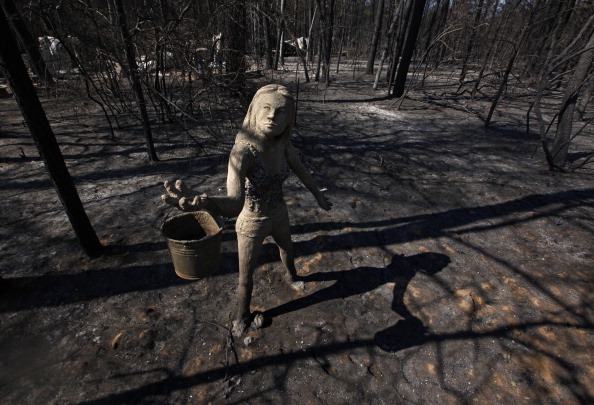
A statue stands in front of the remnants of a burned down home outside Bastrop, Texas.
It seems counter-intuitive, but victims of wildfires in Texas should be thinking about the possibilities of flood, according to a new report by the Texas Division of Emergency Management and the Federal Emergency Management Agency.
While rain is a much-needed commodity in Texas these days, too much of it could have destructive consequences. Because of the wildfires that burned thousands of acres this year in Texas, “flood risk is higher,” the agencies say. “When fire burned away trees and other vegetation, healthy roots that soak up rainwater were lost,” the report says. “Storm runoff can cause severe erosion, mudslides and flooding.” Continue Reading →
This rig uses hydraulic fracturing to obtain gas from Texas' Barnett Shale formation. Photo courtesy of KUT News.
The Railroad Commission of Texas, which oversees drilling in the state, passed new rules requiring the disclosure of chemicals used in hydraulic fracturing (“fracking”) today. The rules were proposed by the state legislature earlier this year and signed into law by Governor Rick Perry this summer. Companies will have to disclose on the website FracFocus what chemicals they use for fracking in Texas.
Any wells that have an initial drilling permit from February 1, 2012 on will have to make the disclosure. The commission notes in a release that “before the rule passed, Texas operators conducting hydraulic fracturing were voluntarily entering chemical data into the public website FracFocus for about half of all wells in Texas undergoing hydraulic fracturing,” the commission said in a statement.
A natural gas well drilling rig in Sublette County, WY
It’s been only a few days since the EPA released draft findings of contamination by hydraulic fracturing (“fracking”) drilling operations in Wyoming, and already the industry is attempting to drill holes in the EPA’s findings. Residents near the drilling sites in Pavillion, Wyoming asked the EPA three years ago to investigate possible contamination after noticing water from their wells started tasting and looking off. So what has been the industry’s response?
Question the evidence. The company behind the alleged contamination, Encana, clearly hopes to discredit the EPA’s findings. In a lengthy press release Monday, the company said the EPA’s findings are “irresponsible” and full of discrepancies. The EPA’s “conclusions do not stand up to the rigor of a non-partisan, scientific-based review,” the company said, but Encana doesn’t say if that scientific review has been performed or not. (The EPA released the findings in draft form to allow public input and scientific review, which they say is standard practice.) And while attempting to discredit many of the EPA’s discoveries, Encana also points to other EPA evidence as vindicating. “The EPA’s reported results of all four phases of its domestic water well tests do not exceed federal or state drinking water quality standards for any constituent related to oil and gas development,” the Encana release states. Continue Reading →
About StateImpact
StateImpact seeks to inform and engage local communities with broadcast and online news focused on how state government decisions affect your lives. Learn More »