Today, the House passed a bill preventing a doubling of interest rates on new student loans, which was scheduled to go into effect Sunday.
In New Hampshire, Gov. Lynch’s veto on a education tax credit for businesses was overidden — a “keystone” of the Republican agenda, as Sam Evans-Brown reported for NHPR on Wednesday.
And the New Hampshire Business Review has a story about Stay Work Play, an organization trying to solve two of New Hampshire’s biggest problems at once: New Hampshire students’ enormous student-debt burden, and employers’ skilled worker shortage. Recent graduates of N.H. colleges team up with local employers, who contribute $8000 over four years directly to their loan provider. In return, businesses “remain competitive by recruiting young, educated workers.”
A couple of weeks ago, Arthur Laffer — an economist made famous for his work in the Reagan administration — co-wrote an opinion piece for the Wall Street Journal warning that the expiration of federal tax cuts in January puts the country on the verge of a “Taxmageddon.”
Laffer’s “supply side” or “trickle down” economic ideas are at the root of what business boosters here call the “New Hampshire Advantage” — the Granite State’s lack of an income tax is what Laffer considers ideal. Laffer has been pushing this idea in state capitals of late.
As the Pew Center On The States’ Stateline reported in March, Laffer has been “staging a comeback,” working with politicians and organizations in Kansas, Missouri and Oklahoma to abolish the personal income tax. While Laffer was trying to dissolve the income tax in the Midwest, New Hampshire legislators were working to make an income-tax ban part of the New Hampshire constitution — a measure on which voters will get the final say in November.
The Affordable Care Act requires businesses with more than 50 employees to provide health insurance, or pay penalties. Meanwhile, smaller businesses can receive a tax credit to offset the cost.
In Manchester at Dyn – an internet infrastructure company with about 150 employees – Vice President Gray Chynoweth says he doesn’t expect the ruling will affect his company right away. He says Dyn already provides generous health benefits. Continue Reading →
Tomorrow, the constitutionality of the Affordable Care Act will likely be handed down by the Supreme Court. There are two main pieces under consideration: the individual mandate, and Medicaid expansion.
Bernard Pollack
According to John Stephen, New Hampshire’s former Health and Human Services Commissioner, Medicaid expansion will cost the state an additional $1 billion over ten years. Currently, Medicaid costs the state $1.4 billion annually, so this brings the cost up about 7 percent per year. To Stephen, this is a “huge amount of dollars.” To Deb Fournier of the liberal-leaning New Hampshire Fiscal Policy Institute, this would be a “healthcare bargain” — although as she understands it, Medicaid expansion may bring about no new costs at all.
In New Hampshire, the Affordable Care Act is most certainly in the eye of the beholder. Continue Reading →
The internet is abuzz with talk of the Affordable Care Act. Two Mondays in a row, eager newsmakers have been gearing up to pounce on a Supreme Court decision only to find it won’t be announced… just yet. With a complicated piece of legislation facing a confusing series of legal challenges, trying to understand the situation can lead to some serious eye crossing.
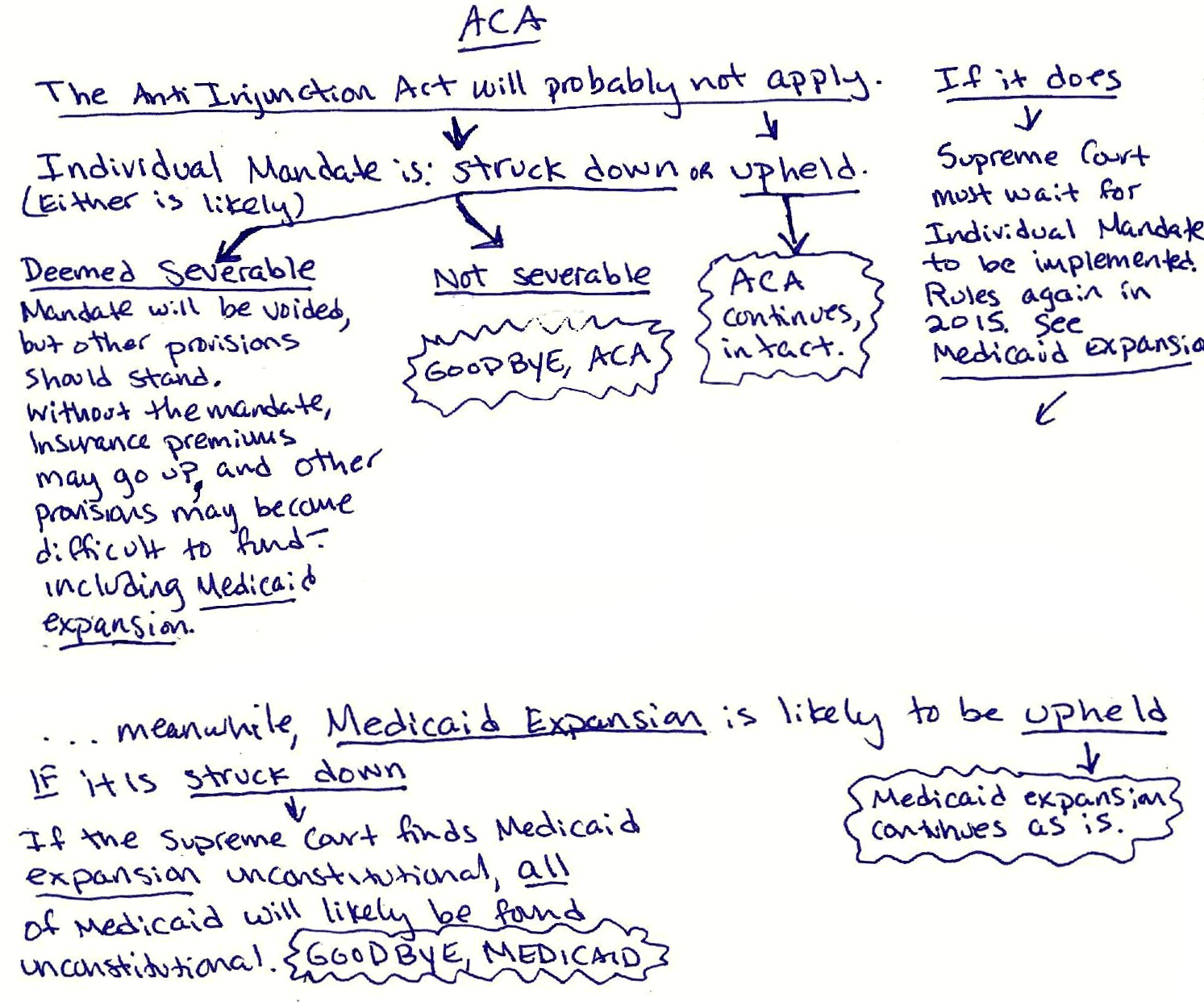
I used two charts describing the possible outcomes of the Supreme Court ruling on Thursday — one is from the Brookings Institute, another from Kaiser Health News — to make my own, slightly less confusing, chart:
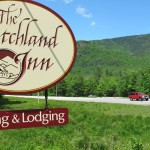
Ed Butler bought the Notchland Inn with his husband, Les Schoof, nearly 20 years ago. “It’s supposed to get easier as you get older,” Butler says. “But that has not been the case here.”
The Notchland Inn was built in 1862. It is a classic Mount Washington Valley business: Small, independent, and catering to a niche market of elopements, newlyweds, and romantic getaways.
“There are some who succeed better than we have, who do have a little more breathing room as their businesses mature,” Butler says. “We are continuing to grow our bottom line. It’s just tougher doing it.”
With the inn’s unpredictable bottom-line, it’s becoming more difficult for 62-year old Butler and Schoof to plan for retirement. “There are ways to survive, and we will survive, and eventually, not have to be here forever,” Butler says. “Or, if we are here forever, then we’ll eventually become gentlemen innkeepers, because after awhile, you can’t do all the physical work you did 10, 15 years ago.”
“The real challenge, I think, is that the national chains can take a hit if the economy is slow,” Butler says of the chains that have sprung up in the area over the past few years. “They can actually come in and invest money in ways that family-owned businesses can’t, necessarily, because we only have one business. We don’t have dozens.”
As the country continues to struggle with high unemployment and a lackluster economic recovery, New Hampshire is doing surprisingly well. Unemployment is at five percent — much lower than the national average. And more people are starting small businesses. In our weekly “Getting By, Getting Ahead” series, StateImpact is traveling the state, gathering personal stories from the people behind the economy. For our first installment, we visit the White Mountains, where independent country inns that have drawn tourists for more than a century face new competition. Continue Reading →
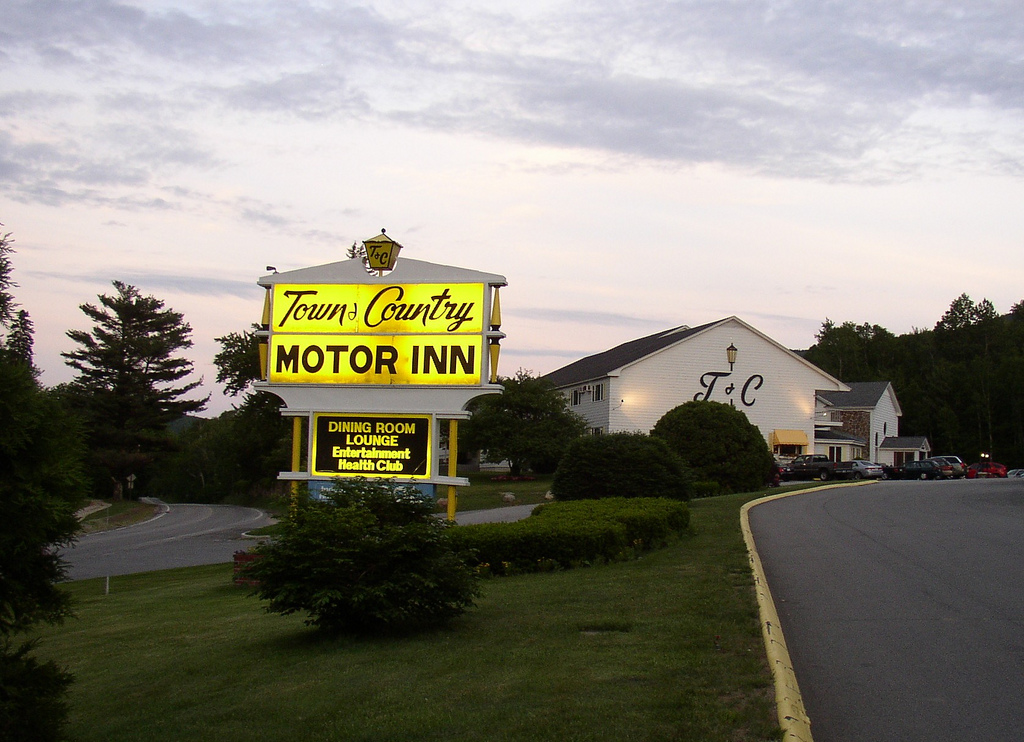
The privately owned Town and Country motor inn located in the White Mountains.
Tomorrow morning on NHPR, we’ll introduce you to Ed Butler, an innkeeper in the White Mountains. Ed’s story is Part One of our series “Getting By, Getting Ahead,” examining how people across New Hampshire’s seven regions are navigating a recovering economy.
_______
As you follow the winding highway through Franconia and Crawford Notches, weaving in and out of the White Mountains National Forest, you’ll encounter short bursts of economic activity. Mom-and-pop motels, country inns, diners, and small shops selling souvenirs, snowshoes and fishing poles all dot the Mount Washington Valley. Some of these outposts look as if they were frozen in the 1950s, built and marketed during the golden age of the road trip.
These heaping helpings of Americana are the traditional economic driver of the tourism-dependent White Mountains. In the late 1980s, a new element arrived. Major corporations began building up the North Conway area with outlet stores, restaurant franchises, and chain hotels. At first, this influx helped the older businesses. Rather than simply catering to the outdoorsy set, innkeepers could cast their nets to a wider crowd, bringing in people who wanted the ambience of a rural mountain retreat while indulging in some tax-free shopping.
Over the past seven or eight years, though, that dynamic has been changing. National chains have begun moving deeper into the Mount Washington Valley. This trend has been particularly upsetting to small innkeepers. “I think whenever you introduce another number of rooms to your mix, you are making everyone have to rethink their business model,” says Janice Crawford, Executive Director of the Mount Washington Valley Chamber of Commerce. Continue Reading →
Amanda Loder has been touring the state gathering the stories about how Granite Staters are making it work in this economy. We’re calling the series “Getting By, Getting Ahead.” The first blog-post debuts this coming Monday.
Keep your eyes peeled for that, and Loder’s radio feature the following Tuesday. A different region will be spotlighted each week this summer, with an interactive web-gadget on the way, too.
Today I’m heading to Bedford to get to know what’s on the minds of women business-owners. It’s a one-day conference called Women Inspiring Women. If everything goes according to plan, you’ll be reading some of their stories right here.
And in the meantime, we’re also gearing up to dive deep with the amendment banning the personal income tax. Texas is the only state with such a constitutional amendment*, so we’ll be looking at exactly what went down in 1993, when that amendment became law.
*Correction: in researching we discovered that Nevada, also, has a state amendment prohibiting a personal income tax, and that Texas’ amendment isn’t technically a ban. More to come!
Taxing campgrounds is a divisive issue. In July 2009 the New Hampshire legislature extended the meals and rooms tax to campgrounds — but then repealed that tax nine months later. It had been met with too much opposition, and had failed to produce the expected revenue.
But that doesn’t mean campers are in the clear. Yesterday, the Concord Monitor ran a story we highly recommend about seasonal tenants returning to campgrounds to find a new tax — a property tax, this time — awaiting some, but not all, campers. Reporter Tricia Nadolny writes that as tenants returned to Deering’s Oxbrow Campground, which straddles the Hillsborough-Deering town line, “an odd arrival split the campsite in two: those who got property tax bills and those who didn’t.” Continue Reading →
New Hampshire Public Radio Intern Tina Forbes Reports:
Did you vote on your favorite local restaurant this year? Winners of the New Hampshire Magazine’s ‘Best of New Hampshire’ contest will be gathering on Thursday night to celebrate and share some contest-winning morsels at the Verizon Center in Manchester. The public may attend.
Rick Broussard, editor of New Hampshire Magazine explained that the event has two goals.
One is to draw the whole state together like a big block party to celebrate food and culture and to provide people with some enlightenment about the great restaurants and talent that exist in our cities and small towns. The second goal is to raise funds and awareness for the important work of the NH Food Bank.
StateImpact seeks to inform and engage local communities with broadcast and online news focused on how state government decisions affect your lives. Learn More »