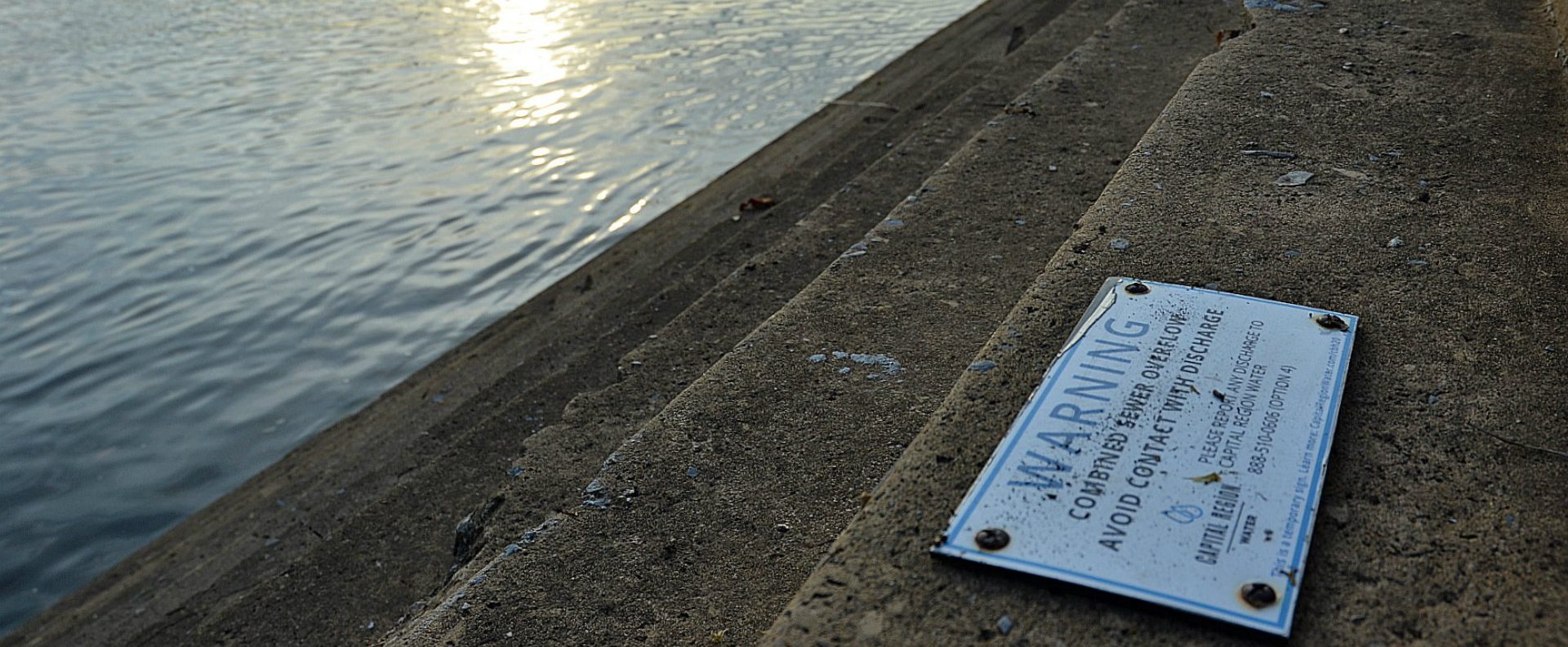
A Capital Region Water sign posted along the east bank of the Susquehanna River reads “Warning. Combined sewer overflow. Avoid contact with discharge.”
Brett Sholtis / WITF News

A Capital Region Water sign posted along the east bank of the Susquehanna River reads “Warning. Combined sewer overflow. Avoid contact with discharge.”
Brett Sholtis / WITF News
Brett Sholtis / WITF News
A Capital Region Water sign posted along the east bank of the Susquehanna River reads “Warning. Combined sewer overflow. Avoid contact with discharge.”
The future of water pollution regulation in Pennsylvania is murky following a U.S. Supreme Court ruling that narrowed the Environmental Protection Agency’s authority.
In a 5-4 ruling earlier this month, the court determined the EPA cannot impose “end result” provisions in permits that regulate water pollution.
The case came about when San Francisco sued the EPA over discharge permits for the city’s combined sewer system, which carries both sanitary waste and stormwater. Combined sewer systems are common in older cities in Pennsylvania, including Lancaster and Harrisburg. During heavy rain events, the waste can overflow into bodies of water.
San Francisco argued the EPA’s ban on any discharge that contributes to “a violation of any applicable water quality standard” for receiving water was unlawful under the Clean Water Act.
The city said the law allows the EPA to impose specific limits on pollutants but not to hold permit holders responsible for overall quality of the water that receives the discharge.
The Supreme Court agreed.
Environmental groups say the ruling introduces uncertainty that threatens water quality.
“The problem, in my opinion, with this decision is that it does not give a lot of guidance on what to do next,” said Abby Jones, vice president of legal and policy at PennFuture. “It just says this kind of narrative, broad water quality ‘end result’ requirement – you can’t have those anymore. It says nothing about what could replace it.”
Lancaster city is under a 2017 consent decree with the EPA to address sewer overflows to the Conestoga River.
Amber Strazzo Righter, communications manager in the Lancaster mayor’s office, said they are not commenting on the San Francisco case or how it might affect the city.
Harrisburg’s sewers have outflows to the Susquehanna River.
Capital Region Water, the authority that operates the water and sewer systems for Harrisburg and the surrounding area, said the ruling actually removes a layer of uncertainty.
“Until now, the EPA and state agencies could insert broad end-result requirements into permits but include no direction on how to achieve those goals, said External Affairs Manager Rebecca Patterson.
She said it is expected that discharge limits and narrative provisions will have to be written much more strictly in order to achieve the goals set in past permits.
“CRW will need to review our recently issued (National Pollutant Discharge Elimination System) permit and the consent decree we are currently operating under to determine if there are broad, end-result requirements that this ruling will affect. This will take some time,” Patterson said.
The state Department of Environmental Protection has permitting authority under the Clean Water Act, delegated from the federal level. The DEP did not respond to a request for comment about the ruling.
Many types of entities need a NPDES permit, including wastewater treatment plants, power plants and landfills.
Jones said she expects permitted entities and the DEP to comb through their permits and consent decrees to see if the ruling impacts language in those documents.
While industry groups have claimed the ruling as a victory, Jones said she doesn’t believe companies will prefer permits that are overly prescriptive.
“ The good thing about narrative water quality standards is it allows the facility to figure out how best to meet them based on their costs and the way their facilities operate,” Jones said.
Jones said it’s likely more court cases will arise as stakeholders try to interpret the ruling and protect water quality.
”Under the Clean Water Act, we have something called anti-degradation, meaning that you can’t make the water quality worse once you’ve hit a standard,” Jones said.
Steve Hvozdovich, Pennsylvania campaigns director for Clean Water Action, said they will be watching cities with combined sewers to see if they act on the Supreme Court’s ruling.
Hvozdovich said permits with overall goals can give regulators flexibility to address new issues. He pointed to a class of chemicals known as PFAS, which were not factored into permits years ago, but are now known to cause health issues. PFAS, an abbreviation for perfluoroalkyl and polyfluoroalkyl substances, are often described as forever chemicals because they are capable of lingering indefinitely in the environment.
Environmental regulators are often understaffed, Hvozdovich said. Setting specific limits on every possible pollutant will slow down permitting.
Hvozdovich said he’s concerned this ruling is just the latest in a series from the court that make it harder to protect peoples’ health and the environment.
“Does this open the door for another policy coming down the line that’s going to continue to roll back or weaken environmental protection?” Hvozdovich said.