From Left: StateImpact Reporter Emily Corwin, NHPR News Director Sarah Ashworth, and StateImpact Reporter Amanda Loder
After two years and hundreds of posts, multimedia features, and radio stories, StateImpact New Hampshire is freezing this website and moving our business and economic coverage to NHPR.
StateImpact New Hampshire launched in late July of 2011 as a pilot collaboration between NPR and New Hampshire Public Radio. The mission was to cover the business beat in a way that hadn’t been done before: using a combination of multimedia, data analysis, and shoe-leather reporting to break down how public policies, trends, and daily news developments affect regular people.
A hallmark of StateImpact New Hampshire has been our flexibility. We began as a one-person, all-digital operation in our first year, focusing heavily on data and trends. In the spring of 2012, we added a team member and expanded our reach into radio features, special series, and even video. We will take this multi-faceted reporting mindset to the NHPR newsroom, where we will continue to find innovative ways to cover business, the economy, and other issues important to Granite Staters.
We thank you for following us on our social media accounts and RSS feed, and for checking in with the site. We’re proud of what we’ve accomplished in such a short stretch of time, and hope you will continue to follow our work at NHPR.
It’s always tough to narrow down years of work into a short list of highlights…but these are the stories that readers, listeners, and our peers have singled-out: Continue Reading →
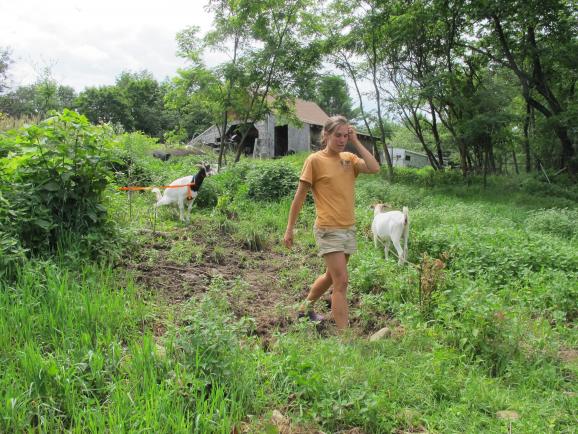
Ray Conner at Evandale Farm, with goats. Conner is hopeful the state's new slaughterhouses will help her expand her business.
According to the USDA, Americans are producing and eating more locally-raised food every year. But the market for local meat has trailed behind the market for local produce. Until recently, reasoning has been that there’s a shortage of local slaughterhouses. But as three slaughterhouses open their doors in NH this year, industry-wide studies show that more slaughterhouses may not be the answer, after all.
Pete and Tara Roy ran a small slaughterhouse in Vermont before they decided to expand. They turned away good customers for five years straight. So about a year ago, the couple built this, bigger meat cutting plant across the river in N. Haverhill, New Hampshire. Pete Roy has a bandana tied tight around his head. As he leads me onto the kill floor, one of his five kids trail behind us.
Roy points to a pneumatic lift and giant stainless steel saw. He says considering the capital it takes to build a new facility at all, it was go big, or go home.
We got 10,000 feet here we had two in our other plant, this is way bigger. Our capacity, the infrastructure is here to kill 40 or 50 beef a day, we don’t have the equipment or the manpower, nor do we have the demand, but we built the shell, the infrastructure is all here to grow significantly.
Like all USDA slaughterhouses, the Roys’ facility had to include an office and a separate bathroom for a full time USDA inspector. Continue Reading →
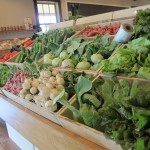
Heron Pond Farm sells produce and other goods at their farm stand in Kensington, N.H.
Cantelmo says having a freezer allows him to over produce during peak season, increasing consistency at his farm stand.
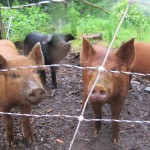
Pigs at Pheonix Hill Farm in Boscawen, where Ryan Ferdinand and Mike Hvizda live and work.
Mike Hvizda and Ryan Ferdinand are farmers and artists in Boscawen. Because farming is so costly, however, they are scaling back to focus on careers as realtors.
Heron Pond farm stand, Kensington, N.H.
Andre Cantelmo says selling value-added processed foods like pesto, made in an industrial kitchen, can help increase profits for produce all around.
With almost 60 farmers markets across the state, demand for local food is growing. But local farmers still struggle to make a profit growing local food. In fact, about three quarters of all farms in New Hampshire gross less than $10,000 from sales each year.
This is the first installment in our summer business series investigating how a changing market place is affecting New Hampshire farmers.
At the Concord Farmers’ Market on a Wednesday evening in July, an older woman peers over a table at some whimsical looking vegetables shaped like a curlicues. She asks a young farmer standing behind the table what to do with them. “You just put it wherever you’d use garlic, or chives,” the farmer explains. “They’re good.”
StateImpact seeks to inform and engage local communities with broadcast and online news focused on how state government decisions affect your lives. Learn More »