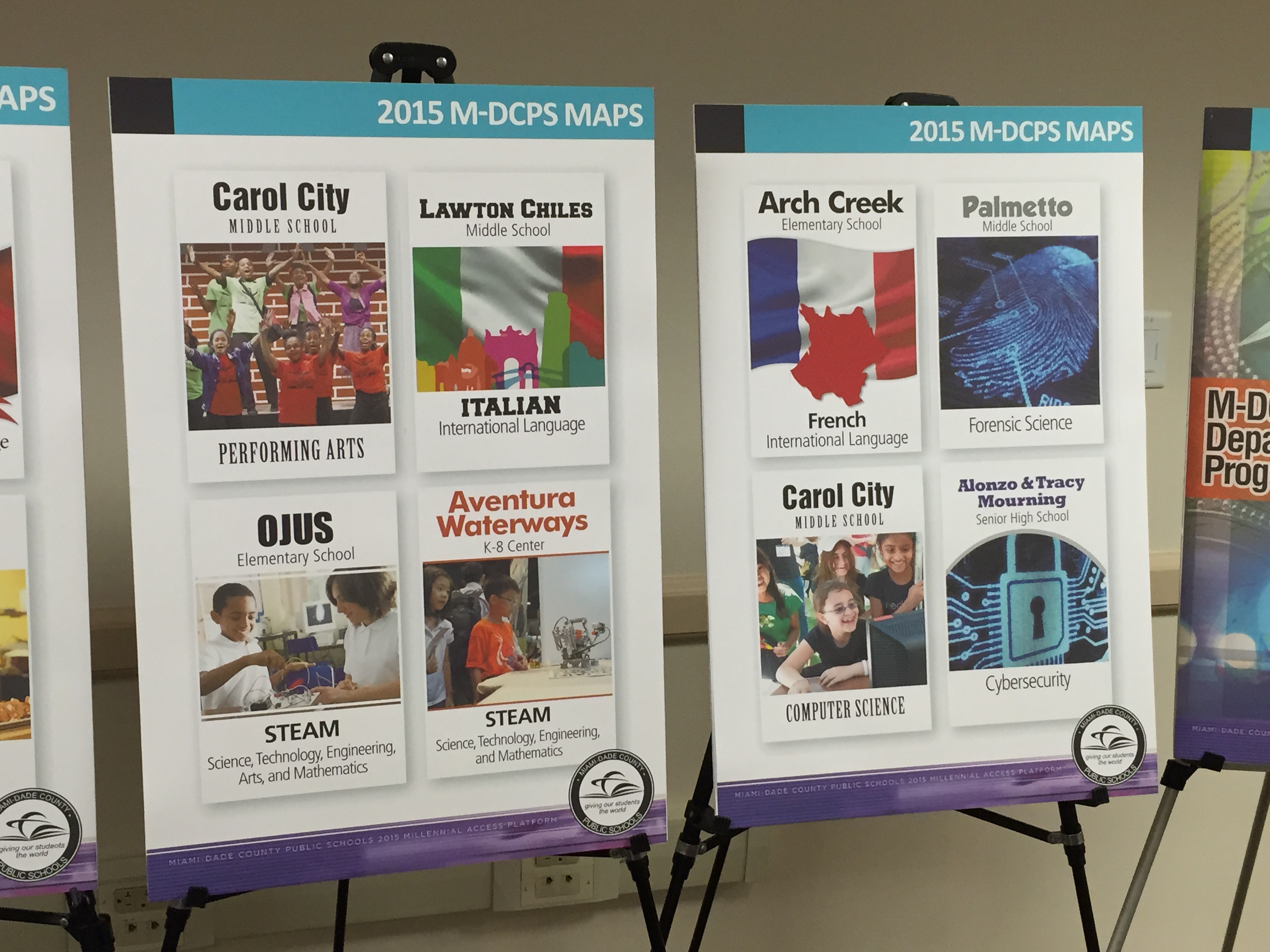
Posters advertise new Miami-Dade County school choice programs.
Miami-Dade County Public Schools plan to eliminate out-of-school suspensions this year, preferring to keep kids in class and address behavior problems.
Miami-Dade schools have included $3.2 million dollars in the district budget to eliminate out-of-school suspension.
“Traditional outdoor suspensions and disciplinary actions don’t work,” said Miami-Dade schools superintendent Alberto Carvalho. “We ought to understand the root causes of student misbehavior…to actually address the human being behind the behavior, rather than simply condemning it and applying a consequence to it.”
The district is setting up “success centers” so suspended students don’t disrupt classrooms. The centers are staffed by teachers, social workers and other service providers to work with the students – and keep them on their classwork.
“This is not going to be a vacation” for suspended students, said Carvalho.
At one point, the Schultz Center had state funding and a big, multi-million dollar contract with Duval County schools to help teachers improve their craft.
The Schultz Center has trained thousands of teachers since it was founded in Jacksonville in 1997. But when state revenues declined, the Schultz Center funding was cut.
So the Schultz Center had to change. The non-profit is expanding beyond Northeast Florida to offer training to teachers statewide, both in person and online. And they’re building an incubator for education entrepreneurs.
They’re also helping teachers adjust to big changes in the classroom.
State law requires that teachers are evaluated each year. That evaluation must include how well that teacher’s students performed on standardized exams — and whether they did better or worse than expected, based on a complex statistical formula.
That formula is known as VAM, or value-added model. The VAM score counts for at least one-third of a teacher’s total evaluation score.
Thursday’s decision sets a statewide standard for 4th through 10th grade language arts teachers, 4th through 8th grade math teachers and Algebra I teachers — teachers in subjects with a statewide exam. State officials said the rule change will apply to about one-third of all Florida teachers.
State Board of Education member Rebecca Fishman Lipsey is questioning the accuracy of forcible sexual assaults reported on state college campuses.
A State Board of Education member is questioning the number of sexual assaults reported on state college campuses.
Rebecca Fishman Lipsey believes it is unlikely that there were only seven forcible sexual assaults reported by the 28-college sytem with more than 400,000 students. Those figures do not include crime data for the dozen schools in the state’s university system.
Fishman Lipsey began Wednesday’s board meeting by handing out pages of state college system crime data. Notice anything unusual she asked?
“It’s just a string of zeroes,” she said of the column tallying forcible sexual assaults. “Initially, for maybe half a second, my brain could go ‘Wow, how wonderful there’s not a single rape at any of our campuses. That’s an incredible thing.’
But Fishman Lipsey said she doubts the news is that good. She asked the Florida Department of Education to look into the accuracy of the figures.
Broward County schools superintendent Robert Runcie shared lessons learned at a White House summit on student discipline.
South Florida school leaders traveled to Washington Wednesday to share ideas on how to reduce on-campus arrests and suspensions.
Superintendents from Broward County and Miami-Dade County shared how their districts dealt with the problem at a summit hosted by the White House.
Research shows that students who are suspended before 9th grade are less likely to graduate. And on-campus arrests can stick with a student for life, hindering chances at a college education or finding a job.
Broward County schools superintendent Robert Runcie said his district led the state in the rate of arrests and suspensions when he took control in 2011. Minority students were arrested and suspended at disproportionate rates.
“Our goal can’t be to have students go into the courtroom,” Runcie said. “Our focus has got to be keep them in the classroom and out of the courtroom.”
The district started a new program to try to change student behavior and avoid arrests and suspensions. More than 2,000 students went through the program its first year and more than 90 percent did not commit a second offense.
The difference in passing rates between state and federal tests has been dubbed the proficiency, or honesty, gap.
Some states are telling students and parents they are better at reading, writing, math and other subjects than they really are, according to a new website from the Foundation for Excellence in Education.
The website, WhyProficiencyMatters.com, tracks the percentage of students scoring at grade level on state tests — “proficient” in education jargon. The site then compares those rates to how well students perform on the National Assessment of Education Progress, or NAEP. Students take the NAEP every two years and the exam results are considered the gold-standard of education data.
The group has found that many states report a much higher percentage of students are proficient on state tests than are proficient on NAEP. Foundation for Excellence in Education director Patricia Levesque says some states are telling students they’re ready for college or the workforce when they might not be.
“It’s really important to look at what is the gap between how your students are doing on the national test compared to how they’re doing on the state test,” she said, “because that gap tells you, basically, how honest is your state being to parents with how their individual child is doing.
“We’ve been telling parents ‘Oh no, your child is fine.’ But then when they get to college they’re actually not ready.”
You’d expect South Florida residents might see a reason to require students to study Spanish — gateway to Latin America, and all — and they do.
But the University of Florida found the idea was supported by more than 60 percent of those polled in every region of the state — North, Central, Southwest and Southeast.
Christopher McCarty is the director of the University of Florida Survey Research Center at the Bureau of Economic and Business Research. He added the question to the university’s monthly economic poll and is surprised by the result.
“Given this is somewhat of a contentious issue, certainly in other states, I thought that this might be more contentious here,” he said. “But there was strong support for requiring Spanish and requiring our children learn to be bilingual.”
Another way Florida has tried to help school prepare students for jobs is the Career and Professional Education Act. The law helps businesses create academies within public schools to train students and help them earn professional certifications. Those certifications can help students find a job or earn college credit.
So what kinds of certifications are Florida students earning?
Computer skills are a top choice, with students learning how to edit and manipulate images, create web sites and use basic office software. Food protection is the top career-specific certification, followed by several medical certifications.
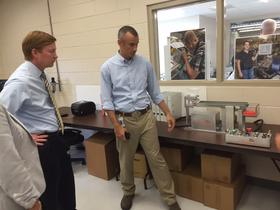
State Agriculture Commissioner Adam Putnam is briefed on AMskills.
Not every high school student wants to or even needs to go to college, but graduating students without a college degree may have a hard time gaining entry or experience at companies hiring for high paying, high skilled jobs. A local program is trying to bring that experience to graduating students.
Seven years in the making, AMskills was designed to be a German style apprenticeship program where tenth grade students apply to get in, just like applying for a job, and train on the job while earning good money. After graduation, they have experience and sometimes a job waiting for them.
“We’re always looking for a skilled workforce,” Juergen Borsh, general consul for Germany, said. “This is one of the big obstacles when a decision is being made in a German company- where do we want to go and invest?”
Borsch said German businesses in the US want to expand their operations but they can’t find enough workers who have the skills they need.
“I have learned here in Florida, I have been here for two years now, that many companies say we would love to expand,” Borsch said, “We could expand– we need the people, and I hear this in so many different fields.”
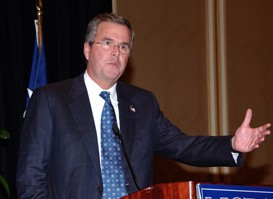
The education foundation started by former Gov. Jeb Bush has released a list of donors.
This week, the education advocacy group started by former Gov. Jeb Bush released a detailed list of donors for the first time. The Foundation for Excellence in Education posted the list on its website.
The Foundation for Excellence in Education conducts research and advocates for states to adopt education policies, including expanding school choice, measuring student, teacher and school progress and adopting the Common Core math and language arts standards. The group has raised $46 million since 2007.
The donor list does not reveal exact amounts, but lists each gift within a range — such as from $10,000 to $25,000. Gifts of more than $1 million did not have an upper range. More than 180 donors have given to the group.
Foundations were the biggest givers, with the Walton Family Foundation donating between $3.5 million and more than $6 million. The Bill and Melinda Gates Foundation gave between $3 million and more than $5 million over five years.
StateImpact seeks to inform and engage local communities with broadcast and online news focused on how state government decisions affect your lives. Learn More »