The exhibit hall at FETC, an annual education technology conference in Orlando.
Marketplace, the daily business news show from American Public Media, is launching a new series on education technology.
The U.S. education market is worth $2 trillion, Adriene Hill reports.
The first story takes a look at where venture capitalists are spending their money. Some are investing in projects like Remind101, which lets teachers send out mass reminders for homework, field trips and any other deadlines.
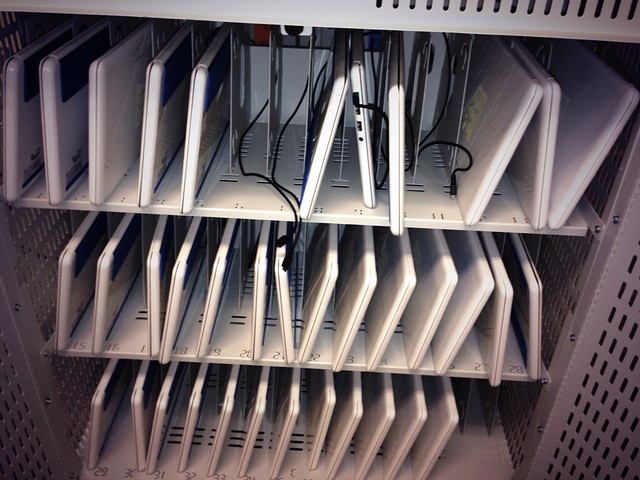
Most schools have found the best way to accomplish those goals is with wireless networks and more laptops or other portable computers. But many Florida schools will need to be rewired, and districts will have to purchase or lease additional computers.
Orange County schools estimate it will cost roughly $280 million to upgrade their schools. Hamilton County schools superintendent Tom Moffses estimates it will cost $3.6 million for the 1,700-student district between Tallahassee and Jacksonville.
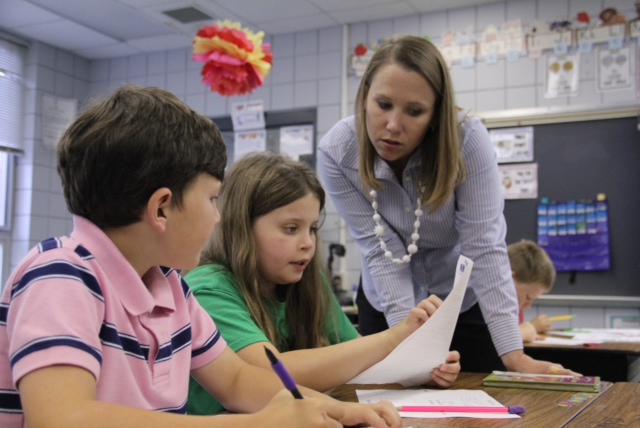
Laurie Langford, a second grade teacher at West Defuniak Elementary, helps two students look for evidence in a reading passage about public sector jobs.
This story is the fourth of a six-part series with the Hechinger Report looking at how schools are preparing for the Common Core State Standards in Florida. It was produced in partnership with StateImpact Florida, a reporting project of NPR member stations.
Students in Laurie Langford’s second grade classroom are reading about public sector jobs. As the students work together, Langford repeats a phrase that has become increasingly common in her classroom.
“Go back to your article, OK? Look in the text. Find your evidence,” Langford said.
In 2011, when this elementary school in rural West Defuniak adopted the new Common Core standards, many teachers revamped their lessons to phase out the creative writing that is typically taught in the early years of elementary school. Instead, even in the youngest grades, teachers are focusing on evidence-based writing.
Last year, Langford says she focused more on ‘fun’ writing assignments.
“Last year I did a cute writing on… ‘just as my mom opened the oven for thanksgiving dinner, the turkey popped out and…’ And the kids went on with it,” Langford said. “And it was really cute and really fun, and we threw it in a center this year, but we are not going to spend all week writing about a turkey running away.”
For the past few years, the new nationwide Common Core state standards have been slowly rolling out in Florida’s schools. Next year, all schools will fully implement the standards, which lay out what students are expected to learn in reading and math in kindergarten through twelfth grade. It’s led to big changes for teachers, many of whom are throwing out lesson plans and cherished writing assignments and learning new ways to teach the basics, like multiplication.
The percentage of Florida third graders passing state reading and math exams was unchanged this year.
The percentage of Florida third graders passing the state’s FCAT math and reading exams did not improve this year — remaining largely flat for the past three years — according to initial test results released Friday.
Fifty-seven percent of third graders scored at least a 3, the state’s passing score, on the reading test. On the math exam, 58 percent of third graders scored a least a 3. The reading and math tests are on a scale of one to five points.
The percentage of third graders at risk for being held back rose slightly, to 19 percent.
Florida law requires third graders scoring a 1 on the reading test be held back. Those students can still advance to fourth grade based on other test results or a portfolio of their work.
Florida State University is facing criticism over the influence of donor money in the classroom.
There are questions about whether a nonprofit founded by a prominent conservative activist has too much influence at a public college.
Florida State University rewrote its agreement with the Charles Koch Foundation after some on campus complained that the relationship undermined the school’s academic integrity. But critics say it still gives donors with their own agendas too much influence in the classroom.
NPR’s Greg Allen reports:
Editor’s note: The original version of this post inaccurately described the Charles Koch Foundation. The post has been updated.
Hackers stole unencrypted Social Security numbers and credit card info for current and former American Institutes of Research employees.
Hackers stole employee data earlier this month from the American Institutes for Research, the company chosen to produce Florida’s next standardized test.
No student information was stolen, according to Education Week. But, the hackers got Social Security numbers and credit card information for about 6,500 current and former employees.
“The breach only affected our business systems,” said Larry McQuillan, the organization’s director of public affairs. “By design, student data resides on an external information system independent from the domain that was affected.”
The Washington-based AIR has hundreds of contracts with federal, state, and local agencies, including the United States departments of agriculture, commerce, defense, education, health and human services, and more, according to the group’s website. The organization has been a major provider of both online and pencil-and-paper assessments to districts and states, including Delaware, Minnesota, and Oregon.
AIR also has contracts with the Smarter Balanced Assessment Consortium, one of two major multi-state consortia developing online assessments aligned to the new Common Core State Standards, and the organization provides educational program evaluation and value-added teacher evaluation services to a number of states and districts. It’s worth noting that AIR is currently embroiled in a dispute over a lucrative contract being awarded by the Partnership for Assessment of Readiness for College and Careers. (The executive vice president of AIR, Gina Burkhardt, is also a member of the board of Editorial Projects in Education, the publisher of Education Week.)
Do traditional district schools receive more money than charter schools? A Rutgers University researcher says the gap is not as big when you compare actual expenses.
But that study only looked at revenue, argues Rutgers University researcher Bruce Baker in a new National Education Policy Center review, and ignores the complex financial relationships between school districts and charter schools. Public school districts often must pay for transportation, special education, food and other services for charter schools. Sometimes, the district receives money only to pass it on to a charter school.
Baker looked at how much traditional public schools and charter schools spend on students and found the gap was usually smaller than the University of Arkansas researchers found. In some places, such as Bridgeport, Connecticut, charters schools spent more per student than district schools.
“Simply put, the findings and conclusions of the study are not valid or useful,” Baker wrote.
This story is part of a series from The Hechinger Report and StateImpact Florida looking at how Florida schools are getting ready for Common Core standards. Read — and listen to — the first two stories here andhere.
It makes sense that Florida’s new K-12 math and language arts standards based on Common Core will mean changes for those classes.
But science, social studies – even gym classes – will also change when every grade starts using the standards this fall.
At Tampa’s Monroe Middle School, near MacDill Air Force base, science coach Janet Steuart said the standards are bringing changes to her classes too.
John O'Connor / StateImpact Florida
Monroe Middle School science teacher Andrea Groves works with a student. Many science classes will add more reading and writing assignments as Florida finishes the switch to new K-12 math and language arts standards this fall.
“There will be more emphasis on how you write in science,” Steuart said. “How you write with clarity. How you take a position; you defend it; you use evidence, pictures, text – whatever you have to defend it.”
Common Core outlines what students should know in math and English classes at the end of each grade. The emphasis on writing is the third, embedded set of standards within Common Core – literacy.
Common Core calls for students to read and write more outside of language arts classes. And they should pull evidence from their assignments to support their work.
That might mean more non-fiction books or reading historical or technical documents in addition to close readings of classic novels or poetry.
Steuart says there’s this writing assignment as an example.
“Defend the classification of the platypus as being a mammal,” she said. “What characteristics does it have that maybe it shouldn’t be? It lays eggs. So is there enough evidence that it should be a mammal or is there enough evidence that, no, we’ve got to revise that?”
For some districts the new emphasis on reading and writing will be a shock. A Common Core recommended reading list includes science texts about earthworms, the moon landing and Euclid’s treatise that is the basis of geometry.
But Hillsborough County schools have been adding reading and writing assignments to courses the past few years.
Seventh grade Civics teacher Tony Corbett says not much will change when Monroe Middle completes the switch to the new standards next school year.
“It just gives us 10 things to focus on that we’ve already been focusing on,” Corbett said. “They’re already supposed to be able to summarize. They’re already supposed to have vocabulary. They’re already supposed to do main idea. They’re already supposed to do primary documents. And that’s pretty much what the focus of Common Core is.”
Common Core will even mean changes for physical education classes. Teachers might need to work in math and writing assignments.
Some districts post vocabulary lists in the gym – or create math games.
It’s something Monroe Middle PE teacher Shane Knipple said he already does.
“We always try to integrate different subject areas as much as we can,” Knipple said. “A lot of science, and definitely a lot of math with scoring, counting and things of that nature.
Students running a mile outside on the track were calculating whether they were still on pace to finish in eight minutes.
Knipple said the changes Common Core will bring to PE classes are just good teaching.
“A lot of times in education they put things under different names when it’s something you’ve been doing all along,” he said. “True P.E. teachers that do what they’re supposed to do, I think we’re probably doing most of what we need to do already.
Monroe Middle gym teachers said they’ve been told more changes will happen over the next few years. But like teachers in other subjects, they’re confident they will be ready.
Many school districts don’t restrict contractors from using the data. And a federal privacy law was written prior to widespread Internet use and needs updating.
From the story:
Students shed streams of data about their academic progress, work habits, learning styles and personal interests as they navigate educational websites. All that data has potential commercial value: It could be used to target ads to the kids and their families, or to build profiles on them that might be of interest to employers, military recruiters or college admissions officers.
The law is silent on who owns that data. But Kathleen Styles, the Education Department’s chief privacy officer, acknowledged in an interview that much of it is likely not protected by FERPA — and thus can be commercialized by the companies that hold it.
Districts could write privacy protections into their contracts with ed tech companies. But few do.
A recent national study found that just 7 percent of the contracts between districts and tech companies handling student data barred the companies from selling it for profit.
The privacy concerns include big, new firms such as Knewton, and national non-profit efforts such as Code.org, which is encouraging kids to learn computer programming.
Students at the all-girls Ferrell Preparatory Academy in Tampa. Ariana Jerome, Shawna Kent, Elena Postlewait and Destiny Jackson all say they prefer their all-girls school to the co-ed schools they previously attended.
In the best-designed studies, Hyde found no evidence students benefit from single-gender education across 14 outcomes, including math performance, self-esteem, attitudes about math and science and more.
“Often it will work in the first year,” Hyde said, “because everybody’s enthusiastic about it. They recruit the best teachers, and so on. But after the first year, when the novelty wears off, it doesn’t really produce any benefits.”
StateImpact seeks to inform and engage local communities with broadcast and online news focused on how state government decisions affect your lives. Learn More »