As school districts purchase textbooks and other materials for new standards, two studies find much of what is on the market is a poor match for Common Core.
Brevard County schools are considering 30 new middle and high school textbooks for the nationally crafted math and language arts standards known as Common Core,Florida Today reports.
The standards are currently used in kindergarten through second grade, and are scheduled to be used in every Florida grade when classes start this fall.
Like Brevard County, school districts across the state that have yet to do so will soon need to make big curriculum decisions. But there’s a problem — researchers are finding many textbooks and classroom materials aren’t a perfect match for Common Core.
The final recommendation is up to Education Commissioner Pam Stewart. She has said she plans to announce her choice next month.
AIR beat out bids from testing heavyweights such as Pearson — who currently has the state FCAT contract — CTB/McGraw-Hill and the ACT Aspire. From the story:
Casi Adkinson, a teacher at West Defuniak Elementary listens as a student explains her answer during morning group work.
In Defuniak Springs in Florida’s panhandle, the third graders at West Defuniak Elementary are learning division.
Specifically, 72 divided by six. Their teacher, Casi Adkinson drew circles onto the board.
“I share my 72 into my six circles,” Adkinson said. “Are we ready to do that together? Ready? 1,2,3,4,5…”
With the class counting along, Adkinson drew 72 marks, grouped into six separate circles.
“Ok, I shared my 72,” she said. “What do I do next? Alaya?
“Oh! You count how many there are in the six circles,” Alaya said.
By the time the lesson is over, the class finished only four problems.
“I know to some people, they might think ‘that’s not many problems, I’d want to cover 20,’” Adkinson said. “It doesn’t matter if you cover 20 problems if they don’t understand why they’re doing it.”
The idea of ‘less is more’ has permeated West Defuniak Elementary since 2011. That’s when the school began to phase in the new Common Core standards with its youngest students.
This weekend, a Duval County high school will be hosting a conversation about volunteerism, bridging disparities and the community roll of a historic African-American school.
William M. Raines High School opened in segregated Jacksonville in 1965. Its first principal famously hired the best teachers he could find—recruiting educators with degrees from Columbia. For decades, it was a community pillar.
But in recent years, Raines has struggled with poverty, neighborhood violence and low test scores. At one point, the state threatened to close Raines and several other failing Duval schools.
But for many Raines grads—including filmmaker Emanuel Washington—the school was too important to dissolve.
Washington made a documentary about the school’s history, We Remember Raines, which will be screened at the school on Saturday. Continue Reading →
House Committee on Education and the Workforce Dem / Flickr
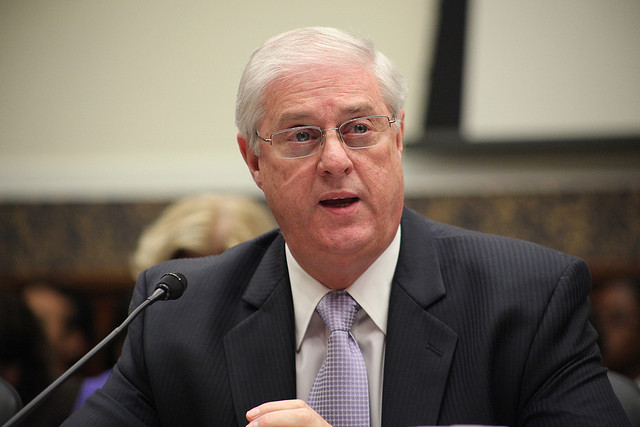
National Education Association president Dennis Van Roekel.
The head of the nation’s largest teacher’s union says school districts are botching the implementation of shared math and language arts standards known as Common Core.
“Seven of ten teachers believe that implementation of the standards is going poorly in their schools. Worse yet, teachers report that there has been little to no attempt to allow educators to share what’s needed to get CCSS implementation right. In fact, two-thirds of all teachers report that they have not even been asked how to implement these new standards in their classrooms,” NEA President Dennis Van Roekel writes in the Feb. 19 letter. “Consequently, NEA members have a right to feel frustrated, upset, and angry about the poor commitment to implementing the standards correctly.”
In all, the letter is more evidence of a phenomenon my colleague Andrew Ujifusa of State EdWatch fame and I wrote about in this week’s edition of Education Week: Unions are in a tricky situation on the common core. They’ve been among its greatest champions, and are now faced with rank-and-file members’ gripes as it’s implemented, especially in New York.
The NEA won’t oppose the standards, Van Roekel writes in the letter. “[S]cuttling these standards will simply return us to the failed days of No Child Left Behind, where rote memorization and bubble tests drove teaching and learning,” he says.
Florida is one of 45 states which have fully adopted the standards. Common Core outlines what students should know at the end of each grade. The standards are expected to be more difficult in order to better prepare students for college or a job.
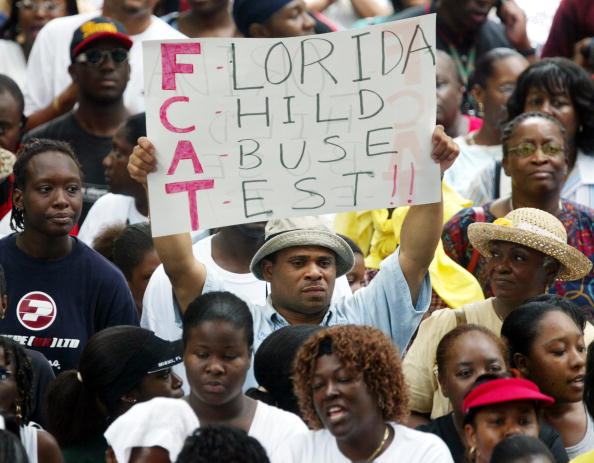
Parents and students protest outside then-Gov. Jeb Bush's Miami office in this 2003 photo.
At yesterday’s State Board of Education meeting, Orlando mom Andrea Rediske scolded members for state and federal rules requiring standardized testing.
Tuesday, she sought support for the Ethan Rediske Act, or HB 895, which would exempt students from state standardized tests if parents, special educators and school superintendents could prove a medical need to skip the test.
“This incident caused anguish to my family,” Rediske told the board, “and shows a stunning lack of compassion and even common sense on the part of the Department of Education.
“You may ask yourselves: ‘If this is such a problem why isn’t there more public outcry from the parents of disabled children?’ I am here to tell you why. Parents of severely disabled children are exhausted. We spend our lives keeping these children alive.”
Most school districts no longer require students to learn how to write in cursive. Since the 1970s, fewer and fewer people see the importance of curlicues.
Every October, high-school students across the country take the PSAT, or Practice SAT, a standardized test developed by College Board that provides high school students a chance to enter scholarship programs and gain access to college and career planning tools.
But, it wasn’t the algebraic equations that terrified the kids. It was the cursive.
Seriously.
As the kids filled in their identifying information, they came to a section that asked them to copy a pledge promising not to cheat – in cursive – and then to sign their names.
“Miss, what do they mean by ‘sign your name’?” one student asked.
“You know, the way that you write your name on important documents, like contracts or checks.”
Questioning stare. “Like, in cursive?”
“Yes.”
I have never seen so many stunned teenagers, paralyzed, gripping their pencils, gulping. It took one child a full five minutes to copy the roughly 25 words and sign his name. Continue Reading →
Protestors object to Common Core math and language arts standards outside a State Board of Education meeting in Orlando.
The State Board of Education approved changes to the state’s K-12 standards that keeps calculus and cursive writing, and clarifies and adjusts when some standards are taught.
The board approved the changes despite dozens of parents and activists asking the board to rescind the standards. The vote marks another –possibly final — transformation for Florida’s K-12 math, English and language arts standards known as Common Core. Florida is one of 45 states which have fully adopted Common Core.
The standards outline what students should know at the end of each grade.
Education Commissioner Pam Stewart said debate over the content of the standards is over.
“I think that the vote that the board took today certainly does lay to rest where we’re headed,” she said, “the direction we’re going with our standards. This is the right move.”
Senate President Don Gaetz wants to requires students receiving tax credit scholarships to take state standardized tests.
The debate over whether to require students using one of the state’s private school scholarship programs take state standardized tests is flaring up again.
Florida lawmakers want to expand the state’s private school scholarship program for low-income students funded with tax credits. But Senate President Don Gaetz, R-Niceville, thinks the scholarships should also come with the requirement that those schools administer the same statewide test as Florida’s public schools, as the Orlando Sentinel reported last week.
The issue is important as Florida chooses a new statewide test tied to Common Core language arts and math standards to replace the FCAT. Education Commissioner Pam Stewart is expected to recommend a new test next month.
Senate President Don Gaetz sat down with StateImpact Florida to talk about some of the biggest education issues for lawmakers this spring, including what kind of test will replace the FCAT.
Q: Florida is in the process of implementing Common Core standards. The state still hasn’t determined how students will be assessed on what they’ve learned. Plus, you still have critics who say this a national take over of education. You’ve said you would not support legislation to repeal common core. But are there any plans to change it this year?
A: When you look at materials used to teach students, that’s where some of the criticism has come in. So there’s legislation that would make clear that the selection of instructional materials is up to the local school board.
Then there’s the issue of assessment. Speaker Weatherford and I last year wrote to the Department of Education and said get Florida out of Common Core PARCC.
StateImpact seeks to inform and engage local communities with broadcast and online news focused on how state government decisions affect your lives. Learn More »