These teachers are learning how to make math an interactive, engaging experience for students under the new Common Core State Standards.
They were led by Ilea Faircloth, a staff training specialist for Bay County schools.
“With Common Core, if we are implementing the math practices with fidelity and to the intent of the mathematical Common Core writers, we are instilling in them the love of mathematics,” Faircloth said. “We are challenging them and pushing them. We’re not giving them answers – we’re making them think.”
And “It’s fun and it’s engaging, and it’s not boring,” Faircloth said.
Teachers in this training session are learning techniques that Faircloth says will work for students of all ages.
Common Core will have kids thinking out loud, discussing solutions with each other, and explaining their answers. Continue Reading →
Editor’s note: Names of teachers and students have been changed.
Professionals should be responsible for their job performance and should be evaluated and retained accordingly.
Who doesn’t agree with that?
My problem isn’t with accountability or evaluating teachers. My problem is with the schemes I’ve encountered so far in my career that have been designed to hold teachers accountable.
I’ve been lucky enough to teach at a range of schools. And even though I’m the same teacher, I’ve been treated (and paid) differently in ways that had more to do with the kind of school in which I was working than with my performance in the classroom.
My first encounter with Florida’s school grading system and the accompanying bonuses for teachers happened when I was teaching in a large urban school in one of the poorer neighborhoods in Miami-Dade County. The system is designed to combine many pieces of data, such as student test scores or percentage of students taking advanced classes, and reduce it to a simple A through F letter grade.
My high school was graded an F. My colleagues and I not only suffered the shame of being publicly labeled failures, we were denied the bonus given to the “successful” teachers at higher-performing schools.
Three years later, I taught at one of those higher performing schools, located in an affluent suburban neighborhood. My school received an A grade and I got my accolades and my bonus.
This new way of teaching is designed to better prepare students for college and a career.
Thousands of teachers are getting help from the Florida Department of Education at training sessions this summer – studying a different way to guide student learning.
Principals and other school personnel are learning, too.
K-12 Deputy Chancellor Mary Jane Tappen says administrators need enough knowledge about the standards to recognize them in the classroom and lead teachers through the transition.
“It’s to help administrators recognize what a classroom where Common Core is being taught should look like and how to support teachers with resources and lesson study,” Tappen said this week during a training session near Pensacola. “So administrators have some skills but also some resources to help them.”
It’s a big change for long time educators like Bagdad Elementary School Principal Linda Gooch in Santa Rosa County. She’s worked in education more than three decades, seven of those years as an administrator.
Q: What are administrators learning at these summer institutes?
A: We are learning how to be the instructional leader that we need to be to make sure that our teachers are able to implement Common Core in the way that it should be.
We have to have a little bit of information about all of the different areas because it’s up to us to make sure that we are providing the professional development that our teachers need and encouraging our teachers to be leaders – to work with their grade levels and to work with other grade levels because we can’t do it all. Continue Reading →
Tea Party members, Lois Miller, right, and Charlie Batchelder, left, hold signs to protest Common Core across the street from Marion Technical Institute where school administrators were meeting on Southeast Fort King Street in Ocala, Fla. on Wednesday, April 3, 2013.
The training session by Washington, D.C.-based FreedomWorks was tied to a rally protesting a national conference on Common Core State Standards. The two events were scheduled for neighboring hotels on June 29.
Hotel officials told FreedomWorks they were concerned about unpredictable crowds after seeing people mention the protest and training session on social media.
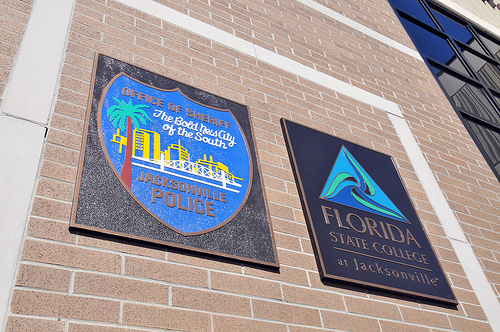
Florida State College at Jacksonville is questioning a new national ranking of education schools.
A Florida college rated “substandard” in national rankings of education schools said the rankings were “inaccurate and misleading” and rely too much on information obtained on the Internet.
But Tiffany Hunter, Florida State College at Jacksonville dean of education, said the school only has an early childhood education program. Florida has two certifications for early childhood education and elementary education, Hunter said, and the requirements for each are different.
Therefore, the school should not have been included in the evaluation of elementary education programs.
“It seems very apparent that the evaluation was inaccurate and misleading on all levels for our program at FSCJ,” Hunter said by email. “There is a division between Early Childhood and Elementary education and it does not appear to be understood by the NCTQ.”
State and education leaders will also need to provide help outside the classroom, such as bolstering school college and career counseling, better tracking and analysis of federal financial aid applications and developing a statewide program to encourage students to go to college.
Florida schools are now transitioning to Common Core State Standards, which outline what students should know by the end of each grade. The standards are intended to ensure that every high school graduate will be ready for college-level work or qualified for a job with a salary which could support a family.
But The Florida College Access Network analysis argues that increasing academic rigor alone won’t be enough. The group provides research and advocacy with the goal of increasing the percentage of Floridians with higher education degrees or credentials.
Got a question about Common Core standards? Drop us a line.
StateImpact is answering reader-submitted questions about the Common Core, a new set of expectations for what students should know and be able to do in math and English at each grade level. Florida is one of 45 states that have fully adopted the Common Core.
Today, we’re answering a question posed from a reader (in Arizona, thanks for reading!) about financial literacy education and a question about what Common Core standards say about teachers teaming up on lessons.
I teach financial education for grades K-12 on behalf of a credit union. My question relates to aligning the presentations that I make to the Common Core Standards.
In previous years, I would review the performance objectives under the Social Studies Standard, and prepare lessons that addressed these performance objectives (e.g., budgeting, saving money, checking accounts). In this way, my presentations were in sync with what the students had to learn.
With the new standards will there continue to be performance objectives to which I can refer? If not, what will replace these performance objectives? Will Common Core Standards affect personal finance objectives, and if so how?
K-12 Deputy Chancellor Mary Jane Tappen was constantly on the move, ducking in and out of dozens of training sessions.
“Next year, we are doing blended course descriptions which means in all English language arts and math classrooms, they’ll be teaching the Common Core,” Tappen said.
Hillsborough County schools superintendent MaryEllen Elia asked the State Board of Education to review the school grading formula.
The State Board of Education has asked that a panel of school superintendents and other education officials to review the state’s school grading system and potentially recommend changes.
Superintendents from Hillsborough and Miami-Dade schools said that they are concerned changes to the school grading system will mean a dramatic drop in school grades.
The board approved changes to the system last year — such as including the test scores of students at special education centers and raising the target score on the state reading test. Additional changes are set to take effect this year.
The school grading system tries to combine many measures of school performance, such as test results or the percentage of students taking advanced courses, into an easy-to-understand letter grade. The grades can determine which schools receive additional help to improve results, or influence property values.
The grading system has also drawn criticism for being punitive and putting too much emphasis on test results.
Hillsborough County schools superintendent MaryEllen Elia said at the state board’s Tampa meeting today that a district analysis shows test scores are rising, but according to the state formula, the district saw “unexplained and large drops in learning gains.”
“We have other assessments that show kids making gains,” Elia said. “When we’re seeing it and this test isn’t showing it. We’ve got a problem.”
Miami-Dade teacher Jeremy Glazer says all signs indicate a day without students is the most important day of the school year.
Editor’s note: Names of teachers and students have been changed.
A week ago Thursday — the end of the year for students — brought with it the usual catharsis of the last day.
There were hugs and tears as well as exchanges of notes and cards, gifts and promises, and words of wisdom and encouragement. I shared summer reading recommendations with students who reciprocated with book, movie, and music suggestions for me. That final day was a culmination of the relationships we’ve built and the work we’ve been doing together all year.
The next day, Friday, was the last day for teachers. It’s always the day when schools seem most empty. They feel like a hive once the bees have gone, a useless shell. Friday is the day we finish grading, clean out our classrooms, and take care of all the administrative trivia (book inventories, etc.) that keep schools going but aren’t the meat of what we do.
Thursday is the kind of day that makes me feel most like a teacher, and Friday the kind of day that makes me feel least like one.
But the State of Florida says I have it backwards. Friday, the day without children, was actually the most important day in the final judgment of how I and every other public school teacher in Florida, performed this year.
You see, that’s the day the Florida Comprehensive Assessment Test scores came out.
StateImpact seeks to inform and engage local communities with broadcast and online news focused on how state government decisions affect your lives. Learn More »