More than half of the state’s top-rated districts lost their ‘A’ rating this year. An ‘A’ grade is often a bragging right for school officials and a selling point for real estate agents and home buyers.
Sixteen states adopted SREB goals 10 years ago to guide policymakers and education leaders.
Florida is outperforming other southern states in a variety of indicators, according to the 2012 progress report. Florida is among the leaders when it comes to qualified teachers, college and career readiness, and school leadership standards.
For the second installment in our series, The Secret Lives of Students, we hear from Miami students about how school cliques affect their performance in class.
Editors note: this post was written by students Genice Nadal, Ana Chao and Teresa Fernandez.
Sarah Gonzalez / StateImpact Florida
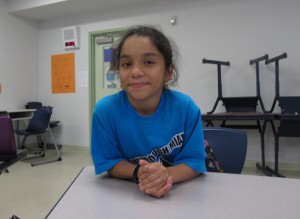
Genice Nadal, 10, in class at The Carrolton School in Coconut Grove.
By Genice Nadal, 10
Cliques can affect your educational performance because when you are left out of one you feel unimportant and that’s not a feeling you’ll love.
Some cliques include the popular, nerd, and normal cliques, or if there is an empty table that is where the loners are.
I am part of a clique also but the clique I hang out with feels more sister-like. We are just one big sisterhood but it’s just more than I can describe.
A higher percentage of charter schools earned an ‘A’ grade on the 2012 report cards than district schools, according to a StateImpact Florida analysis of grade data.
And the decline in ‘A’-rated schools was larger among district schools than charter schools.
But just as with district schools, the percentage of charter schools earning an ‘F’ grade increased this year. And a higher percentage of charter schools earned an ‘F’ grade than district schools in 2012.
The Florida Department of Education released grades for elementary and middle schools Wednesday. High school grades will be released later this year.
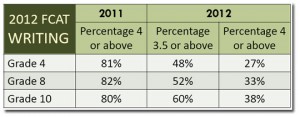
State leaders and school officials expected school grades to drop this year after education officials made changes to the Florida Comprehensive Assessment Test and required students with disabilities and those learning English count toward a school’s grade.
Dunbar technology student demonstrates hardware to middle school students.
If you want to learn about the latest in computing and other advanced technology, it’s tough to find a better source than a company that helped revolutionize the industry.
That’s one reason why Florida is becoming the first state to offer the Microsoft IT Academy to middle school students.
The academy provides students with technology skills that will ultimately help them compete in a global economy. Students receive hands-on experience with the latest Microsoft software and hundreds of web-based E-Learning courses.
214 Florida high schools already have access to the program.
The student authors who reported and wrote about conflicting home and school rules.
Editor’s note: We’re launching a new series for the next month, asking students to tell us what life is like in Florida schools.
The students are part of Breakthrough Miami, which runs programs in the summer and during the school year for students in elementary, middle and high schools.
We asked students to tell us what was on their minds. The answer? Rules, cliques, school lunches and other aspects of school life. They’ll also tell us what they think of online classes and whether teachers are teaching to the test.
This post was reported and written by elementary students Joshua Partridge (10), Saed Cameron (11), Emma Blanco (10), Joshua Johnson (11), Ashanti Kinchen (10) and Teley Laporte (11) – Students participating in the summer school program, Breakthrough Miami.
It’s a common problem that students everywhere face: Your parent or guardian tells you to defend yourself if confronted at school, while your principal tells you that hitting back equals suspension.
Fewer Florida schools earned an A this year after state officials raised standards.
Fewer Florida schools earned an ‘A’ on the state’s annual report card, while more schools saw their grades drop to ‘C’, ‘D’ and ‘F,’ according to state Department of Education data released this morning.
Last year 58 percent of Florida elementary and middle schools earned a ‘A’ grade. This year the percentage fell to 43 percent. That’s 368 fewer schools earning a ‘A.’
At the other end of the spectrum, an additional 14 schools earned an ‘F’ — a total of 47.
The percentage of schools earning ‘B,’ ‘C,’ and ‘D’ grade also increased, with the number of ‘D’ schools doubling.
StateImpact seeks to inform and engage local communities with broadcast and online news focused on how state government decisions affect your lives. Learn More »