Miami-Dade public schools’ technology education is getting a $75,000 boost from a Verizon Foundation.
The Education Fund will dole out the grant to help Miami Dade teachers and students in STEM programs – science, technology, engineering and math – during the upcoming school year.
The money will help teachers to implement a new initiative called “bring your own device.” It focuses on the use of mobile computing devices for learning.
Teachers will start training on how to use mobile technology in the classroom next month.
The district is working toward having students and staff connect their personal devices, like smartphones and iPods, to the district’s wireless network during class.
Garcy Lawson, 12, says using technology in class keeps students interested, but also distracts them.
For today’s installment in our series, The Secret Lives of Students, we hear from one student about the good and bad aspects of using technology in the classroom.
Editor’s note: This post was written by elementary school student Garcy Lawson.
By Garcy Lawson, 12
One thing that I like about school is that we use a lot of technology. Our assignments are online; we e-mail our teachers for help and use online textbooks.
These things are all great as they keep students interested in class. But a lot of times, they also cause distractions.
Someone always has a problem with someone else’s desktop wallpaper, and feels as if they have to comment. Continue Reading →
Miami teacher Karla Mats teaches special education science at Hialeah Middle School. She says she was observed by her principal for 20 minutes out of the school year, and she says that isn't enough time to fairly rate her performance.
When Florida teachers were evaluated last year, the stakes for most of them were pretty low.
No more. Soon, teacher evaluations will be tied to teacher pay.
New York City Mayor Michael Bloomberg is leading an effort to make it easier for foreign graduates of U.S. universities to get a work visa.
Editors note: This post was written by WLRN reporter Luc Cohen.
The presidents of more than 100 U.S. research universities signed a letter to President Obama and Congressional leaders urging them to make it easier for international students to get jobs in the country after they graduate.
The letter argues that highly skilled workers in STEM fields — science, technology, engineering and mathematics — are in high demand in the U.S. work force and necessary for global economic competitiveness.
The university presidents call on Congress to provide students who graduate from American universities with advanced STEM degrees with a “clear path to a green card.”
“After we have trained and educated these future job creators, our antiquated immigration laws turn them away to work for our competitors in other countries,” the letter reads.
The presidents of the University of Miami, Florida State University, the University of Florida and the University of Central Florida all signed the letter.
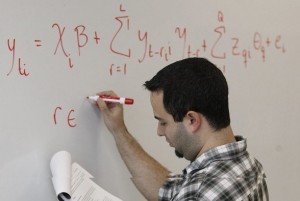
High school advanced calculus teacher, Orlando Sarduy, writes out the formula that will grade and help determine the pay of Florida teachers. Even for a college math major like him, the formula is too confusing to understand. He calls it a "mathematical experiment."
The report found Tennessee schools “systematically failed” to identify low-performing teachers through a combination of student test score improvement and principal evaluations, according to The Tennessean. Often, a principal’s evaluation and the teacher’s student testing score did not match.
Three-quarters of Tennessee teachers earned the highest scores of 4 or 5 on their principal’s evaluation, but just half of teachers earned a 4 or 5 based on test data.
The results were similar at the other end of the scale.
Principals awarded scores of 1 or 2 to just 2.5 percent of teachers. But 16 percent of teachers earned a 1 or 2 based on test scores.
Of those teachers who scored a 1 based on test scores, the average principal score was 3.6.
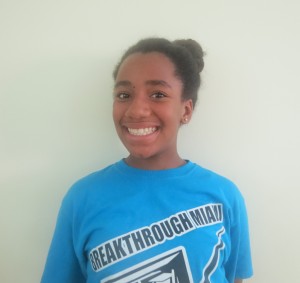
Asatta Mesa, 12, says teachers have taught her to read the FCAT questions before she reads the passage, so she can know where to look for the answers.
For today’s installment in our series, The Secret Lives of Students, we hear about tricks students have learned to pass the FCAT.
Editor’s note: This post was written by middle school student Asatta Mesa who is participating in the summer school program, Breakthrough Miami.
By Asatta Mesa, 12
As a student in Florida, I’ve been taking the FCAT since the third grade.
I am now entering the eighth grade, meaning that I have spent five years and a countless number of months preparing and taking a test that will not help me gain any knowledge or help me for the future.
FCAT takes so much time away from the education of students.
You learn tricks just to pass a test and then never apply those tricks to living in society. Continue Reading →
The study shows Florida scores increased, on average, by 3.2 percent of a standard deviation a year. That means Florida students improved by more than two grade levels during the 19-year period studied.
Those gains came despite Florida ranking at the bottom of states for increasing per pupil spending.
Dieudonne Saint-Georges, 13, does not participate in her schools magnet program. She says she feels like she's been labeled as an "average or below average learner."
For today’s installment in our series, The Secret Lives of Students, we hear how magnet schools can make some students feel left out.
Editor’s note: This post was written by middle school student Dieudonne Saint-Georges who is participating in the summer school program, Breakthrough Miami.
By Dieudonne Saint-Georges, 13
It’s natural for humans to group themselves according to interest and views. It has come to the point that humans crave companionship and acceptance. However, separation tends to cause problems.
Throughout history the fact that humans naturally group themselves have been known to cause wars.
One group tends to believe they are superior to the other, or others and that causes conflict. Sure cliques that form in schools are created unpretentiously, but sometimes that causes separation in schools.
John F. Kennedy Middle School is separated into its well-known magnet program called BEAT and its regular school. It seems as though people have become accustomed to seeing the school as two now.
The Florida College System Foundation financial literacy grant is awarding $10,000 to 10 Florida colleges for programs to help students with their money. The funding is from the Division of Florida Colleges and the Florida College System Foundation.
Grant winners are encouraged to create their own financial literacy programs or enhance programs already in place.
StateImpact seeks to inform and engage local communities with broadcast and online news focused on how state government decisions affect your lives. Learn More »