That’s a conclusion one could draw from an Indiana University study on the importance of teaching handwriting over keyboard skills, according to a story from our friends at StateImpact Indiana.
IU psychology professor Karin James says research shows letter writing activates portions of the brain critical to reading in children.
Like Indiana, Florida has joined 42 other states adopting a set of national curriculum guidelines that emphasize teaching students how to type. Many schools are purchasing electronic tablets, such as the iPad, to replace traditional textbooks.
What do you think of the conclusions? Have schools abandoned traditional skills such as handwriting? What have been the results?
Children wait to shake hands with Florida Gov. Rick Scott during his January visit to the Florida International Academy charter school in Opa Locka, Florida.
Our ongoing series on charter schools prompted some reader questions this week. Keep the questions coming — we’ll answer them in future posts.
SheilaY wanted to know more about how charter schools select their students:
Do the requirements differ from school to school? When comparing charter schools to public schools, these questions need to be asked. If charter schools are being selective in who they accept into their schools, is it really fair to compare them to public schools?
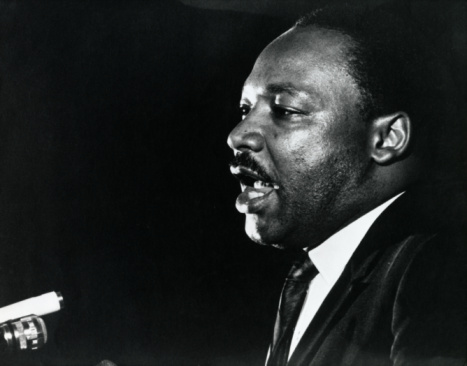
Dr. Martin Luther King, Jr. and Rosa Parks are the two most common civil right's figures K-12 students learn about.
When it comes to teaching K-12 students about the nation’s civil rights movement, more than half of U.S. states are failing, according to a new study by the Southern Poverty Law Center.
In the study, “Teaching the Movement: The State of Civil Rights Education 2011”, SPLC’s Teaching Tolerance arm looked at each state’s required education standards and curriculum, and compared that to what civil rights historians consider core information about the civil rights movement.
Florida is one of three states who scored an “A” letter grade in civil rights education, along with Alabama and New York. But authors say there is still room for improvement in every state.
“For too many students, their civil rights education boils down to two people and four words: Rosa Parks, Dr. King and ‘I have a dream,’” said Maureen Costello, SPLC’s Teaching Tolerance director. Costello said one of the most shocking findings is that educators make the movement “seem easy,” she said, because there is very little attention placed on opposition and racism. Continue Reading →
Charter Schools USA is one of Florida’s largest for-profit management companies, with 25,000 students in three states. The company was just awarded a contract to help turn around three Indiana schools taken over by the state.
Charter Schools USA CEO Jonathon Hage is a one-time adviser to former Florida Gov. Jeb Bush and helped draft the 1996 Florida law creating charter schools. Hage sat down with StateImpact Florida for a question and answer session.
Here are excerpts:
Q: When you guys opened in 1997, what was the landscape like?
A: I was involved in helping write the original charter school law in Florida. I worked for Jeb Bush’s Foundation for Florida’s Future and worked on the policy and then I fell in love with the concept after helping start one of the first charter schools in the state.
Children wait to shake hands with Florida Gov. Rick Scott during his January visit to the Florida International Academy charter school in Opa Locka, Florida.
Charter schools are an idea dreamed up by an obscure education professor in the 1970s which have grown into a primary alternative to traditional public schools.
Mountain states are adding more teachers than the rest of the country, according to a Stateline.org analysis of U.S. Census Bureau data. North Dakota led the way in percentage increase in teaching positions between 2008 and 2010, followed by Montana.
Florida added slightly more than 20,000 elementary and secondary education jobs during the three-year period, a 6 percent increase according to Census data. The growth in education jobs was flat from 2001 to 2008.
But unpacking the numbers a bit shows that teacher jobs were added while districts cut those working outside the classroom.
Florida schools have reduced the number of education jobs the Census classifies as “other” by 4,458 since 2008, a 4.4 percent decline. Since 2001, Florida schools have reduced the number of education jobs the Census classified as “other” by 13,500 positions — a 12 percent reduction.
Charter schools are championed by much of state leadership, including Gov. Rick Scott and Florida lawmakers.
More than 500 charter schools were scheduled to open this fall in Florida and all of them fit into one of three categories.
Experts say no particular type of charter school is more successful than another, but each kind of school has particular strengths and weaknesses.
The original charter school model focused on local leaders forming an oversight board and spelling out the school’s mission, goals and methodology in a contract or charter. These schools range from non-profits founded by local activists, to schools set up by cities or towns to schools organized by those with professional expertise.
Florida has also had private, for-profit companies managing charter schools since state lawmakers first approved charter schools in 1996.
School districts are beginning to manage charter schools as well, offering a growing third option.
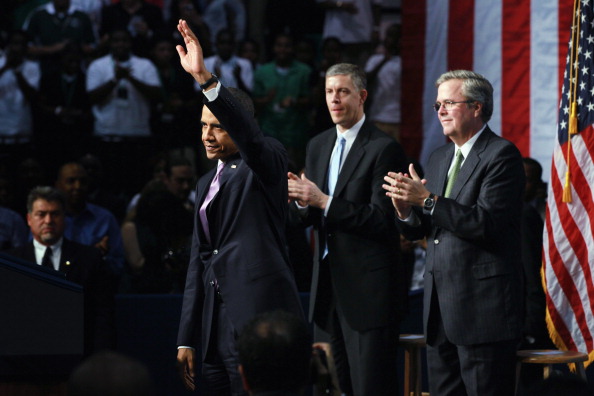
President Barack Obama (left), U.S. Education Secretary Arne Duncan (middle) and former Florida Gov. Jeb Bush (right) at a Miami rally in March.
Former Florida Gov. Jeb Bush will appear on MSNBC tomorrow, part of the parent network’s Education Nation initiative in New York City this week.
Bush will join Newark Mayor Cory Booker on “Morning Joe” at 8:20 a.m. Bush, who served from 1999-2007, is a leading national voice for education reform based on measurable student results.
Charter schools are championed by legislative leaders and Gov. Rick Scott, shown here in January visiting Florida International Academy in Opa Locka.
For 15 years Florida has conducted an experiment in public education.
The goal was to improve the entire education system by granting charter schools more leeway to innovate.
Welcome to StateImpact Florida’s Charter Schools 101 series examining the effect those schools have had on students, teachers, parents and communities — and what comes next.
One in every 17 Florida students attends a charter school and enrollment has tripled over the past decade.
A United States Senate study committee found that for-profit colleges are collecting nearly a quarter of all funds issued to veterans for education. According to the study, for-profit colleges benefited from more than one billion dollars in G.I. Bill money last year. That’s compared to a total distribution of just over four billion dollars.
University of Phoenix alone profited off of the G.I. Bill to the tune of nearly $210 million.
StateImpact seeks to inform and engage local communities with broadcast and online news focused on how state government decisions affect your lives. Learn More »