
Caption
Joe Wertz / NPR StateImpact

Caption
Joe Wertz / NPR StateImpact

Joe Wertz / NPR StateImpact
Inmate Stephen Argo mans a lathe in the machine shop at the McLeod Correctional Center, where he's been getting skills training. Argo already has a job lined up when he leaves prison in a few days.
Being tough on crime is expensive. It costs Oklahoma taxpayers about $20,000 a year to pay for the housing of each inmate in the state’s overcrowded prison system, Department of Corrections data show.
But being tough on crime can also mean giving criminals a chance at having a life on the outside.
At the large, open machine shop in the minimum-security McLeod Correctional Center near Atoka, workers are hunched over drill presses and milling stations, jotting notes on blueprints. But every couple of hours, the motors die down and everyone lines up for a head count.
Then it’s right back to work.
Here, inmates approaching release are getting hands on experience in welding, farming, construction and machining.
“I haven’t been out in 16 years, robbery with a firearm,” says Jay Ackley, a McLeod inmate and, basically, the foreman of the machining shop. “I was young and stupid and selfish.”
[module align=”right” width=”half” type=”pull-quote”]
“We’ve closed several campuses around the state that, frankly, we just didn’t have the money to continue operating.”
[/module]
Ackley has been involved with CareerTech’s Skills Centers school system for the past five years and is one of the program’s biggest advocates.
“It’s a lifesaver, man. If these guys are willing to come in and learn, and really dig in, just what we can show them here and teach them here, they’re set for life,” Ackley said. They’ve got a career that’ll last them a lifetime. They don’t ever have to come to prison again.”
He has a simple plan for when he’s finally set free next year:
“Work, work, work, it’s all about getting out and getting to work.”
That’s a sentiment shared by everyone here, including Stephen Argo, who’s prepping his drill to cut a new chess piece.
I’ve been gone almost six years, and I’ve done different kinds of programs since I’ve been in. But this is probably the one that’s probably helped change my life right here,” says Argo, who gets out in just a few days. “The pressure and stress of, ‘What am I going to do now?’ I don’t really have to worry about that now, because I’m confident and I’ve learned a lot out here.”
The drill press at Argo’s workstation is meant to machine metal, but these chess pieces are made of wood. Old broom handles, in fact. Aluminum is just too expensive. State budget cuts mean cost-cutting wherever possible, says Jim Meek, superintendent of the Skills Centers.
“We’ve closed several campuses around the state that, frankly, we just didn’t have the money to continue operating,” he says.
The cuts also resulted in fewer instructors and, consequently, hundreds of fewer inmates participating.
Joe Wertz / StateImpact Oklahoma
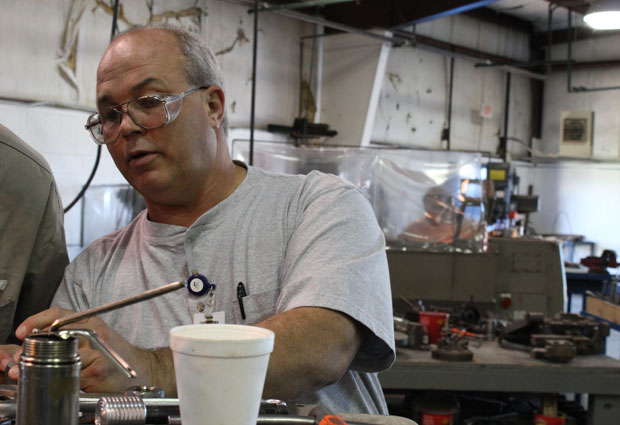
Instructor Rick Reese guides an inmate and machining student adjust a tool on a lathe at the McLeod Correctional Center near Atoka.
“We were located at Alva, new facility up there. We had a plumbing program, an electrical program up there,” Meek says. “We had a great deal of success with those young offenders up there. And they’re gone. We can go down to Granite, which is a facility that greatly needs extra programs there. And, uh, when we left there we left with two welding programs.”
Back at the McLeod Correctional Center, machining instructor Rick Reese holds up an elaborate aluminum meat tenderizer as he talks about how training prisoners can reduce recidivism, crime rates, unemployment and poverty.
“These guys come from nothing. And when they leave here with the confidence that they can make something like that, that’s huge,” Reese says.
These inmates are the lucky ones. They’re getting months, or even years of training. But with less and less money available for the program, fewer and fewer are able to take advantage, and prepare themselves for the rest of their lives.


