From Left: StateImpact Reporter Emily Corwin, NHPR News Director Sarah Ashworth, and StateImpact Reporter Amanda Loder
After two years and hundreds of posts, multimedia features, and radio stories, StateImpact New Hampshire is freezing this website and moving our business and economic coverage to NHPR.
StateImpact New Hampshire launched in late July of 2011 as a pilot collaboration between NPR and New Hampshire Public Radio. The mission was to cover the business beat in a way that hadn’t been done before: using a combination of multimedia, data analysis, and shoe-leather reporting to break down how public policies, trends, and daily news developments affect regular people.
A hallmark of StateImpact New Hampshire has been our flexibility. We began as a one-person, all-digital operation in our first year, focusing heavily on data and trends. In the spring of 2012, we added a team member and expanded our reach into radio features, special series, and even video. We will take this multi-faceted reporting mindset to the NHPR newsroom, where we will continue to find innovative ways to cover business, the economy, and other issues important to Granite Staters.
We thank you for following us on our social media accounts and RSS feed, and for checking in with the site. We’re proud of what we’ve accomplished in such a short stretch of time, and hope you will continue to follow our work at NHPR.
It’s always tough to narrow down years of work into a short list of highlights…but these are the stories that readers, listeners, and our peers have singled-out: Continue Reading →
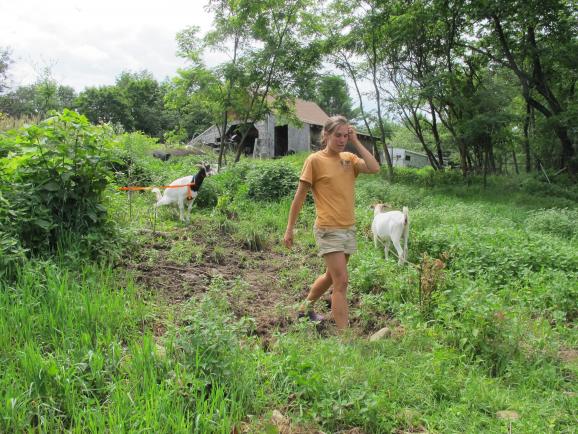
Ray Conner at Evandale Farm, with goats. Conner is hopeful the state's new slaughterhouses will help her expand her business.
According to the USDA, Americans are producing and eating more locally-raised food every year. But the market for local meat has trailed behind the market for local produce. Until recently, reasoning has been that there’s a shortage of local slaughterhouses. But as three slaughterhouses open their doors in NH this year, industry-wide studies show that more slaughterhouses may not be the answer, after all.
Pete and Tara Roy ran a small slaughterhouse in Vermont before they decided to expand. They turned away good customers for five years straight. So about a year ago, the couple built this, bigger meat cutting plant across the river in N. Haverhill, New Hampshire. Pete Roy has a bandana tied tight around his head. As he leads me onto the kill floor, one of his five kids trail behind us.
Roy points to a pneumatic lift and giant stainless steel saw. He says considering the capital it takes to build a new facility at all, it was go big, or go home.
We got 10,000 feet here we had two in our other plant, this is way bigger. Our capacity, the infrastructure is here to kill 40 or 50 beef a day, we don’t have the equipment or the manpower, nor do we have the demand, but we built the shell, the infrastructure is all here to grow significantly.
Like all USDA slaughterhouses, the Roys’ facility had to include an office and a separate bathroom for a full time USDA inspector. Continue Reading →
Heron Pond Farm sells produce and other goods at their farm stand in Kensington, N.H.
Cantelmo says having a freezer allows him to over produce during peak season, increasing consistency at his farm stand.
Pigs at Pheonix Hill Farm in Boscawen, where Ryan Ferdinand and Mike Hvizda live and work.
Mike Hvizda and Ryan Ferdinand are farmers and artists in Boscawen. Because farming is so costly, however, they are scaling back to focus on careers as realtors.
Heron Pond farm stand, Kensington, N.H.
Andre Cantelmo says selling value-added processed foods like pesto, made in an industrial kitchen, can help increase profits for produce all around.
With almost 60 farmers markets across the state, demand for local food is growing. But local farmers still struggle to make a profit growing local food. In fact, about three quarters of all farms in New Hampshire gross less than $10,000 from sales each year.
This is the first installment in our summer business series investigating how a changing market place is affecting New Hampshire farmers.
At the Concord Farmers’ Market on a Wednesday evening in July, an older woman peers over a table at some whimsical looking vegetables shaped like a curlicues. She asks a young farmer standing behind the table what to do with them. “You just put it wherever you’d use garlic, or chives,” the farmer explains. “They’re good.”
You know the drill – you get a pretty invitation in the mail with a link to Amazon.com or Bed Bath and Beyond. You sit down on the couch, point, click, type in your credit card digits and wave goodbye to your hard-earned money.
But if a couple wants their friends to shop locally, well – they’ve got to travel back in time.
When I arrived at Things Are Cooking, a kitchen appliance store in Concord, I asked owner Mike Beauregard to show me how his store handles wedding registries. He handed me a pen, a clipboard and a photocopied piece of paper.
When New Hampshire residents discuss the revival of commuter rail, they are usually referring to the controversial “Capitol Corridor,” an estimated $300 million project which seeks to extend tracks northward from the MBTA station in Lowell to Nashua, and then on to Manchester and Concord.
Earlier this year, the Executive Council approved moving forward with a $3.9 million feasibility study that will explore the proposed rail’s financial and environmental impacts.
Meanwhile, a smaller-scale push for locomotives is provoking a quieter debate in another pocket of the state: in Plaistow, a southeastern town bordering Haverhill, Massachusetts, with a population under 8,000.
Sean Fitzgerald, Plaistow’s town manager, has long advocated for a commuter rail station, which would extend the Haverhill MBTA line by four or five miles. He trumpets it as an incubator for transit-oriented residential and commercial development, as well as a means of alleviating congestion from the highway.
In the last 15 years, the number of vehicles clogging the commercial Route 125 corridor has increased dramatically, according to Sheldon Wolff, owner of Wolff Realty Group in Plaistow since 1991. Because of the town’s proximity to Route 495, I-93 and I-95, Plaistow is a magnet for large chain stores and businesses. “There’s a bottleneck coming off 495 [from Haverhill] into 125. The town has been doing numerous things to alleviate traffic.”
Fitzgerald says that depending on the time of day, “it can take 20 to 40 minutes to travel from Route 125 in Plaistow to the Haverhill MBTA station,” with up to 26,000 trips a day.
In February, Transportation Commissioner Christopher Clement told a legislative committee that his agency was neither for nor against a House bill that would raise the state’s gas tax by 12 cents to pay for much-needed repairs to New Hampshire’s roads and bridges.
At the time, Clement could remain, as he put it, “revenue agnostic,” as long as income earmarked for his department from a proposed casino was still a possibility.
But the House swept the casino option off the table two weeks ago, leaving the gas tax increase as the only proposed alternative to address the state’s crumbling infrastructure.
Accordingly, at a gathering of business leaders in Concord on Monday, Clement assumed a less guarded position on the House proposal.
A gas tax hike, he said, would put the department on a “path to greatness.” The increase, which would bring in an estimated $817 million over the next 10 years, would allow for completion of I-93, double state aid for municipal bridge and highway repairs and fully fund the state’s 10-year transportation plan. Continue Reading →
New Hampshire’s campaign-finance regulations are a jumble of contradictions, a fact that people who study the issue never fail to point out.
A year ago, a consortium of good-government types awarded the Granite State a “D” for political financing, citing how easy it is for donors to get around the dollar limits on contributions.
Last week, a campaign-finance watchdog group weighed in, and once again New Hampshire found itself at the bottom of the class.
In an analysis of disclosure requirements for PACs, non-profits and outside spending groups, the National Institute on Money on State Politics gave New Hampshire an “F.”
As competition in the auto industry heats up, car makers are tightening their image and branding campaigns. But car dealers — who feel financially vulnerable despite soaring profits — say manufacturers are expecting them to pay too much of the price.
In New Hampshire, dealer organizations are behind a bill that would protect them from what they see as exploitation by manufacturers, which won near-unanimous support in the Senate and is now being considered by the House. Manufacturers argue that government shouldn’t interfere with their private business contracts.
But behind all the he-said she-said, there are changing forces in the automobile industry.
Scott Holloway has been selling cars for as long as he can remember. His father Paul Holloway bought a dealership in the 1960s, they’ve been expanding across the state ever since. While there have long been tensions between dealers and manufacturers, the Holloways say they have never seen anything like what’s happening now.
“This is the thing that really made my skin crawl almost,” says Scott Holloway, pointing to some light fixtures at his Buick and GMC dealership in Portsmouth. “We went to PSNH and did their green energy program, less than three years ago.” Holloway says he pulled out all the lights, and got energy saving lights put in. Then, a couple years later, Holloway says, General Motors told him he had to replace the energy efficient lights with GM’s standard issue lights. If Holloway didn’t comply, GM would increase the cost he pays on every car. Continue Reading →
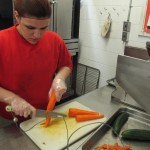
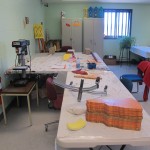
Women cook their own meals at the Goffstown Women’s Prison,but unlike their male counterparts, they cannot receive culinary certification.
Knives in the Goffstown Prison kitchen are locked down with a steel cable.
The Goffstown Women’s Prison was originally built as a Hillsboro county jail.
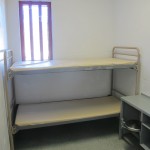
Some women sleep in very small cells. Others share a room with 21 other inmates.
Nearly 24 years after the courts first ordered a new facility for female inmates, the New Hampshire House has approved a capital budget with $38 million set aside for a 224-bed women’s prison in Concord.
Now, a class action lawsuit is driving lawmakers to act.
85 percent of the women here at the Goffstown prison face mental health problems. Another 85 percent face substance abuse issues, and most suffer from both. The most common sentence is theft, followed by forgery, and then murder.
It can take 5 or 6 tries to get any given door to open at the Goffstown womens prison. And that’s after the guard in the control room has unlocked it. But, if you’re persistent, you can get where you’re trying to go.
Almost ten years ago, Holly Wheatley stole $24,000 by forging checks issued by the state. She was a state employee.
Over the hum of vending machines in the prison visitors room, Wheatley says she’s 4 years into her 6 year minimum sentence. Continue Reading →
College juniors from the New England area can apply to participate in “hackademy,” a free weekend program of coding workshops, networking, and a mini-hackathon at the Dyn headquarters in Manchester. The program is part workshop, part recruitment strategy for the growing tech company.
About StateImpact
StateImpact seeks to inform and engage local communities with broadcast and online news focused on how state government decisions affect your lives. Learn More »