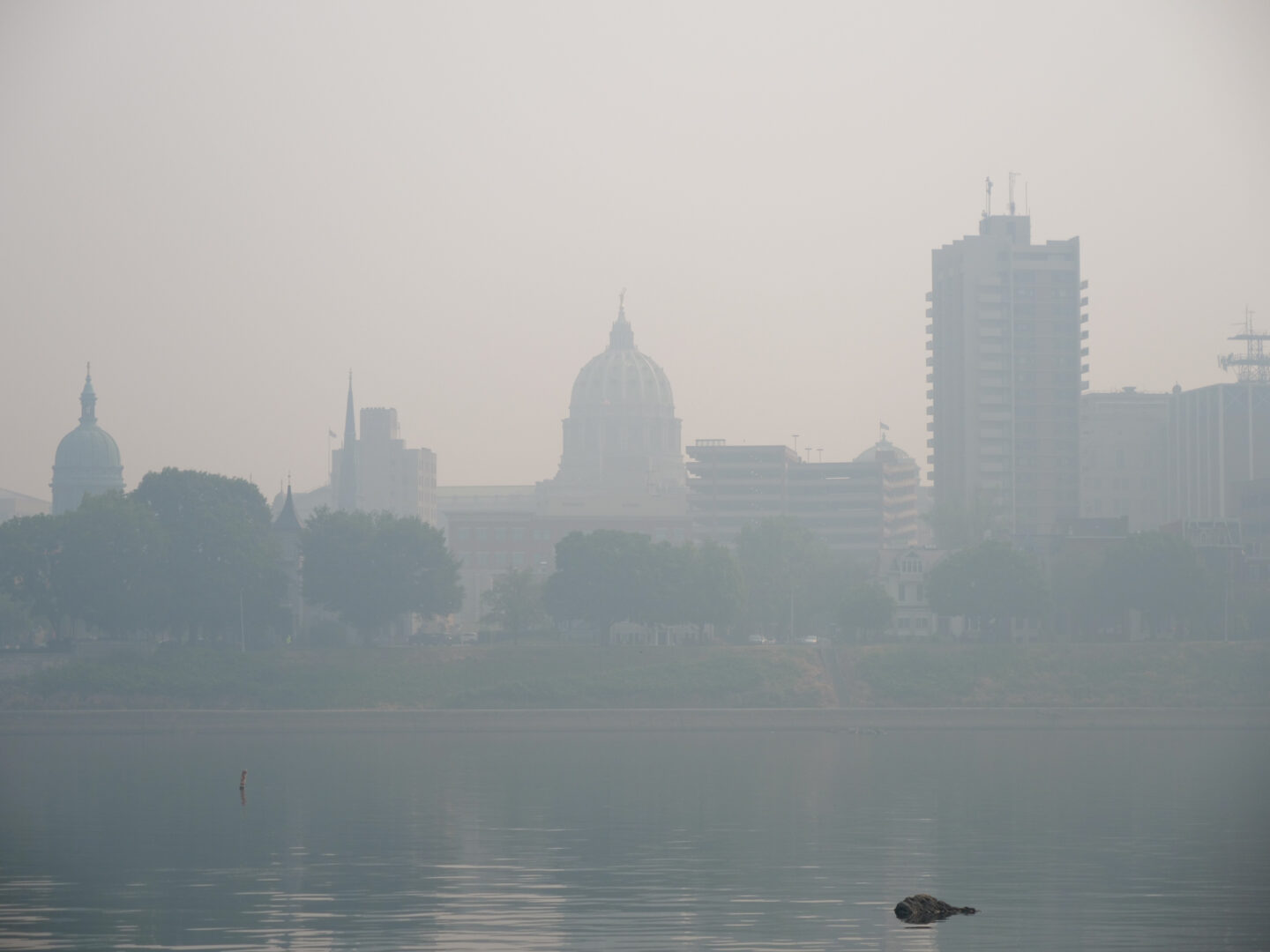
The state capitol building is shrouded in a haze as smoke from Canadian wildfires filtered into Pennsylvania on June 8, 2023. The smoke degraded air quality across Pennsylvania and other states in the northeast. Jeremy Long - WITF News

The state capitol building is shrouded in a haze as smoke from Canadian wildfires filtered into Pennsylvania on June 8, 2023. The smoke degraded air quality across Pennsylvania and other states in the northeast. Jeremy Long - WITF News
The state capitol building is shrouded in a haze as smoke from Canadian wildfires filtered into Pennsylvania on June 8, 2023. The smoke degraded air quality across Pennsylvania and other states in the northeast. Jeremy Long - WITF News
Wildfire smoke from Canada and the western U.S. that blanketed the region in June 2023 nearly doubled the average number of days with unhealthy air alerts in Lancaster County over a three-year period, according to the annual State of the Air report from the American Lung Association.
Overall, the report shows that county residents continue to breathe some of the unhealthiest air in the country, with the Lancaster metro area ranking 22nd worst in the country – 8 spots higher on the worst list since last year’s survey – and 2nd worst in the Mid-Atlantic region for measures of daily particle pollution from 2021 to 2023. The finding in this year’s report is worse than two years ago, when an analysis of 2019-2021 data ranked the Lancaster area as the 24th worst for this measure of air pollution.
Fine particle pollution, or soot, is made up of microscopic bits of ash, metals, dust or chemicals. Sources of the pollution can be construction sites, power plants, transportation, and farming.
Particles can get deep in the lungs and cross over to the bloodstream, where they can irritate heart conditions and raise the risk of heart attacks or strokes.
The county averaged 8.5 days of unhealthy air per year over the period, earning an F grade. In last year’s report, Lancaster averaged 4.3 unhealthy air days per year and ranked 30th worst in the country.
The Lancaster area also got a failing grade for the year-round average level of particle pollution. Its grade for ozone fell from a B to a C for the county’s 1 average day per year with high ozone levels.
Ground level ozone, or smog, is the result of pollution reacting with sunlight. It can irritate respiratory conditions such as asthma.
The six-county Harrisburg metro area got failing grades for each measure of particle pollution and a D for ozone. It ranked 44th worst in the nation for short-term particle pollution and 32nd worst in long-term particle pollution — both worse than last year’s report.
The Philadelphia-Reading-Camden area ranked 3rd worst in Mid-Atlantic for both ozone smog and daily particle pollution.
Pittsburgh’s metro area ranked worst in Mid-Atlantic for both measures of particle pollution.
Nationally, the report found that 25 million more people are living in areas with unhealthy air, compared to last year’s report. The report concluded that 156 million people, or 46% of the U.S. population, currently live in an area that got a failing grade for at least one of the three measures. The association said this is the highest number in the last decade.
The group is calling on people to support the U.S. Environmental Protection Agency and the work it does to ensure clean air. That includes calling on federal lawmakers to adequately fund the EPA’s work and defend the environmental rules and regulations it enforces.
“Everyone with lungs normally wants clean air, especially for them and their families. And those air protections are under threat,” said Kevin Stewart, director of environmental health for the American Lung Association.
The report does not grade how well efforts to reduce air pollution are working, but it notes that climate change is making it harder to clean up the air because of increases in extreme heat days, droughts and wildfires.
The report includes data from 2023, when smoke from massive wildfires in the American West and Canada’s northeast blew into the region.
“So, from the Midwest up to New England, down to southern Virginia, and so on, we saw wildfire smoke showing up in the air pollution data,” Stewart said.
Stewart said sensitive groups – including the very old or young, people with respiratory diseases and pregnant people – should keep an eye on air quality at airnow.gov and adjust their time spent outside according to the measurements.
Individually, people can also try to minimize the air pollution they create, by using less energy at home and making sure furnaces and car engines are properly tuned.
At the state and local levels, the report encourages policies to reduce greenhouse gas emissions from vehicles and buildings, such as investing in electric vehicle charging stations. It also recommends cool roofs, porous pavements, increased green spaces and solar panels to protect neighborhoods from extreme heat that contributes to ozone formation.