Idaho’s senators are trying to block new USDA recommendations that would limit servings of potatoes to school kids.
The Northwest News Network reports the USDA is recommending that districts in the National School Lunch Program limit servings of starchy vegetables to one cup a week per student. That means fewer scoops of corn, lima beans and most politically charged — potatoes.
“Every state grows potatoes,” he says. “Now, Idaho is the No. 1 growing state, but we represent one-third of all U.S. potatoes. So this is an important issue for really every state in the union.” – Frank Muir, Idaho Potato Commission
Here’s why Idaho’s senators and potato farmers don’t like the proposal:
294,000 acres of Idaho farmland was planted with potatoes in 2010
That acreage equaled 113 million hundredweight (cwt) of potatoes or 11,300,000,000 pounds
Those potatoes brought in more than $852 million dollars for Idaho farmers last year
The Idaho Department of Labor is touting the state’s energy economy and reports a four percent growth in jobs between 2007 and 2010. At the same time, a study released today by the department in collaboration with the Center for Regional Development at Purdue University, shows a 15 percent decline in jobs over that three year period.
“Energy accounted for about 6 percent of jobs and 7 percent of businesses in Idaho, ranking the state 14th and 22nd respectively among the states. From 2007 to 2010, Idaho employment in this sector was hit hard by the recession, falling 15 percent. Idahoans working in the energy industrial cluster made on average $25,000 more per year than the overall average wage earner in the state, based on a comparison of Idaho energy job and establishment attributes with those of the nation and the other 49 states.” – Illuminating Idaho’s Energy Industry, Fall 2011
25,149 babies were born in Idaho in 2008 at the height of the recession
A noticeable decline in the U.S. birthrate is linked closely to the economic recession starting in 2008. A new Pew Research Center report out this week says there were a record number of births in 2007, just as the economy slid into the recession, when 4,316,233 babies were born. Preliminary data for 2009 indicate the number of births dropped to the lowest number since 2004 at 4,131,018.
“A state-level look at fertility illustrates the strength of the correlation between lower birth rates and economic distress. States experiencing the largest economic declines in 2007 and 2008 were most likely to experience relatively large fertility declines from 2008 to 2009, the analysis finds. States with relatively minor economic declines were likely to experience relatively small declines.” – Pew Research Center
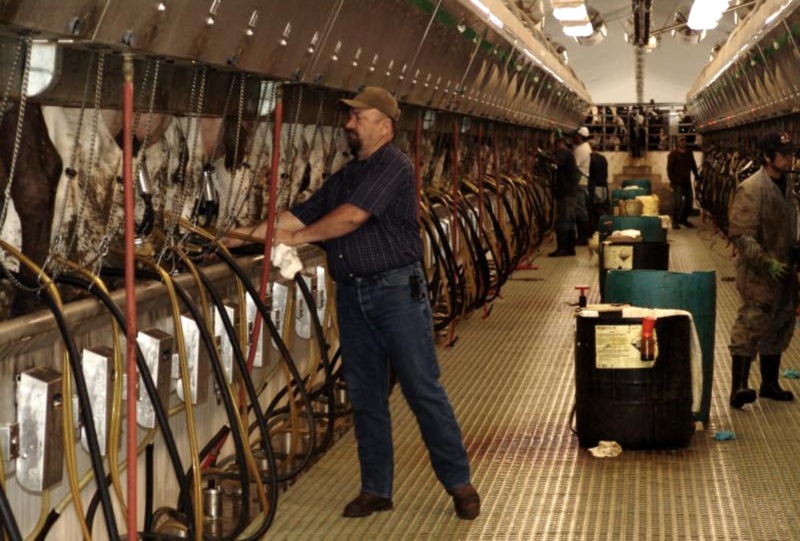
Luis Bettencourt working at one of his 11 dairies in southern Idaho
It’s hard to find optimism about the state of Idaho’s dairy industry among the very people who operate farms, milk cows, and try to make a living selling their product. The Idaho Dairymen’s Association reports there were 569 dairies in the state as of September 30th, 2011. That’s a significant drop from a few years ago when in 2008, 800 dairies were licensed to sell milk.
“I don’t think anyone would want to get into a losing business,” says Sharon Bettencourt. She and her husband Luis own one of the largest dairy operations in Idaho. They have 60,000 cows spread across 11 facilities. “At this point, we are trying to hang on to what we do have…there is no room for growth.”
While the number of dairies is on the decline in Idaho, the number of milk cows and the production of things like milk, cheese and cottage cheese are on the rise. According to a study from Boise State University’s College of Business & Economics which looked at the economic impacts of the dairy industry in Idaho, the number of dairy cows here is up more than 35-percent.
John Brown / Getty Images
In 2008 there were 550,333 dairy cows in Idaho
“The producer has to be better at making more milk,” says Jeff Ackerman who is the dairy operations manager at Bettencourt Dairies. “Production has grown because economics have gotten harder — we’re producing more milk out of the same number of cows, we have to, to squeak out any margins” says Ackerman. Continue Reading →
The New York Times is drawing attention to the large number of states that have this year considered implementing drug testing for people who receive public assistance.
“[Thirty-six] states considered drug testing for recipients of cash assistance from the major welfare program, Temporary Assistance for Needy Families, according to the National Conference of State Legislatures; 12 states proposed it for unemployment insurance; and some also considered making it a requirement for food stamps, home heating assistance and other programs.” – The New York Times
The idea is, of course, a polarizing one, and this state has had its own flirtation with it. In 2010, the Idaho Legislature asked the Department of Health and Welfare to study the costs of implementing random drug testing for adults receiving public assistance. According to the department’s resulting analysis, such a program would cost more than it would save.
Idaho Legislature
Rep. Judy Boyle is a rancher, writer and small business owner from Midvale.
Reached today, Rep. Judy Boyle, a Midvale Republican who co-sponsored the resolution requesting the study, said the Department of Health and Welfare took too narrow a view. “My concern is to help people get off drugs,” she said. “I know there are serious problems with people trading their food stamps for drugs, so we’re just enabling people to stay on drugs.”
Boyle says she has prepared draft legislation, and she plans to introduce a bill in the upcoming session. “It’s not to throw people off of welfare. It’s to help them,” she said.
RealtyTrac, a company that tracks foreclosures nationwide, released September data today. In Idaho, the total number of foreclosures dropped from August to September, from 1,860 to 1,654. The state had the seventh highest foreclosure rate in the nation in September, with one out of every 391 housing units receiving a foreclosure filing. A map of foreclosure rates by county is available here.
A comparison of this year’s third quarter numbers to the third quarter of 2010 yields somewhat sunnier news for the state and the nation. In Idaho, the total number of foreclosure filings decreased by nearly 42 percent over that period, compared to 34 percent nationally. However, a RealtyTrac analyst predicts that foreclosure activity will begin to pick up again, as banks work through the raft of poorly filed foreclosures that resulted from so-called robo-signing.
Source: RealtyTrac
By most estimates, it will be at least several years before the foreclosure crisis abates, nationally and in Idaho. But local organizations that provide foreclosure prevention counseling services say they could run desperately short on funding as soon as January. That’s because the greatest share of support for such services comes from grants funded with federal dollars, and because Congress continues to struggle over the 2012 budget, for the fiscal year that began October 1st. Moreover, Department of Housing and Urban Development funds for counseling services were zeroed out in fiscal year 2011. Continue Reading →
Idaho has the unwelcome distinction of having one of the highest foreclosure rates in the nation. Nearly 2,000 Idaho homeowners lose their homes each month, according to RealtyTrac’s count of foreclosure filings. But that’s not the whole story. Even as many homeowners work their way through foreclosure, low prices draw new buyers in. It’s a cycle of dreams lost and dreams gained.
Not long ago, Carmel Crock made a drive that she had avoided for much of the last year. She turned onto a steep road that winds into the hills above Boise, past homes she knows well. “This is Jenny and Ray’s house,” she said. “I watched Ian be born, and I’ve known Corey since he was teeny tiny. And this house, the second one on the corner, is my house. Was my house.”
Molly Messick / StateImpact Idaho
Carmel Crock, in the backyard of her new home. Since her move, she has been trying to make the new house feel like a home by planting flowers and a small vegetable garden.
It’s a simple 1960s ranch, white with green trim. Crock says it was the sunset views and the peacefulness of this spot above the city that made her and and her husband, Ken Harris, want to live here. At night they could hear foxes barking, and wild turkeys calling to one another. “And quail!” she said. She and Harris used to joke to one another, complaining about the noise. “That was our laughter lying in bed with the windows open! A cacophony of wildlife.” Continue Reading →
Remember the conversations with your parents or grandparents that began with, “When I was your age, I could buy a burger, a coke and a movie ticket for $5”?
And the typical response would go something like “I get it, Dad, (eye roll) things were cheaper back in the dark-ages.”
Bureau of Labor Statistics / U.S. Department of Labor
CPI Inflation Calculator
It all has to do with the value of the dollar and the changes in prices of all goods and services purchased. Here’s a fun tool from the U.S. Department of Labor that lets you see just how far $5, $100, $1000 could go back in the dark-ages (all the way back to 1913).
Idaho General Fund collections of $229.1 million in September 2011 were $0.1 million above the forecast amount.
Idaho’s Division of Financial Management released its latest revenue report today showing a slight uptick in individual income and corporate tax collections over what state economists had predicted.
“Idaho General Fund collections of $229.1 million in September 2011 were $0.1 million above the forecasted amount.” – Division of Financial Management
Still, Idaho sales tax collections were lower than expected.
“It was expected to contribute $93 million to the state’s General Fund in September. Instead, it added $91.6 million.” – Division of Financial Management
That $1.4 million gap is much smaller than August’s shortfall which came in at $6.8 million under what economists had forecast.
Governor Butch Otter speaking at the annual Buy Idaho conference, October 5, 2011
Buy Idaho launched in 1986, with support from then newly elected Lieutenant Governor Butch Otter, as a way to market Idaho-made products. The member driven marketing cooperative celebrated its 25th anniversary this week. Governor Otter calls the 1,100 member Buy Idaho effort a “great success”. Still, he told attendees at Buy Idaho’s annual conference the group needs to be more aggressive.
“We’re going to continue to go to those marketplaces, go to those buyers that are not only in the U.S. but around the world, and say, ‘Folks we have things we think you need, and we in Idaho would be more than happy to supply those for you.’ And you never know what these marketplaces are looking for until you start demonstrating your products and how it might be applicable to their operation,” said Otter.
The governor is also urging local companies to ramp up hiring. With about 70,000 Idahoans out of work, Governor Otter asked Buy Idaho members to look at the recently passed tax credit program known as the Hire One Act as an incentive to add new jobs. Continue Reading →
About StateImpact
StateImpact seeks to inform and engage local communities with broadcast and online news focused on how state government decisions affect your lives. Learn More »