In part, it’s because math lessons are more discrete. A quiz can tell you which math concepts a student is having problems with, as a teacher notes in the story.
But reading builds on many skills — vocabulary, grammar, contextual knowledge — and it is difficult to pinpoint just which one is the trouble spot. Reading deficiency may be more of a problem than math deficiency long term, educators say.
Orange County Superintendent Barbara Jenkins and Chairman Bill Sublette focused their State of the Schools speech on changes in curriculum and technology.
Orange County schools superintendent Barbara Jenkins says the district should be a leader as they switch to new education standards and add more required digital instruction.
“Orange County Public Schools intends to be at the forefront of that change,” Jenkins said during her “State of the Schools” address last week with school board Chairman Bill Sublette.
The two spoke about “schools of the future” and what it will take to make Orange County, one of the nation’s largest school districts, the “top producer of successful students in the nation.”
Tea Party members, Lois Miller, right, and Charlie Batchelder, left, hold signs to protest Common Core across the street from Marion Technical Institute where school administrators were meeting on Southeast Fort King Street in Ocala, Fla. on Wednesday, April 3, 2013.
Tea party groups see opposition to Common Core standards as the issue to revitalize a political movement which failed to defeat Democratic President Barack Obama in last year’s election and lost a court challenge to Obama’s health care law.
“This is the issue that could change things for the tea party movement,” said Lee Ann Burkholder, founder of the 9/12 Patriots in York, Pa., which drew 400 people — more than twice the usual turnout — to a recent meeting to discuss agitating against Common Core.
The standards have been fully adopted by Florida, 44 other states and the District of Columbia. Common Core lays out what students are expected to know in math and English language arts by the end of each grade.
The standards streamline the number of topics schools teach children in each subject. Common Core also requires teachers ask students what they know and to prove how they know it.
Orange County is planning to add up to five K-8 schools. Research shows students at those schools tend to perform better and have fewer discipline problems.
The popularity of K-8 schools is growing in one of Florida’s largest districts.
Orange County Public Schools will add up to five kindergarten through 8th grade schools to the three already in place.
These are traditional public schools, not charters or magnets. Kids will be zoned for them just like any other.
The average middle school in Orange County has 1,000 students. The new K-8 schools will have similar student populations.
“Our research has shown that the optimal size of a K-8 is 900 to 1,200 students,” Jenkins said. “Anything larger, and we need to build a traditional middle school. Anything smaller, and we cannot justify the operating costs.”
He stayed on point with his message: School choice, merit-based pay for teachers, and higher academic standards are good; Unions and social promotion of students are bad.
Bush said being competitive in a global economy means measuring everything American students do against the best students in the world.
“Higher standards is a key element of that. The Common Core State Standards are clear and straight forward,” Bush said. “They will allow for more innovation in the classroom; less regulation. They’ll equip students to compete with their peers across the globe.”
“The greatest mistake we make in public education is underestimating the capacity of our children to learn. When we do that, particularly with our at risk kids,” Bush said, “we take from them the right to rise.”
Bush said America isn’t rising to the challenge, because only 4 in 10 kids who “go through the most expensive education process in the world” are ready for college or a career by the end of 12th grade. Continue Reading →
However, the Council of Chief State School Officers is asking for some wiggle room from the U.S. Department of Education from No Child Left Behind requirements — or the waivers from the law granted to states such as Florida — during the transition.
The standards have been fully adopted by Florida, 44 other states and the District of Columbia. Common Core lays out what students are expected to know in math and English language arts by the end of each grade.
The standards streamline the number of topics schools teach children in each subject. Common Core also requires teachers ask students what they know and to prove how they know it.
Superintendent Mike Grego is wrapping up his first school year as head of Pinellas County Schools.
Education leaders gathered in Orlando today for a summit sponsored by the Florida Sterling Council, a not-for-profit corporation supported by the Executive Office of the Governor.
The summit covered a wide range of issues facing schools and universities.
Pinellas Superintendent Mike Grego laid out his plan to move the district forward as the state transitions to Common Core standards. Florida schools are scheduled to use the new standards in every grade by the fall of 2014.
The district will need to establish goals in critical need areas and hold the players accountable, he said.
Grego’s five goals include improving student performance, especially at schools with a higher percentage of students living in poverty; improving district reading instruction; ensuring schools are safe and reducing staff turnover; balancing the district budget; and making sure school technology is up to date and ready for online end-of-course exams.
Researcher Matthew Di Carlo takes a second look at just how much improvement there was on Florida Comprehensive Assessment Test writing scores this year.
But the average fourth grade score improved only slightly. The percentage of fourth graders scoring 3.0 or better, the expectation prior to last year, improved by just two percentage points.
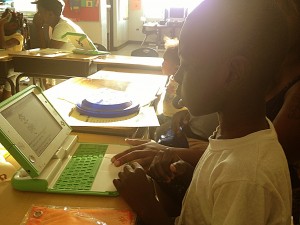
It’s family literacy night at Holmes Elementary School in Liberty City, and first grader Adam Redding is reading a poem about plants while he absentmindedly tips dirt out of a plastic cup and onto a laptop.
Sammy Mack / StateImpact
In this classroom, dirt on a keyboard is okay. The green and white computer is a rugged little machine from One Laptop Per Child, the organization best known for trying to put an inexpensive computer into the hands of every child in the developing world. Adam’s cup of dirt is part of a lesson plan that involves researching plants on the laptop, reading a poem, and seeding a corn kernel in a cup.
Welcome to the one-to-one classroom. One computer for every student. Continue Reading →
About StateImpact
StateImpact seeks to inform and engage local communities with broadcast and online news focused on how state government decisions affect your lives. Learn More »