The report’s conclusions echo our investigative story from last year that found 86 percent of Florida charter schools do not enroll any children with profound disabilities — compared to more than half of district schools which do.
The GAO report also found the largest gap was for students with intellectual disabilities. District schools enrolled students with disabilities at a rate nearly twice that of charter schools — though those students are a small percentage of the total student body.
But charter schools were more likely than district schools to have high percentages of students with disabilities. That’s likely because of schools such as the UCP charter chain in Orlando and Tampa’s Pepin Academies which specialize in autism or other disabilities.
Florida’s Board of Governors plan for the future is a trilogy.
Most states have long-term goals and an accountability plan to make sure everyone follows through.
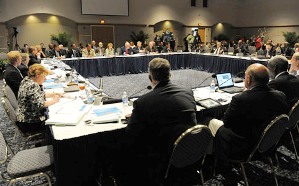
But Dr. Jan Ignash, Vice Chancellor of the State University System, says it’s the middle volume that could be the most interesting as the board meets at the University of Central Florida this week.
“The board is now in the middle stage of what our chancellor calls the three great books. The strategic plan sets the long-range system plan and includes goals for degree production, research and other measures out to the year 2025,” said Ignash. “The accountability report is the other book end.”
“But in the middle are these university work plans, and this is really unique. There are not many states that do this,” said Ignash. Continue Reading →
One section of the 4th grade exam had students measure volume change as ice melts. Seventy-one percent of those tested accurately measured the change in volume. But only 15 percent were able to back up their conclusion with data.
Officials with the National Assessment Governing Board, which oversees the NAEP, were concerned U.S. students struggled with more difficult problem-solving.
Austin Beaucage, 16, at his home in Key Largo, Fla. He doesn't want to go back to school after the summer break because he says there is too much school bullying.
Freshman Austin Beaucage has been picked on his whole life.
He’s small for his age and socially awkward.
But the bullying was never like last month at Coral Shores High School in Key Largo, Fla.
“Some senior locked me in a closet in my 6th period and he wouldn’t let me out,” he said.
“And I was banging on the door and then the other kids in the class were laughing.”
Austin, 16, speaks with his head down. His lips hardly move.
He says he was locked in the closet for most of the period.
According to his school district policy, this is not considered school bullying.
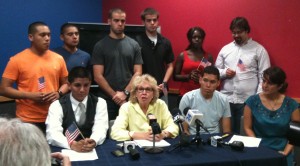
Activists Cheryl Little and several DREAM Act supporters held a press conference at Miami Dade College's Wolfson Campus on Friday.
Young immigrant rights activists in Miami are celebrating and breathing a sigh of relief.
President Barack Obama announced that undocumented young people in the U.S. will no longer have to fear deportation.
His executive order applies to immigrants under 30 who got here before they were 16 years old.
Immigration has long been a contentious and unresolved political issue in Washington, but to Jose Machado, an undocumented 17-year-old in Miami, this is about survival. Continue Reading →
Florida’s public schools rely heavily on parents to provide supplies and help with fundraisers. It turns out businesses also have crucial roles to play in providing resources for schools.
“Their pledge to student academic success through business partnerships embodies the fundamental relationship between education and the workforce,” said Education Commissioner Gerard Robinson. “As students prepare for post-secondary education and careers, the skills they learn today through these partnerships will ensure they are ready to compete for the jobs of tomorrow.”
Federal student loan rates will double on July 1 unless Congress strikes a deal to extend the lower rates.
Students enjoying a temporary reprieve in federal student loan rates know that the deal comes the an end July 1 — unless Congress can reach an agreement to extend the lower rates.
The Miami Herald has a nice rundown on who will see their rates jump to 6.8 percent from 3.4 percent and who won’t. The story also lays out the political challenges facing any Congressional deal.
The potential rate increase comes as students and families are increasingly finding college unaffordable, and the financial hits are coming from all directions: federal Pell grants can no longer be used for summer classes; state financial aid programs such as Florida’s Bright Futures scholarships have been scaled back; double-digit tuition increases have become the norm.
But not all undergraduates would be affected by the rate increase. Subsidized Stafford loans are awarded only to low-to-moderate income students, while unsubsidized loans (which anyone is eligible for) are already set at 6.8 percent, and so would not be affected by the July 1 deadline.
Anyone who took out a loan before July 1 — whether you’re still in school or have graduated — would also be unaffected, as student loan rates are fixed at the time you borrow.
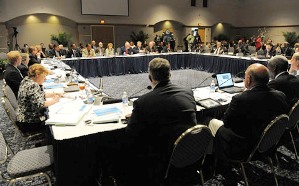
Over three days, the board will hear presentations about each public university’s work plan for the next three years — including their tuition requests.
The board will review applicants for openings on boards of trustees at Florida A&M University (1), New College of Florida (1), and the newly created Florida Polytechnic University (5).
Gov. Rick Scott will address the panel during an informal lunch on Tuesday in an ongoing effort to keep the peace between the Governor’s Office and the board. Continue Reading →
The vote is the strongest opposition yet to the FCAT and Florida’s accountability system to assure teachers, schools and districts are educating students.
StateImpact seeks to inform and engage local communities with broadcast and online news focused on how state government decisions affect your lives. Learn More »