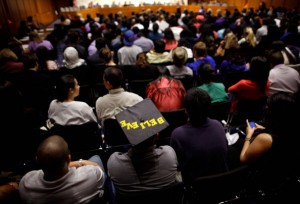
Teacher hold signs thanking former Gov. Charlie Crist for vetoing a bill that included pay-for-performance in 2010. The requirement is now state law and districts are beginning to implement plans.
The best Miami-Dade teachers could buy a new car with their bonuses this year while most of their colleagues may only be able to replace an alternator with their bonuses.
The difference in the size of those checks is an attempt to pay teachers based on their performance and that of their students, also known as merit pay, and part of a national experiment to answer a decades-old question: How can school districts motivate teachers to improve?
The experiment involves two issues: What’s the best way to determine which teachers are the most effective; and creating a new pay structure to reward good performance, encourage teachers to improve and draw top students into the field. Florida is one of a handful of states that have required districts to develop pay-for-performance programs, putting them in place by 2014.
A Boca Raton group said they will sue Gov. Rick Scott over how the state chooses its textbooks, according to the St. Petersburg Times.
“The group says the new textbook adoption process does not provide for enough time, readers or transparency relating to decisions on appropriate subject materials in schools.
“It is not possible for two people to review all the textbooks in Florida within a 4-month period of time,” the lawsuit reads, “and thus Senate Bill 2120 renders it impossible for the Defendants to provide high-quality education to all children in Florida as required by law.”
It is at least the eighth lawsuit naming Scott as a defendant since he took office this year. He signed SB 2120, a conforming education budget bill, into law on May 26. Citizens for National Security wants the law repealed and blames Scott for not vetoing the textbook provision.”
A Senate Judiciary Committee hearing on the DREAM Act
StateImpact Florida’s Monday story about the effect of new Bright Futures scholarship requirements on illegal immigrants or the children of illegal immigrants prompted a number of comments from readers asking why those students should get the lottery-funded scholarships — or any public benefits — at the expense of another student.
The story also spurred Juan, a 22-year-old illegal immigrant who lives in Broward County and will graduate college this fall, to contact us about the story because he too has received a Bright Futures scholarship. Juan said he was the only illegal immigrant he knew of receiving Bright Futures. He recorded an interview earlier today.
Juan’s family came from Venezuela on a visa, but missed a deadline for paperwork and lost their claim for citizenship. His case illustrates the complexities of immigration law, because at one point Juan was “living a normal life” with a driver’s license and other documents before losing those privileges.
Former Atlanta school chief Beverly Hall has a column in Education Week addressing her school district’s cheating on state tests. Her conclusion? Don’t blame the reforms.
“Should I have anticipated cheating, based on dramatic gains in test scores? With hindsight, I wish I had.
But there was every reason to believe that our dramatic restructuring would produce dramatic results, as it has. And those results continue to be confirmed by tests that have been independently administered and completed under the tightest security.
As awful as this cheating scandal is, it would be even more awful if we learned the wrong lesson from it. The culprit is not standardized testing or teacher accountability. We need both.”
Seven Florida colleges placed in the top 100 “Best Buys,” according to a Forbes list released this week, led by the University of Florida at 11, Florida State University at 13, New College of Florida at 16 and the University of North Florida at 19.
Those rankings could change, as the South Florida Sun-Sentinel notes, because lawmakers allowed colleges and universities to raise tuition by 15 percent a year until tuition reaches the national average.
Florida schools finished out of the top 100 in a separate Forbes ranking.
Yesterday’s story about a new requirement for the Florida Lottery-funded Bright Futures scholarship prompted a number of questions from readers, including how an illegal alien could get a scholarship in the first place?
Here are answers to some of those questions.
What has changed?
The new law changes two requirements for Bright Futures. First, students must now fill out the Free Application for Federal Student Aid, or FAFSA form, which can be a tedious task asking parents to submit their detailed financial information. The most common way to submit the form is online, and to do so requires a valid Social Security number.
The second change is that students must fill out the FAFSA every year in order to obtain their Bright Futures. In the past, students only had to prove their residency when the state initially awarded the scholarship, and then it was renewed if the students maintained their grades.
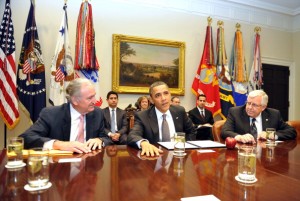
President Barack Obama meets with members of Congress in March to discuss renewing the No Child Left Behind education law.
Education groups have spent $47 million lobbying the federal government through the first half of 2011, according to Center for Responsive Politics research, as Congress and the federal education department try to decide how to deal with the long-overdue reauthorization of No Child Left Behind.
The group reports that $3 million more was spent on lobbying in the second quarter of 2011 than the first quarter. Among those paying for lobbyists, the National Education Association teacher’s union spent $3.6 million.
President Barack Obama (left), U.S. Education Secretary Arne Duncan (middle) and former Florida Gov. Jeb Bush (right) at a Miami rally in March.
Congress needs to reauthorize federal No Child Left Behind education standards, but President Barack Obama is growing tired of waiting.
Secretary of Education Arne Duncan said a month ago that the agency planned to issue waivers to exempt some states from NCLB requirements as many states claim a high percentage of their schools will fail to meet its goals.
Former Florida Gov. Jeb Bush is also weighing in — we told you about his Politico op-ed last week — arguing that districts that adopt reforms and show improvement should earn a federal waiver. Bush suggests a list of reforms very similar to those he pushed while governor and now known as the “Florida model:” A letter grade rating system; measuring teacher performance; and expanding school choice and online options.
A new law designed to collect more information on college students is having an unintended effect – it could prevent some undocumented students from receiving the state’s Bright Futures scholarship. And as Sarah Gonzalez of StateImpact Florida discovered, the new policy could also discourage U.S. citizens from applying for the merit-based scholarship.
StateImpact seeks to inform and engage local communities with broadcast and online news focused on how state government decisions affect your lives. Learn More »