Marie Cusick is a reporter with StateImpact Pennsylvania and WITF in Harrisburg. She joined WITF from Albany, New York where she worked as a multimedia reporter for WMHT. Her work was broadcast by public stations across New York as part of the Innovation Trail— a reporting collaborative between six stations. She appeared regularly on WMHT’s award-winning, statewide public affairs TV show, New York NOW. She also traveled throughout the state to cover some of New York’s biggest stories, including the devastation caused by Superstorm Sandy in New York City in 2012, the flooding from Tropical Storm Irene in the Catskills in 2011 and the debate in Albany over New York’s moratorium on hydrofracking. Marie was born and raised in Lancaster, Pennsylvania and has previously worked as a reporter and anchor for television stations in Lancaster and Casper, Wyoming. Marie holds a degree in political science and French from Lebanon Valley College.
Speaking this morning at the Energy Information Administration conference Washington D.C., newly confirmed Energy Secretary Ernest Moniz says his agency will move “expeditiously” to evaluate applications for more liquefied natural gas (LNG) export facilities.
The push to export comes as the industry has seen a boom in shale production. It’s produced a glut of gas that has depressed prices in the U.S., while prices overseas remain high.
Janet and Richard Geiger are Chesapeake leaseholders who claim the company has taken advantage of them by underpaying royalties.
It’s not easy to find Mary Jane Foelster’s home.
“We wanted the peace and quiet,” she says. “It’s just wonderful out here.”
Her home sits on 50 acres tucked away down a 1.7 mile dirt road in Bradford County. It’s as far north as you can go in Pennsylvania before crossing the border into New York.
The property is surrounded by forested hills. There’s a pond and a vegetable garden in the yard.
When she and her husband retired here from Philadelphia five years ago, they didn’t realize the property had a gas lease. They also didn’t know there was a gas well on the other side of their hill, nor did they notice when it was drilled and fracked.
But Foelster says she did begin to notice when the royalty checks started coming in from Chesapeake. There was something missing.
Money was being taken out for what Chesapeake called post-production costs –expenses it incurred getting the gas from her well to the market.
She was confused.
“There’s never a clear delineation of what those costs are. I couldn’t begin to tell you what they are.”
After numerous attempts, she finally got a Chesapeake representative on the phone and asked him to explain.
“He really couldn’t tell me why,” she says, “But I can tell you why. Chesapeake is doing whatever they think they can get away with.”
Chesapeake is the biggest natural gas producer in Pennsylvania and the second largest in the nation. But recently it’s faced financial troubles amid low natural gas prices.
Former DCNR Secretary Richard Allan at a meeting in Williamsport last week regarding expanding gas drilling in the Loyalsock State Forest.
Governor Tom Corbett says his secretary of the Department of Conservation and Natural Resources (DCNR) has resigned at his request, but the reasons for the change were not immediately disclosed.
Allan has led the agency since shortly after the first-term Republican governor took office in early 2011.
DCNR has come under increasing public scrutiny over plans to expand natural gas drilling in the Loyalsock State Forest. Allan was confronted by more than 400 opponents of the proposal at a contentious public meeting in Williamsport last week.
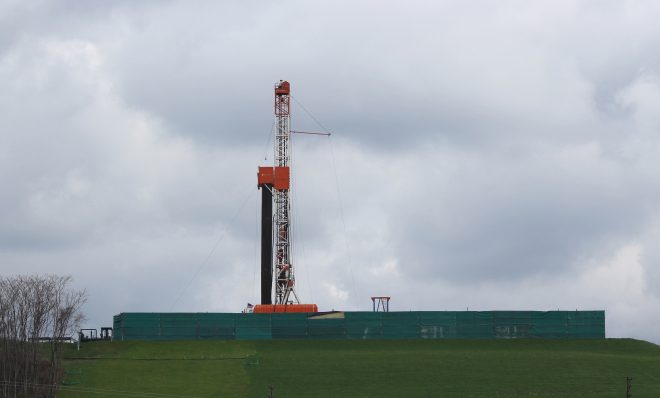
An oil rig in Ohio. Flowserve provides pumps, valves, seals and automation services to oil, gas and chemical companies in more than 70 countries.
Governor Corbett’s office announced today an out-of-state manufacturer of oil and gas industry equipment will relocate part of its operations from New Jersey to Hanover Township in Northampton County.
Texas-based Flowserve Corporation is a global manufacturer and supplier of pumps, valves, and seals for the oil, gas and chemical industry. The new facility is expected to create 124 jobs over the next three years, according to the governor’s office.
“Flowserve is a great example of a company relocating to Pennsylvania to be closer to clients and benefit from the state’s pro-business climate and excellent quality of life,” said Corbett in a statement.
Bloomberg reports Chevron CEO John Watson says the oil and gas industry needs to meet “high” public expectations related to hydraulic fracturing.
Watson was speaking at event in Washington D.C. at the Center for Strategic and International Studies, according to Bloomberg:
“Public expectations are very high, and there’s no reason they shouldn’t be high,” Watson said. “There are some risks out there. Some risks are overstated. But we have to engage them either way.”
As StateImpact reported, Chevron has joined the Center for Sustainable Shale Development –a Pittsburgh-based coalition of environmental groups, philanthropic foundations and energy companies which has developed a set of 15 voluntary performance standards for drillers.
The Pittsburgh Post-Gazette reports residents in Fayette County are concerned state and federal regulators are allowing a company mapping the Marcellus Shale formation to detonate explosives near homes and outside an approved seismic testing area.
According to the Post-Gazette, the company CGGVeritas Land Inc. is collecting geological information for Chevron and has detonated 10 out of 131 underground explosives it installed without authorization.
Bloomberg reports on how confidentiality agreements with landowners across the country have helped protect drilling companies from bad publicity and allegations of pollution.
The Hallowich family sued gas drillers after they said drilling activity near their home outside Pittsburgh made their children sick. The case was eventually settled for $750,000, but the family signed a strict gag order.
The Hallowiches aren’t alone. In cases from Wyoming to Arkansas, Pennsylvania to Texas, drillers have agreed to cash settlements or property buyouts with people who say hydraulic fracturing, also known as fracking, ruined their water, according to a review by Bloomberg News of hundreds of regulatory and legal filings. In most cases homeowners must agree to keep quiet.
The strategy keeps data from regulators, policymakers, the news media and health researchers, and makes it difficult to challenge the industry’s claim that fracking has never tainted anyone’s water.
Governor Corbett speaks with ACF President James Bowles while touring the company's rail car manufacturing plant in Milton.
While touring the ACF Industries rail car manufacturing plant today in Milton, Northumberland County, Governor Corbett faced questions about whether campaign contributions and political influence factor into decisions about which companies he comes to visit.
He says they don’t.
“We don’t go to places just because we may or may not have gotten a campaign contribution,” Corbett told reporters.
The issue came up in the wake of an investigation into another Milton company Corbett toured in 2012. Minuteman Environmental Services was raided by federal and state officials last week. It’s owner Brian Bolus has given $10,000 to Corbett’s campaigns.
The company hauls waste and equipment for the natural gas industry, although the nature of the investigation remains unclear.Minuteman has denied any wrongdoing.
Corbett says his staff thoroughly vets companies.
“We came to [ACF Industries] because this is clearly what we’ve been talking about. Trying to grow the economy, let the private sector come back.”
DCNR estimates between 400 to 500 people turned out tonight to Lycoming College in Williamsport. The meeting ran an hour over its scheduled time slot, due to the number of people who wanted to comment.
Everyone who spoke expressed either concern or opposition to the proposal, which involves 26 well pads, and four compressor stations over a 25,000 acre swath of state forest, known as the Clarence Moore lands.
Although the Commonwealth controls the surface rights on about 18,000 acres, Anadarko Petroleum, along with Southwestern Energy Corporation, can exercise surface control on about 7,000 acres in the Loyalsock. Some of that land is considered the most sensitive. Some opponents want DCNR to use their control over the 18,000 acres as leverage to keep Anadarko off the most sensitive parts of the forest.
Despite the public opposition, DCNR Secretary Richard Allan says his hands are tied.
StateImpact seeks to inform and engage local communities with broadcast and online news focused on how state government decisions affect your lives. Learn More »