County Commissioners Shift Stance, Now Support Corbett Impact Fee
-
Scott Detrow

Scott Detrow / StateImpact Pennsylvania
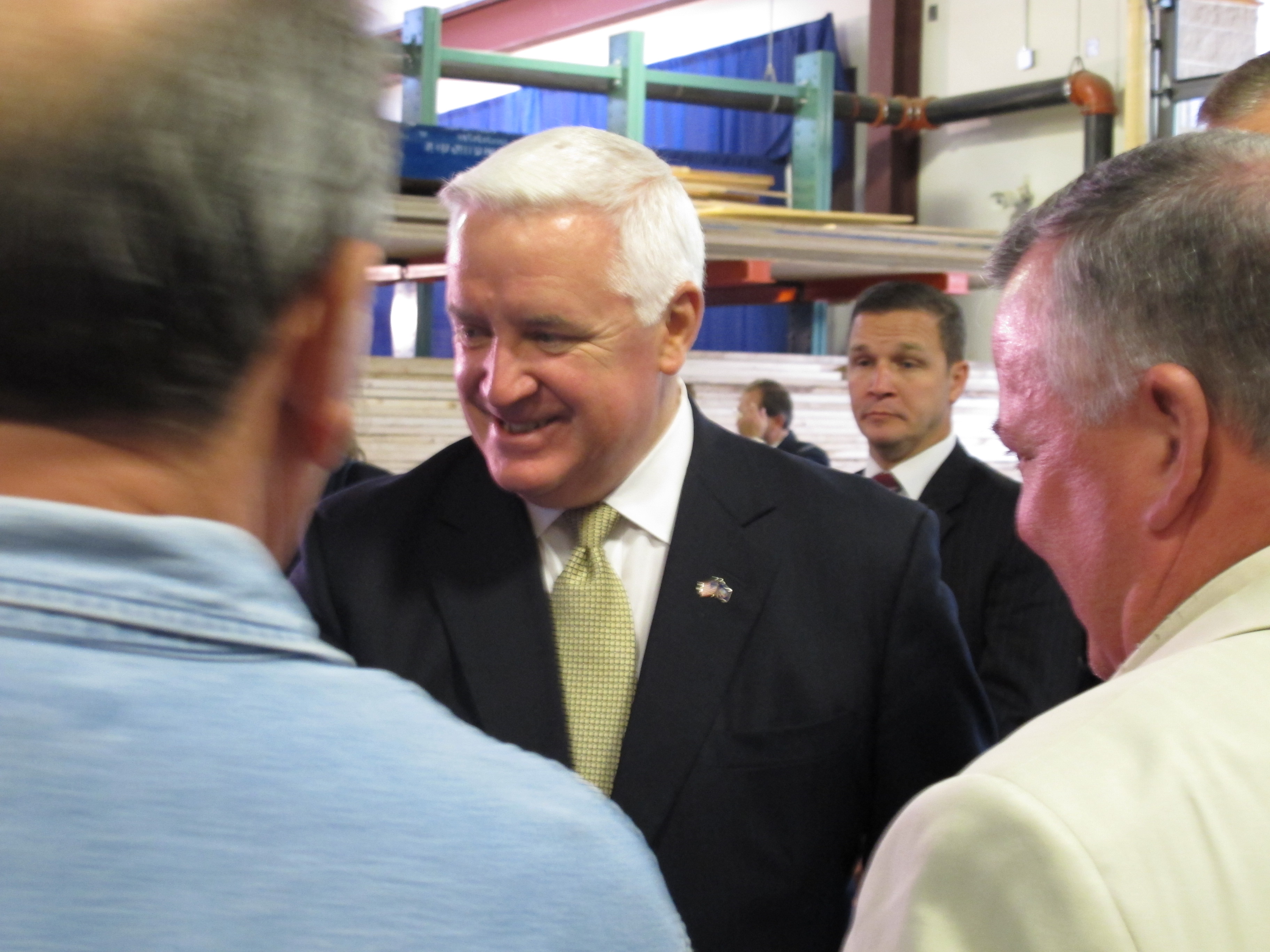
Governor Corbett introduced his impact fee earlier this month, in Pittsburgh
Here’s a sign Governor Corbett’s proposed natural gas impact fee is gaining momentum: the County Commissioners Association of Pennsylvania, which previously expressed “strong reservations” about the proposal, is now backing it.
Executive Director Doug Hill says the shift comes after numerous discussions with two of Corbett’s Marcellus Shale point men, Lieutenant Governor Jim Cawley and Energy Executive Patrick Henderson.
CCAP has aggressively pushed for an impact fee, but balked at Corbett’s plan to administer and collect it on the county level. Hill said members were worried the process would add more demands to already-stretched county tax collectors and administrators. He had also expressed concern counties would impose different levies, and create an economic “border war” of sorts, where drillers would flock to areas with lower fees.
How much money would Corbett’s fee generate for each county? Click on StateImpact’s interactive map to find out.
The potential for a county-to-county disparity still remains, but Hill said Cawley and Henderson assured CCAP that counties would not need to develop the distribution formulas for their municipalities, or be charged with enforcing the municipal-level fee spending. “The bottom line is, our responsibility with municipalities ends with us distributing the funds to them,” said Hill. Statewide data reported to the Department of Environmental Protection would form the basis for fee distribution formulas, he said.
One remaining CCAP concern: the fact counties may not see any impact fee revenue until 2013, at the earliest. “If the legislature acts, let’s say in November, that is not enough time for counties to adopt [an ordinance] by December 31,” said Hill. “Which, if you read the bill, is the trigger for the following year’s levy.” One possible solution: language stipulating the fee would be collected in, say, June, of the first year, and then March 1 afterwards. That would give counties the extra wiggle room to debate and pass local-level fees.
What happens next? Legislative staffers tell StateImpact Senate leaders from both parties are working to turn the Corbett Administration’s outlines into legislative form, and a new bill could surface next week.
Editor's Picks
PARTNERS



FUNDERS



Climate Solutions partners