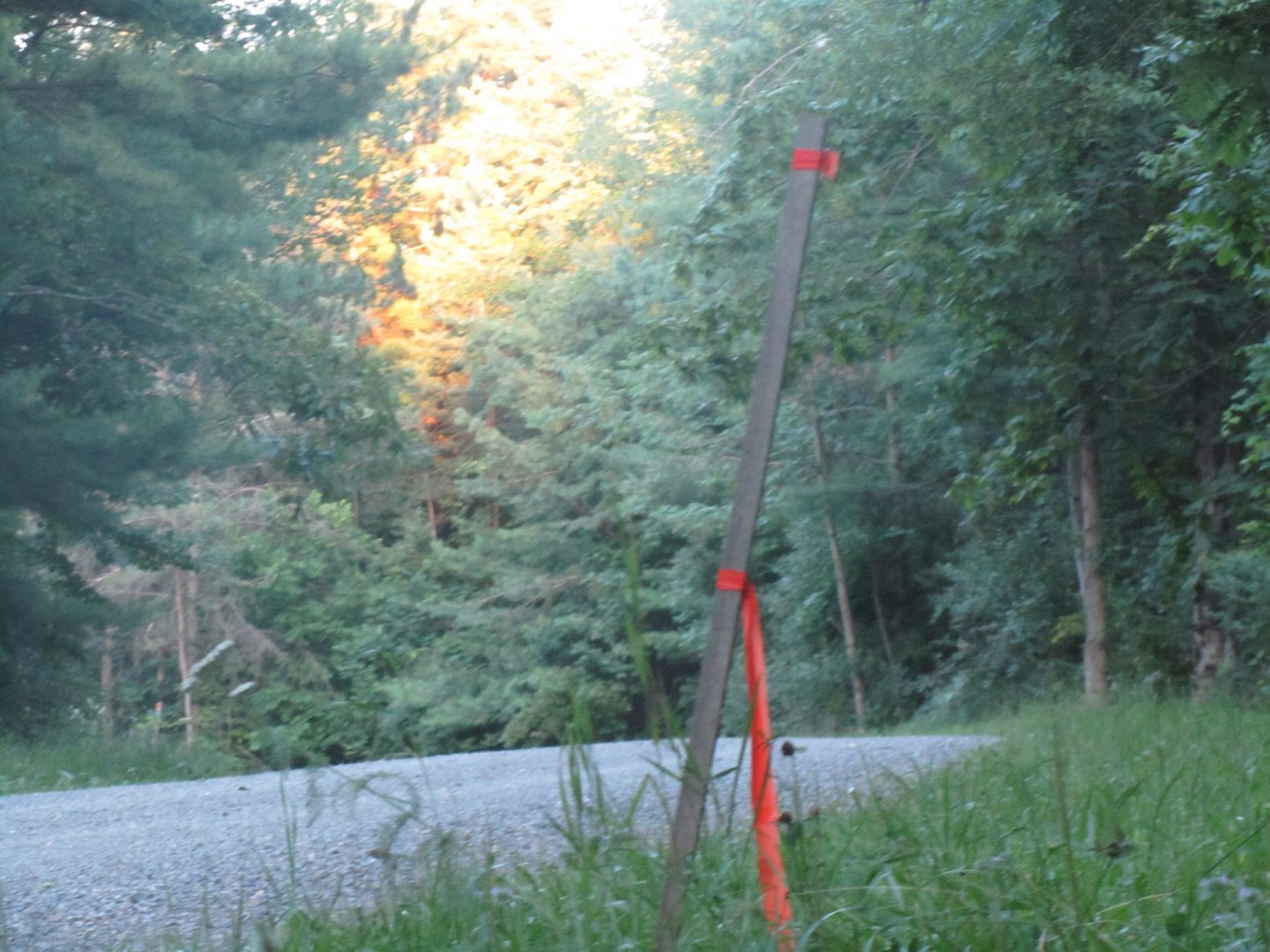
A marker indicates the location of where the proposed Marc 1 Hub pipeline will be built in Lycoming County, PA.
Kim Paynter / WHYY/Newsworks.org

A marker indicates the location of where the proposed Marc 1 Hub pipeline will be built in Lycoming County, PA.
Kim Paynter / WHYY/Newsworks.org
Kim Paynter / WHYY/Newsworks.org
A marker indicates the location of where the proposed Marc 1 Hub pipeline will be built in Lycoming County, PA.
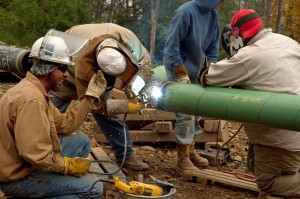
Crews weld a new pipeline in the Loyalsock State Forest.
With the explosion of a major natural gas pipeline in West Virginia this week, it begs the question on where things stand in Pennsylvania. The state’s natural gas boom won’t be much of one unless gas companies can get the gas to market. Natural gas travels through underground pipelines that criss-cross the United States. Some are large, interstate pipelines. Others are smaller lines that go from the well head to what’s called a “gathering line.” And then the gathering lines take the gas to transmission lines. Compressor stations are needed at points along the larger pipelines to pressurize the gas and make it move.
A new web of pipelines in Pennsylvania are in the process of getting built to transport the gas. The new pipeline construction will benefit those in need of jobs, and the companies that do the building. But some residents and local politicians worry about the environmental impacts, and say the current regulatory structure needs updating. The Corbett Administration published a report on the state’s pipelines this week with 16 recommendations to improve regulations. Here’s what you need to know about pipelines in Pennsylvania today:
How many miles of underground natural gas pipelines exist in Pennsylvania?
Nobody knows. That’s because Pennsylvania does not have one regulatory authority that oversees intrastate gas pipelines. In fact, out of 31 states that produce natural gas, Alaska is the only other state, besides Pennsylvania, that doesn’t. Here’s what we do know about pipeline mileage. Pennsylvania’s Public Utility Commission does inspect about 46,000 miles of pipelines that are categorized as public utilities. That means those pipelines deliver gas directly to a consumer, heating their home or allowing them to cook. The PUC has eight inspectors who enforce both state and federal regulations.The federal government, through the Department of Transportation, regulates the interstate pipeline system. Those are the pipelines that travel across state boundaries. One example would be the Transcontinental, or Transco, pipeline that travels from south Texas to the major east coast markets of New Jersey and New York City. More than 55,000 miles of interstate pipelines travel through Pennsylvania. Some counties in Pennsylvania have taken it upon themselves to figure out where pipelines cross beneath their land. Bradford County Planning Commission estimates that its county has about 500 miles of natural gas pipelines and has actually mapped those lines.
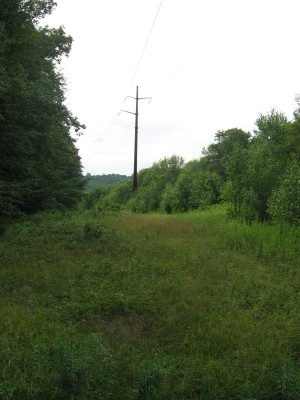
Susan Phillips / WHYY/Newsworks.org
The interstate Tennessee pipeline runs through Wayne County, Pa. with gas on its way to New Jersey and New York.org
So who inspects all of these unknown miles of pipeline?
In some cases, nobody.
How many new miles of pipelines need to be built to transport the Marcellus Shale gas to markets?
Nobody knows that either. And here’s the problem. The state’s current network of pipelines is not equipped to carry the volume of shale gas with the necessary pressure to get it to market. The new pipelines will have to be larger in diameter. That means, if they go through forested areas, a clear cut of between 70 to 130 feet wide is needed to lay the pipe and keep it available for maintenance. The Pennsylvania Chapter of the Nature Conservancy estimates that between 10,000 to 23,000 new miles of pipeline will be needed to transport the Marcellus Shale gas yield.

Kim Paynter / WHYY/Newsworks.org
A marker indicates the location of where the proposed Marc 1 Hub pipeline will be built in Lycoming County, PA.org
So, can companies just lay pipelines wherever they want?
Not really. First, rights of way needed to be secured from private and public landowners. The companies pay for those rights of way. Then permits are needed. But a confusing network of regulatory bodies handles the permitting process. The Federal Energy Regulatory Commission has to approve any interstate pipeline. The Public Utilities Commission has to approve any that serve consumers directly. But few of the new gas lines connected to Marcellus Shale drilling fall neatly into either of those categories.
The proposed Marc 1 Hub pipeline that will run through Lycoming, Sullivan and Bradford counties continues up into New York. So it’s an interstate line and falls within the jurisdiction of FERC. But thousands of miles of gathering lines, which take the gas from the wellhead to the transmission lines, are in the gray area. They do need permits if they run through wetlands or cross waterways, and those permits come from yet another agency, the Pennsylvania Department of Environmental Protection, and the U.S. Army Corps of Engineers. All lines need sediment and erosion permits from the DEP, and the DEP has oversight if the pipelines cross through areas with endangered or rare species.
Sometimes county, or local, level regulations come into play, but not always. Pennsylvania’s new drilling law, ACT 13, restricted local governments from implementing zoning rules for natural gas development, including pipelines. But that provision is still tied up in the courts.
Who owns and operates these pipelines?
Private companies own and operate the pipelines. Sometimes a natural gas company has a subsidiary, referred to as a “mid-stream” company, that builds pipelines. But sometimes, the pipelines are built by companies that don’t actually do any drilling; they just own and operate pipelines and lease them to gas companies. Think of it like a toll road.
Do the companies who own and operate the pipelines pay a specific tax associated with the rights of way and transportation of the gas?
No.
Do any of the impact fee proposals include pipeline companies?
No.

Kim Paynter / WHYY/Newsworks.org
A new gathering pipeline cuts through a forest in Lycoming County, Pa.org
Who likes pipelines?
Deer, elk and snowmobilers love pipelines! Miles of clear cut paths through forests make good travel routes and sources of food for grazing animals. But environmentalists worry that too many pipelines will create what’s called an “edge effect.” That means some species such as interior forest birds, amphibians, and certain wild flowers, which like staying under the canopy, will see their habitat diminished.