Commission Report Sets The Stage For Fall Impact Fee Debate
Scott Detrow / StateImpact Pennsylvania
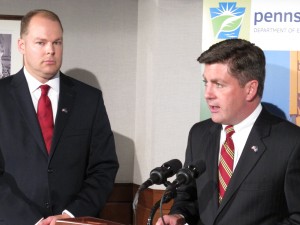
Jim Cawley and Patrick Henderson speak to reporters after a July commission meeting
Governor Corbett’s Marcellus Shale Advisory Commission is recommending an impact fee on drillers, to compensate local government for the strain on services caused by Pennsylvania’s natural gas drilling boom.
Legislative reaction to the report’s language has been muted, at best. Many lawmakers say the suggestion doesn’t go far enough.
(Read the full report here.)
Still, the document will likely play a major role in whether or not an impact fee becomes law this year.
The report is 137 pages. It’s divided into ten sections, with 39 sub-sections, and most importantly, 96 recommendations for new laws, regulations, or approaches to drilling.
And it landed in the General Assembly with a thud.
You’d think the reception would have been different.
A growing number of lawmakers from both parties are desperate to pass some sort of tax or fee on natural gas drillers, and the commission’s green light was seen as the final hurdle to getting a bill passed.
But the report’s impact fee language had most fee supporters rolling their eyes.
They’re voicing two big problems. The first, as Senate Democrat John Yudichak explained, was the commission’s recommendation fee revenue stay within communities hosting drillers, instead of going into any statewide funds aimed at protecting the environment or cleaning up waterways. “That cannot be effective at all,” he said. “I don’t think it’s practical. I don’t think it recognizes reality on the ground. And I don’t think it’s possible that that can get past the General Assembly.”
And members of both parties scratched their heads at this line: “Any fee should include a correlation between the amount of the fee and costs incurred.”
“How do you quantify a stream that is going to be polluted, but we’re not going to find out about it for 20 years? How do you quantify that?” asked Yudichak.
But like it or not, lawmakers will need to work within the commission’s parameters.
That’s because Governor Corbett – the guy who signs the bills into law – has been clear he’ll heed the panel’s recommendations, on whether or not to support a fee.
Corbett has been steadfast in that mindset. He singlehandedly stopped a fee bill from moving through the legislature in June, by threating to veto any fee that reached his desk before the report came out.
And the governor is against a broader tax. He doesn’t want to slow down the growth of an industry putting people back to work, as he explained during an April speech. “ Those are people back on the employment rolls,” he said during an appearance before the State Township Supervisors Association. “Those are people that, if they were on welfare they can be off welfare now. That we won’t be spending tax dollars on. Those are people that have salaries that will pay income taxes. That will go and buy goods, and pay sales taxes. And the people who sell them the goods now have jobs that are growing.”
Corbett is also determined to keep his “no new taxes” pledge. The difference between a tax and fee is in the eye of the beholder, but Corbett’s staffers have warned they’d consider a bill sending money to the state government a violation of the promise.
We’ll have to wait a bit longer to hear Corbett’s reaction. Advisors say he won’t publicly weigh in on the report until August, at the earliest. The administration will spend the next few weeks digesting the report and mapping out its shale strategy.
A growing number of Republican political strategists now see some sort of impact fee as inevitable, given the fact 7 in 10 voters are in favor of a levy.
Senate Republican leaders are eager to pass a bill by year’s end. Their House counterparts are vague on the issue, but a growing number of their rank-and-file members want to get a measure passed.
The GOP can’t expect much help from Democrats who don’t represent drilling districts. The minority party’s leaders want to keep pushing for a broader tax, and then make the lack of a levy a major campaign issue, especially in light of this year’s billion dollar budget cuts.
August is the slowest month of the year for the General Assembly, and lawmakers won’t return to Harrisburg until September. But when the House and Senate reconvene this fall, you can expect the impact fee debate to be front and center.
Editor's Picks
PARTNERS



FUNDERS



Climate Solutions partners