Cain’s 9-9-9 Touches Third Rail Of New Hampshire Tax Policy
Scott Olson / Getty Images
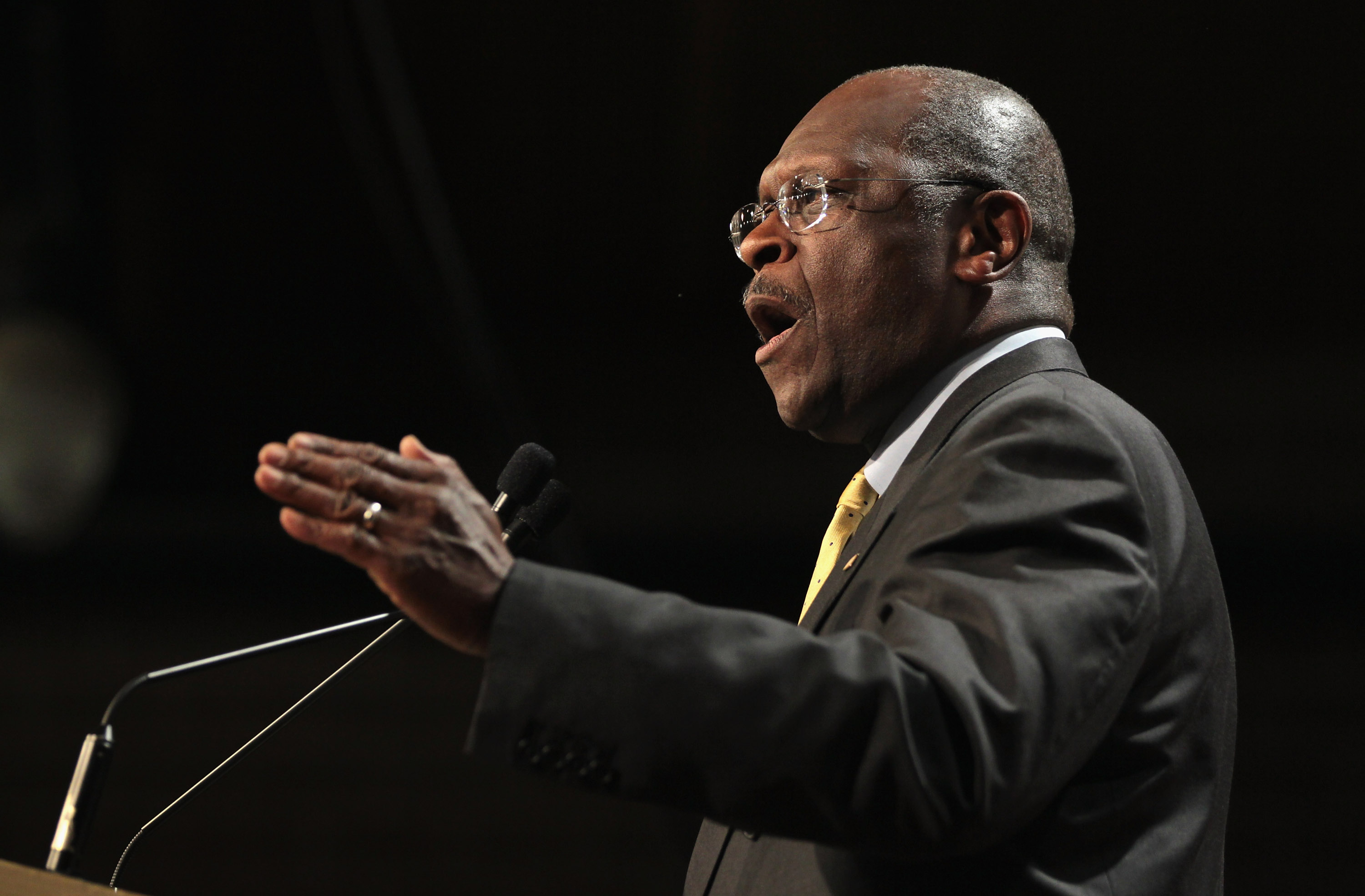
Herman Cain's 9-9-9 plan has made him an unforeseen contender for the presidency. But how does the plan play in New Hampshire, a state known for its libertarian values and unorthodox tax structure?
The attractiveness and simplicity, of Herman Cain’s 9-9-9 plan — a nine percent federal income, corporate and sales tax — has catapulted the Georgia businessman to the head of the Republican presidential field. But for some states, 9-9-9 wouldn’t be simple at all. A handful of states—including the first-in-the-nation primary state of New Hampshire—don’t have a sales tax. So what would a federal sales tax do to the New Hampshire economy?
Pitching 9-9-9 In The “Live Free Or Die” State
Here’s a key point to remember: People in New Hampshire, to put it mildly, dislike taxes. Just ask Andy Smith, the director of the Survey Center at the University of New Hampshire, and—among other things—he studies how the state’s residents feel about taxes.
“New Hampshire is definitely an anti-tax state.”
That’s because New Hampshire is one of two states in the country that doesn’t have a broad-based income tax or a sales tax. (The other one’s Alaska.) And his polling shows a lot of people here like it that way.
“New Hampshire is a state that prides itself on having limited government and independence of individual people. And I think a sales tax is seen then as a way to grow government, and it’s something that will inevitably grow,” Smith said.
In fact, if you’re running for office here, you can expect to be asked if you support a general income or sales tax. Your answer could make or break your candidacy. So when a Republican presidential candidate like Herman Cain comes into New Hampshire for a debate and starts talking taxes … it’s a big deal.
“Continuing to pivot off the current tax code is not going to boost this economy,” Cain said at the Dartmouth College debate earlier this month. “This is why we developed 9-9-9—9 percent corporate business flat tax, 9 percent personal income flat tax, and a 9 percent national sales tax.”
This plan has helped move Cain from long shot to top-tier candidate. But while he now leads many surveys, including a New York Times/CBS News poll out this week, he has also made himself a target. At a recent debate held in Las Vegas, one of his rivals, Texas Governor Rick Perry, suggested that his plan might not sell so well in the Granite State.
“Go to New Hampshire, where they don’t have a sales tax, and you’re fixing to give them one,” he said.
For decades, the New Hampshire economy has relied on its tax-free status to draw retail sales from out-of-staters, people from Maine and Vermont and Massachusetts — all living in states with a sales tax. For example, the state Liquor Commission estimates about half of all sales are to people outside New Hampshire.
What Could A Federal Sales Tax Mean? Depends On Whom You Ask

Amanda Loder/StateImpact New Hampshire
Michelle Lienhart, owner of The Just Be Boutique in Concord, says she still has some reading to do about the 9-9-9 plan...but it's intriguing.
So what would happen if retailers here suddenly had to deal with a federal sales tax?
Julie — she only wanted to give her first name — works at a downtown Concord gallery and frame shop, “I don’t think it’s a good idea, as far as we’re concerned, anyways. It seems like we’ll be getting taxed a lot extra.”
More pleasing to the Cain campaign was this response from Michelle Lienhart, owner of The Just Be Boutique in Concord, “I’m not sure how I feel about the nationwide sales tax…but I’ve heard that we pay a portion of that in the other taxes we pay, so if we’re not paying certain other taxes, it would kind of all wash itself out.”
Lienhart might even want to contact the Cain campaign here and let them know how she feels … if she could find them.
Herman Cain’s Near-Invisible Campaign
Herman Cain For President
If you want to contact the Cain campaign...his website's not the way to do it.
There’s no New Hampshire phone number listed on Cain’s website.There’s an online form for media to send email inquiries. But it’s broken.There’s also a general voter inquiry form. It works—but we haven’t heard back. We sent a Twitter message to @Cain Press—an active Tweeter—and got no response. On the face of it, this seems like an unusual situation for a leading presidential candidate to be in, given the primary is just two and a half months away. Former state GOP chair Steve Duprey is philosophical about it.
“I think what you’re finding,” Duprey says, “when you look at his website and you try to get in touch is, he has a very miniscule organization. He’s running, basically, as a one-man band. If the surge he’s experienced in popularity, recently, in the national polls translates into money, he’ll quickly grow an organization.”
And when can voters here expect to see him?
“He had the bad luck to have his book come out right during this cycle right when he sort of caught a wave, if you will, in popularity. And he’s on book tours all over the country, which do help his national name recognition, but probably don’t help him right here in New Hampshire.”
Charlie Spano, a political operative from Pennsylvania, is heading up Cain’s New Hampshire operation, which at this point consists of a small handful of staffers, about 60 volunteers, working out of an office in Manchester. Spano insists the 9-9-9 plan wouldn’t impose a tax on New Hampshire, because it would lower various federal taxes manufacturers, distributors, and retailers.
“All those taxes that are federally imposed will go away.” Spano says, “They will be replaced by the nine percent tax, which will be levied at the point of sale, and will be invisible to the consumer. It is not, will not be, and was never designed to be, an add-on the in the classic sense, of a sales tax.”
Why Cain Says You Wouldn’t Notice A Sales Tax

Michael Randall / Flickr
Cain's arguing that the price you pay for everyday items--like pens--has a higher tax built-in to their cost than the nine percent federal sales tax he's proposing.
You know how when you buy an item, like a pack of pens, there’s something printed on it, like “MSRP $1.00?” That’s the Manufacturer’s Suggested Retail Price. And the taxes the manufacturer pays to the federal government right now? They’re embedded in that MSRP. You pay the tax when you spend the dollar for the pens. It doesn’t matter if you live in New Hampshire or Massachusetts. You’re paying that tax. What Cain’s arguing is that if you lower a manufacturer’s tax to nine percent from where it currently is—let’s say 22 percent—that one dollar MSRP? You pay 13 cents less, because the manufacturer only has to pass on a nine cent tax to you, instead of 22 cents. Your dollar pack of pens is now 87 cents.
But what’s to keep a manufacturer from just pocketing that 13 cent difference, keeping the MSRP for your pens at one-dollar, and making retailers in New Hampshire tack on a nine-percent federal sales tax?
Charlie Spano is not worried.
“What is far more likely to occur based on the analysis done for the 9-9-9 plan, is that competitive market pressure will drive down the price. Other pen manufacturers may say, we could sell more ink pens if we cut our price. Because we’re not paying 22 percent on average, we’re now only paying nine. Let’s cut our price 10 percent. Suddenly, they’re underselling other pen manufacturers.”
Spano insists that, in the end, everyone should be trusting the market. But not all free marketeers agree.
Dissent In The Free Market Crowd
Charlie Arlinghaus is President of the Josiah Bartlett Center for Public Policy, a New Hampshire-based free market think tank. He’s skeptical of how 9-9-9 would work in the state.
“The proponents always tell you this tax replaces that tax, and we’re changing this and we’re all going to come out better because of this,” Arlinghaus says. “Imposing a sales tax, when so much of our retail sector is based upon the fact that we have no sales tax, and other states have some sales tax: There’s a psychological advantage. If you eliminate that, where people have to just be concerned about the rate, well, it’s two points, four points, five points higher, you eliminate some of the psychological attraction of retail sales in New Hampshire.”
Clearly, New Hampshire’s quirky tax structure is an issue for the Cain campaign in the state.
Mixed News For “The Hermanator”
But there is good news for the Cain campaign: He’s currently polling second in the state to Mitt Romney.
The bad news?
He’s trailing by 29 points.
But, as Bill Clinton and George W. Bush could tell him, you could still lose the New Hampshire primary and go on to win the nomination … and even the presidency.