Molly Messick was StateImpact Idaho's broadcast reporter until May 2013. Prior to joining StateImpact and Boise State Public Radio, she was a reporter and host for Wyoming Public Radio. She is a graduate of Columbia University Graduate School of Journalism.
After several weeks of reporting on the Idaho housing market, it’s impossible not to notice just how many of the people who have lost their homes in the downturn are real estate agents and builders, or do other kinds of work related to housing. In our first broadcast story, for example, we met Carmel Crock, a realtor who lives in Boise. In the midst of the boom, she made financial decisions that counted on the housing market’s continued strength. She refinanced her home in the expectation that her income would keep rising, allowing her to manage a higher monthly payment.
David McNew / Getty Images News
New home construction stalled at this California development in 2008.
Crock says when her income fell and she found herself in the middle of a financial mess, she wasn’t on her own. Many people she knew professionally were also having to figure out how to negotiate short sales. “Unfortunately, I had realtor friends, long-time acquaintances, builders who were going through the same thing,” she says. “None of us were doing this alone.” Continue Reading →
Ben and Lori Jensen of Meridian say they were stunned to receive a lawsuit from their bank months after they lost their home to foreclosure.
Month in and month out, Idaho’s foreclosure rate remains one of the highest in the nation. For many, losing a home is the definition of hitting bottom. But some former homeowners are finding themselves in an even tighter spot than they thought possible. They’ve lost their homes and wrecked their credit ratings. Now lenders are pursuing them for the debt that remains.
The day Ben Jensen found out that he and his wife, Lori, were being sued for more than $140,000 is fixed in his mind, like the slow-motion moments before a car crash. It was a weekday afternoon, and he’d just come home from work. “My wife and I were standing in the kitchen talking,” he remembers. “There was a knock at the door, she went to get it. And as she was walking back she had a really perplexed look on her face.”
RealtyTrac, a company that tracks foreclosures nationwide, released September data today. In Idaho, the total number of foreclosures dropped from August to September, from 1,860 to 1,654. The state had the seventh highest foreclosure rate in the nation in September, with one out of every 391 housing units receiving a foreclosure filing. A map of foreclosure rates by county is available here.
A comparison of this year’s third quarter numbers to the third quarter of 2010 yields somewhat sunnier news for the state and the nation. In Idaho, the total number of foreclosure filings decreased by nearly 42 percent over that period, compared to 34 percent nationally. However, a RealtyTrac analyst predicts that foreclosure activity will begin to pick up again, as banks work through the raft of poorly filed foreclosures that resulted from so-called robo-signing.
Source: RealtyTrac
By most estimates, it will be at least several years before the foreclosure crisis abates, nationally and in Idaho. But local organizations that provide foreclosure prevention counseling services say they could run desperately short on funding as soon as January. That’s because the greatest share of support for such services comes from grants funded with federal dollars, and because Congress continues to struggle over the 2012 budget, for the fiscal year that began October 1st. Moreover, Department of Housing and Urban Development funds for counseling services were zeroed out in fiscal year 2011. Continue Reading →
Idaho has the unwelcome distinction of having one of the highest foreclosure rates in the nation. Nearly 2,000 Idaho homeowners lose their homes each month, according to RealtyTrac’s count of foreclosure filings. But that’s not the whole story. Even as many homeowners work their way through foreclosure, low prices draw new buyers in. It’s a cycle of dreams lost and dreams gained.
Not long ago, Carmel Crock made a drive that she had avoided for much of the last year. She turned onto a steep road that winds into the hills above Boise, past homes she knows well. “This is Jenny and Ray’s house,” she said. “I watched Ian be born, and I’ve known Corey since he was teeny tiny. And this house, the second one on the corner, is my house. Was my house.”
Molly Messick / StateImpact Idaho
Carmel Crock, in the backyard of her new home. Since her move, she has been trying to make the new house feel like a home by planting flowers and a small vegetable garden.
It’s a simple 1960s ranch, white with green trim. Crock says it was the sunset views and the peacefulness of this spot above the city that made her and and her husband, Ken Harris, want to live here. At night they could hear foxes barking, and wild turkeys calling to one another. “And quail!” she said. She and Harris used to joke to one another, complaining about the noise. “That was our laughter lying in bed with the windows open! A cacophony of wildlife.” Continue Reading →
As many as 300 people showed up at the state capitol today for a protest march called Occupy Boise. The event was one of many across the country inspired by ongoing protests on Wall Street. Most demonstrators in Boise said they’re concerned about the economy and the distribution of wealth in the U.S.
Here is what a few of them had to say:
Nicholas Coutts is a 23-year-old retail clerk in Boise, ID “I’m frustrated. I don’t know what to do. I grew up in this country and I love it very much, but there’s some problems… I went to college for three years, couldn’t afford it. I’m halfway through a degree. I’m working at a retail store for minimum wage. Any chance to go back to college would just result in more debt, and from what I’ve been seeing people who’ve been graduating haven’t been getting jobs. I don’t know if it’s worth it.”
Lana Levy is a 64-year-old woman living in Boise, ID. “We need to unify as Americans, come together, work together, and not keep fighting each other… I grew up in the 60s, but I really wasn’t involved in that very much. I just lived my life and grew up. My perception is that it’s time for those of us who didn’t finish that job then to come back in and keep it going now, along with the young folks who are starting to get engaged.”
Kit Knox is a 55-year-old woman living in Boise, ID. “I would hope that by this movement spreading, politicians will begin to see that there are a lot of people who are feeling that they don’t have a voice. I have young grandchildren. I have elderly parents. I myself am aging. And I would like there to be some hope for us, and I don’t think people have any right now.”
Jerry Means is a 63-year-old retired plumber from Nampa, ID. “I’m not asking for any more than to help get our American families back to work. I personally am fortunate enough that I got to retire, but all my children – everybody in America – needs a job again. It’s very depressing to sit at home and not be able to provide for your family.”
Jennifer McCarter is a janitor in Boise, ID. “A couple of weeks ago, I heard what they were doing in New York, and I thought, “Finally.” Finally people are getting together, and saying, “Enough.” It’s like everybody’s waking up across the country.”
Similar protests and gatherings have already occurred across the northwest, and more are planned for communities in Idaho, Montana, Oregon and Washington.
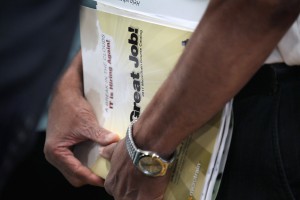
A job seeker clutches a training program catalog at a job fair in Illinois this month.
As this article and others have explained in recent days, many states are struggling to repay the federal government for loans it made to help cover unemployment benefits as joblessness surged during the recession.
“More than 30 states have had to borrow billions from a federal fund to cover unemployment benefits for their jobless residents in recent years.” – CNN Money
More than $1 billion in interest is due to the federal government by tomorrow. The Idaho Department of Labor says the state’s share of those interest payments — $5.5 million — has already been sent. “We paid it on Monday,” said spokesman Bob Fick.
The state also paid off the more than $202 million balance of the loan, money borrowed in 2009 and 2010 when Idaho’s Unemployment Insurance Trust Fund went broke. It financed both payments by issuing bonds this summer, a move that won approval from the Idaho Legislature earlier this year.
Idaho’s repayment means that employers will not face higher federal unemployment taxes come January. By contrast, some states are turning to employers and asking them to pony up.
Spokesman Fick says the Idaho Department of Labor has not had to borrow money from the U.S. Department of Labor since July of 2010. The state’s Unemployment Insurance Trust Fund currently holds $139 million. That amount should rise under the measure signed by Gov. Otter in March.
Valley County's Tamarack Resort, viewed from above.
According to this article in The Idaho Statesman today, a potential buyer of Tamarack Resort is backtracking on an announced $40 million offer. The would-be buyer, Matthew Hutcheson of GV Capital Holdings Inc., reportedly said in a letter to state officials that the local economy needs jobs and infrastructure first, and a resort second. Here’s the key excerpt.
“We cannot in good faith pursue the acquisition of the resort believing, knowing, that without an increase in 1,500 well-paying jobs first, the resort is doomed to continued failure and destruction of the local economy,” Hutcheson wrote to Gov. Butch Otter and Idaho Attorney General Lawrence Wasden in a Sept. 19 letter obtained by the Idaho Statesman. “We must bring in jobs that are sustainable and independent of Tamarack first.” – The Idaho Statesman
Job creation in rural Valley County, Idaho, where Tamarack is located, is no easy thing. In August, the county’s unemployment rate was 16.6 percent. Most of the jobs the county does have are in government or tourism and leisure.
Asked what he thinks about the prospects for creating 1,500 jobs in a county where the workforce now totals just over 4,400, Department of Labor Regional Economist Andrew Townsend didn’t mince words. “I’d love to see 1,500 jobs in Valley County,” he said. “I think everyone would. It’s just how to get from point A to point C on that one. What’s the step B? I don’t think I know.”
Entrepreneur Hutcheson has long been regarded as an unlikely buyer for Tamarack. And this is, of course, only the latest development in the resort’s troubled history.
Job seekers met with recruiters at a California job fair this summer.
This series of maps from the New York Times illustrates Idaho’s hard reality, with respect to the jobless rate. While most states have seen unemployment drop since the end of the recession, Idaho is among the handful that have watched unemployment rise. In June of 2009, Idaho’s rate stood at 7.6 percent. Last month, it was 9.2 percent.
As the Times reports, economists wonder whether the slow recovery in parts of the West and South constitutes a lasting shift in the nation’s economic landscape.
“Unemployment remains high across much of the country — the national rate is 9.1 percent — but the regions have recovered at different speeds.
Now, with the concentration of the highest unemployment rates in the South and the West, some economists wonder if it is an anomaly of the uneven recovery or a harbinger of things to come.” – The New York Times
Mike Ferguson, Idaho’s former chief economist, says it’s painful to acknowledge the reality of the state’s predicament. “Idaho is characterized by having turned down earlier and deeper,” he said, “and it’s turning around more slowly than other states.”
Ferguson doesn’t see signs of a rally ahead. He looks at the national numbers, which show job growth has stalled, and says Idaho’s situation is even more dire. “In Idaho,” he said, “it looks like it’s slipping.”
The Idaho Nonprofit Center is holding its annual conference in Boise this week. University of Idaho economist Steve Peterson gave one of the headline presentations this morning, unveiling the preliminary results of his Idaho Nonprofit Sector Economic Impact report.
According to Peterson’s study (funded, in part, by the Idaho Nonprofit Center) nonprofits are a big deal to the state economy. Here are some key findings, so far: Continue Reading →
If you spent an evening walking around Boise, asking people about the economy, the housing market, and how they’re feeling about all of it, what would you hear? Well, we did that, and here’s your answer. It’s a bit unsettling.
About StateImpact
StateImpact seeks to inform and engage local communities with broadcast and online news focused on how state government decisions affect your lives. Learn More »