A: When you talk about a business cycle, you have a downturn and an upturn. The downturn is the recession and the upturn is the recovery. Once you hit the bottom and start to come up, you’re in recovery, but you certainly haven’t gotten back to where you were before. Even a year and a half later, 2 years later, we’re not back to where we were in 2007. So, although we’re technically in a recovery, we certainly haven’t recovered back to where we were before. The downturn, the bottom, we’ve passed the bottom – but nowhere close to where we were.
Q: Are you seeing signs of recovery in Idaho?
A: Employment has leveled off and has started to increase. Home sales have stopped going down as fast as they were and have leveled off – in some places they’re starting to increase. Housing prices aren’t falling as fast as they used to. Auto sales are up from a year ago – they’re still half of what they were 3 or 4 years ago. So yes, we see signs of recovery. Continue Reading →
Idaho’s economy, like the national economy, has technically been in recovery mode since June 2009. That’s when the latest recession ended. It lasted 18 months, from December 2007 until June 2009. The National Bureau of Economic Research is the group of independent economists that makes these declarations.
Here at StateImpact Idaho, we’re trying to find out if these declarations really mean anything. So we spoke with three local economists. Each agrees a recession is loosely defined as a prolonged downturn in the economy. It’s when gross domestic product doesn’t increase over a period of time and the production of goods and services stalls. Continue Reading →
Here’s a closer look at Idaho’s 2010 private sector gross state product, in millions of dollars.
[spreadsheet key=”0AiLU6Cs5LWZIdHJNaVpiZWVNV1JzaHhvZWVRQkJFb3c” source=”U.S. Bureau of Economic Analysis” sheet=0 filter=0 paginate=0 sortable=1]
According to the Idaho Department of Labor, the value of all goods and services produced rebounded in 2010 by 3.3 percent. Losses were still recorded in the construction, real estate and management sectors.
We’re on a mission to find out from economists, business owners, workers and everyone in between what the words Recession and Recovery mean in Idaho. Here’s what three economists had to say.
State of Idaho
“It’s almost like economists who are focusing on this narrow view of what constitutes a recession have almost made themselves irrelevant. Most people don’t feel like we’re recovering.”
– Mike Ferguson, Idaho’s former chief economist
Boise State University
“We’re in a recession. In the popular use of the term, we’re still in recession, even though the economy isn’t in decline – we’re still in recession, we’re not back to where we were before.”
– Don Holley, Boise State University Economics Professor
Kevin Quinn / Spokesman Review
“For the average person, it’s hard to tell the difference between the recession and the recovery because it’s not having that much impact on wages and salaries, their ability to find jobs and their wealth.”
– Kathryn Tacke, Regional Economist, Idaho Department of Labor
Idaho’s senators are trying to block new USDA recommendations that would limit servings of potatoes to school kids.
The Northwest News Network reports the USDA is recommending that districts in the National School Lunch Program limit servings of starchy vegetables to one cup a week per student. That means fewer scoops of corn, lima beans and most politically charged — potatoes.
“Every state grows potatoes,” he says. “Now, Idaho is the No. 1 growing state, but we represent one-third of all U.S. potatoes. So this is an important issue for really every state in the union.” – Frank Muir, Idaho Potato Commission
Here’s why Idaho’s senators and potato farmers don’t like the proposal:
294,000 acres of Idaho farmland was planted with potatoes in 2010
That acreage equaled 113 million hundredweight (cwt) of potatoes or 11,300,000,000 pounds
Those potatoes brought in more than $852 million dollars for Idaho farmers last year
The Idaho Department of Labor is touting the state’s energy economy and reports a four percent growth in jobs between 2007 and 2010. At the same time, a study released today by the department in collaboration with the Center for Regional Development at Purdue University, shows a 15 percent decline in jobs over that three year period.
“Energy accounted for about 6 percent of jobs and 7 percent of businesses in Idaho, ranking the state 14th and 22nd respectively among the states. From 2007 to 2010, Idaho employment in this sector was hit hard by the recession, falling 15 percent. Idahoans working in the energy industrial cluster made on average $25,000 more per year than the overall average wage earner in the state, based on a comparison of Idaho energy job and establishment attributes with those of the nation and the other 49 states.” – Illuminating Idaho’s Energy Industry, Fall 2011
25,149 babies were born in Idaho in 2008 at the height of the recession
A noticeable decline in the U.S. birthrate is linked closely to the economic recession starting in 2008. A new Pew Research Center report out this week says there were a record number of births in 2007, just as the economy slid into the recession, when 4,316,233 babies were born. Preliminary data for 2009 indicate the number of births dropped to the lowest number since 2004 at 4,131,018.
“A state-level look at fertility illustrates the strength of the correlation between lower birth rates and economic distress. States experiencing the largest economic declines in 2007 and 2008 were most likely to experience relatively large fertility declines from 2008 to 2009, the analysis finds. States with relatively minor economic declines were likely to experience relatively small declines.” – Pew Research Center
Luis Bettencourt working at one of his 11 dairies in southern Idaho
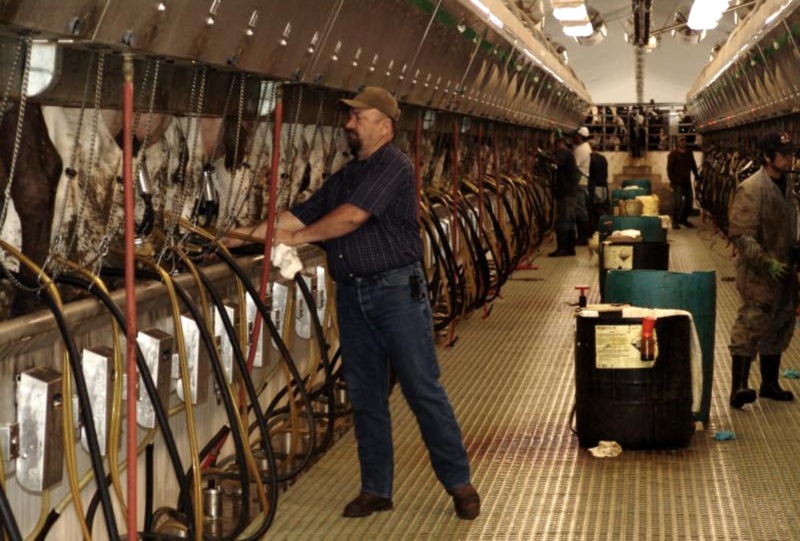
It’s hard to find optimism about the state of Idaho’s dairy industry among the very people who operate farms, milk cows, and try to make a living selling their product. The Idaho Dairymen’s Association reports there were 569 dairies in the state as of September 30th, 2011. That’s a significant drop from a few years ago when in 2008, 800 dairies were licensed to sell milk.
“I don’t think anyone would want to get into a losing business,” says Sharon Bettencourt. She and her husband Luis own one of the largest dairy operations in Idaho. They have 60,000 cows spread across 11 facilities. “At this point, we are trying to hang on to what we do have…there is no room for growth.”
While the number of dairies is on the decline in Idaho, the number of milk cows and the production of things like milk, cheese and cottage cheese are on the rise. According to a study from Boise State University’s College of Business & Economics which looked at the economic impacts of the dairy industry in Idaho, the number of dairy cows here is up more than 35-percent.
John Brown / Getty Images
In 2008 there were 550,333 dairy cows in Idaho
“The producer has to be better at making more milk,” says Jeff Ackerman who is the dairy operations manager at Bettencourt Dairies. “Production has grown because economics have gotten harder — we’re producing more milk out of the same number of cows, we have to, to squeak out any margins” says Ackerman. Continue Reading →
The New York Times is drawing attention to the large number of states that have this year considered implementing drug testing for people who receive public assistance.
“[Thirty-six] states considered drug testing for recipients of cash assistance from the major welfare program, Temporary Assistance for Needy Families, according to the National Conference of State Legislatures; 12 states proposed it for unemployment insurance; and some also considered making it a requirement for food stamps, home heating assistance and other programs.” – The New York Times
The idea is, of course, a polarizing one, and this state has had its own flirtation with it. In 2010, the Idaho Legislature asked the Department of Health and Welfare to study the costs of implementing random drug testing for adults receiving public assistance. According to the department’s resulting analysis, such a program would cost more than it would save.
Idaho Legislature
Rep. Judy Boyle is a rancher, writer and small business owner from Midvale.
Reached today, Rep. Judy Boyle, a Midvale Republican who co-sponsored the resolution requesting the study, said the Department of Health and Welfare took too narrow a view. “My concern is to help people get off drugs,” she said. “I know there are serious problems with people trading their food stamps for drugs, so we’re just enabling people to stay on drugs.”
Boyle says she has prepared draft legislation, and she plans to introduce a bill in the upcoming session. “It’s not to throw people off of welfare. It’s to help them,” she said.
RealtyTrac, a company that tracks foreclosures nationwide, released September data today. In Idaho, the total number of foreclosures dropped from August to September, from 1,860 to 1,654. The state had the seventh highest foreclosure rate in the nation in September, with one out of every 391 housing units receiving a foreclosure filing. A map of foreclosure rates by county is available here.
A comparison of this year’s third quarter numbers to the third quarter of 2010 yields somewhat sunnier news for the state and the nation. In Idaho, the total number of foreclosure filings decreased by nearly 42 percent over that period, compared to 34 percent nationally. However, a RealtyTrac analyst predicts that foreclosure activity will begin to pick up again, as banks work through the raft of poorly filed foreclosures that resulted from so-called robo-signing.
Source: RealtyTrac
By most estimates, it will be at least several years before the foreclosure crisis abates, nationally and in Idaho. But local organizations that provide foreclosure prevention counseling services say they could run desperately short on funding as soon as January. That’s because the greatest share of support for such services comes from grants funded with federal dollars, and because Congress continues to struggle over the 2012 budget, for the fiscal year that began October 1st. Moreover, Department of Housing and Urban Development funds for counseling services were zeroed out in fiscal year 2011. Continue Reading →
About StateImpact
StateImpact seeks to inform and engage local communities with broadcast and online news focused on how state government decisions affect your lives. Learn More »