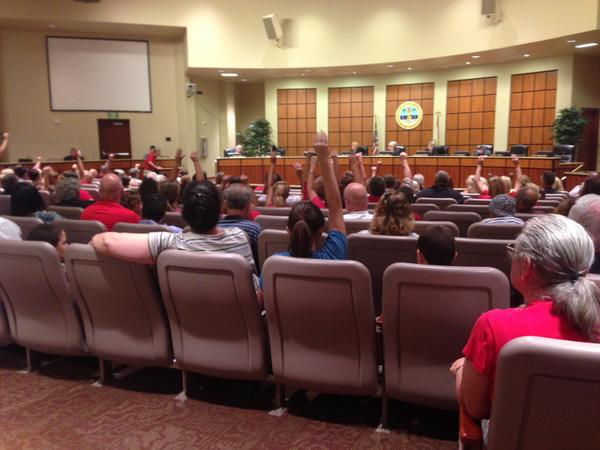
Testing opponents quietly show support for speakers at an August Lee County school board meeting. The board voted 3-2 to reverse its state testing boycott.
Florida schools pushed ahead with new Common Core-based math and language arts standards in every grade, despite rising opposition to Common Core across the country.
And education was a top issue during the governor’s race.
Barry University political scientist Sean Foreman sat down with StateImpact Florida to talk about what we learned in 2014, and what’s next in 2015?
Q: The big story this year was on testing, and we saw some – in at least one county kind of an open revolt against the statewide testing requirements. And we’re starting to hear legislative leaders talk about changing the requirements as well. What do you think is going to happen and what did we learn this year?
And that has many asking how his position on education issues would affect both a Republican primary candidacy and, if Bush survives, a general election candidacy.
He’s also one of the leading proponents for the Common Core math and language arts standards adopted by more than 40 states, including Florida. But opposition to Common Core is growing, and states like North Carolina, South Carolina and Louisiana are considering how to repeal or change Common Core.
“What we’ve realized over the years is that peers can be very persuasive in a positive way and they can influence those that look like them,” said Risa Berrin, who started the program.
The school day is over at North Miami Beach High School. Most students have headed for the doors. But Diamante Sharpe and Erica Poitevien and about a dozen classmates are working on their lesson plans.
“So welcome back to HIP. My name is Diamante,” Sharpe tells the group. “And today is our fourth session – mental health.”
They ask those gathered to clear their desks, pay attention and offer constructive criticism to classmates to help them teach the material better.
Over the course of the year, students teach eight lessons and lead discussions.
Students who are the first in their family to attend college often have a more difficult time finishing their degree.
Research shows those students know less about how to get into and pay for college. And first generation college students are less likely to take tough high school courses needed to be prepared for college.
More than half of teachers were rated “effective.”
The ratings at the other end of the scale were virtually unchanged from last year. Teachers earning “needs improvement” were 1.3 percent of the state total, while three in 1,000 teachers were rated “unsatisfactory.”
Nearly one in five teachers has yet to be evaluated.
The teacher ratings are based, in part, on student test scores and are required by a 2011 law. This is the third year Florida has released statewide data.
The Florida Standards Assessment replaces the FCAT. Students will take the test online.
“Opt Out” groups are pushing back against what they say is too much standardized testing in Florida. The tests are changing as the state transitions to Florida Standards – an offshoot of the Common Core standards being implemented around the country.
Two-dozen groups have been formed at the district level to help parents learn the procedure for opting their students out of the tests.
By following a specific procedure (which may vary depending on the district), the student’s test is invalidated. The result is that the student doesn’t fail, school grades and teacher pay aren’t impacted, and the district is forced to find an alternative means of assessing what the student has learned.
Cindy Hamilton, co-founder of Opt Out Orlando, talked with StateImpact Florida’s Gina Jordan about why she wants an end to so much testing and what she’d like to see happen instead.
StateImpact seeks to inform and engage local communities with broadcast and online news focused on how state government decisions affect your lives. Learn More »