Only Tennessee charter school students receive more funding than traditional district students. The gap ranges from $12,736 per student in Washington, D.C. to $365 in New Mexico. The study looked at the budget year ending in 2011 in 30 states and 48 major urban areas.
“These findings tell us conclusively that public charter schools tend to receive far less money, and that inequity from state-controlled funding is most clearly responsible for the gap in funding,” said Larry Maloney, the study’s lead researcher. “The research cannot explain, however, exactly why local governments provide students in public charter schools with so much less money for their education than they provide students in traditional public schools.”
Florida is a different story though because the state per-student funding is equal. One reason for the difference here is local taxes school districts collect for building maintenance and construction. Charter schools don’t receive a share of that money in most Florida school districts. Charter schools also typically receive a smaller share of federal funding.
The effort, known as Quality Education for All, is intended to help improve schools that have been the center of education-related lawsuits for decades.
The money will pay bonuses to teachers who choose to work in the three-dozen schools, with additional bonuses if teachers improve student performance. The money will also be used to hire Teach For America trained teachers, create a teacher residency program, develop a new district data system for teachers and administrators and more.
The bright spots? Florida’s graduation rates for Hispanic students and English language learners are near the national average. Just eight states have a lower dropout rate than Florida, at 2.1 percent. The national dropout rate is 3.3 percent.
The reversal was led by School Board member Ron Crawford, who last year cast the swing vote to re-establish corporal punishment after a three-year absence. On Tuesday, Crawford said he had to listen to his constituents.
Education Week takes a look at how Orange County and Long Beach, Calif. schools made a big curriculum decision.
Education Week takes a long look at how schools around Orlando and in Long Beach, Calif. solved a similar problem: choosing a curriculum for new Common Core math, literacy and language arts standards.
Orange County went with big publishing companies. Long Beach schools designed their own curriculum. It’s a decision many school districts are facing as they switch to the new standards. Florida schools will complete the transition this fall.
Some Florida school districts have suspended FCAT testing after having problems connecting to the online exam.
UPDATE: Education Commissioner Pam Stewart has sent a letter to Pearson saying she expects “a resolution and explanation for this immediately.”
“This failure is inexcusable,” Stewart wrote. “Florida’s students and teachers work too hard on learning to be distracted by these needless and avoidable technological issues.”
Read Stewart’s letter below.
Original post:
Schools are suspending today’s FCAT testing because some school districts are having computer issues.
The Florida Department of Education says the problem is with testing firm Pearson. The problem is not statewide, they said, but they’ve advised districts having issues to suspend testing.
The Tampa Bay Times reports Pasco County schools have stopped testing. Pasco County schools’ testing director said Leon, Seminole and Brevard schools are reporting similar issues.
Here’s the note the department sent to school districts this morning:
Good morning,
As some of you already know, Pearson is experiencing difficulty with a hosting provider this morning, which is causing issues with testing (both TestNav and TestHear) and accessing the PearsonAccess website for test management. The issue does not seem to be statewide, but several districts have reported issues.
Academica president Fernando Zulueta, at a 2011 meeting in the Bahamas with company leaders. The company is included in a national federal audit of charter schools.
UPDATE: The U.S. Department of Education audit is a broad review of charter schools across the country and not limited to Academica or the Mater Academy network it manages, a fact confirmed by the federal agency.
Academica disputes the U.S. Department of Education’s initial findings and said they have responded to the agency.
We’ve updated the headline for clarity.
ORIGINAL POST: The U.S. Department of Education is investigating the business practices of Florida’s largest for-profit charter school operator, according to a Miami Herald scoop. The federal agency is concerned about conflicts of interest between Academica Corp. and the Mater Academy network it manages.
The auditors found that three of the schools in the Mater network — Mater Academy, Mater High and Mater East — entered into leases with development companies tied to the Zulueta family. Two of the leases were executed while Zulueta sat on the Mater board.
In addition, Mater Academy hired an architectural firm from 2007 through 2012 that employs Fernando Zulueta’s brother-in-law, state Rep. Erik Fresen, the report said.
“We identified four related-party transactions, two of which indicated, at a minimum, the appearance of conflicts of interest between Mater Academy and its CMO [charter-management company],” the Mater Academy in Hialeah Gardens and its nonprofit support organization, Mater Academy Foundation.
“Mater Academy shares the same board of directors with the foundation and based on our review of the board of directors meeting minutes at Mater Academy, there is evidence of Mater Academy’s board of directors transferring public funds to the foundation,” the auditors noted.
Those grades depend a lot on student FCAT scores. So Hillsborough Superintendent MaryEllen Elia took a moment pump up students at West Tampa’s Graham Elementary School before this week’s testing.
“Next week you’re going to have an opportunity to do great again, right?” Elia asked.
“Yeeesssss,” the kids responded.
“Who’s gonna do great?” Elia asked.
She got silence in response.
“You better all have your hands up,” another teacher cut in, drawing laughs from the room.
Florida students are taking FCAT math, reading and writing exams for the final time this year. The test started as a way to measure student progress. But anger with FCAT has grown as state policies added more consequences to the test scores.
Some parents say the pressure is too much. That one bad day testing could have long-term consequences. A small group of parents are pulling their kids out of the FCAT and encouraging other parents to follow.
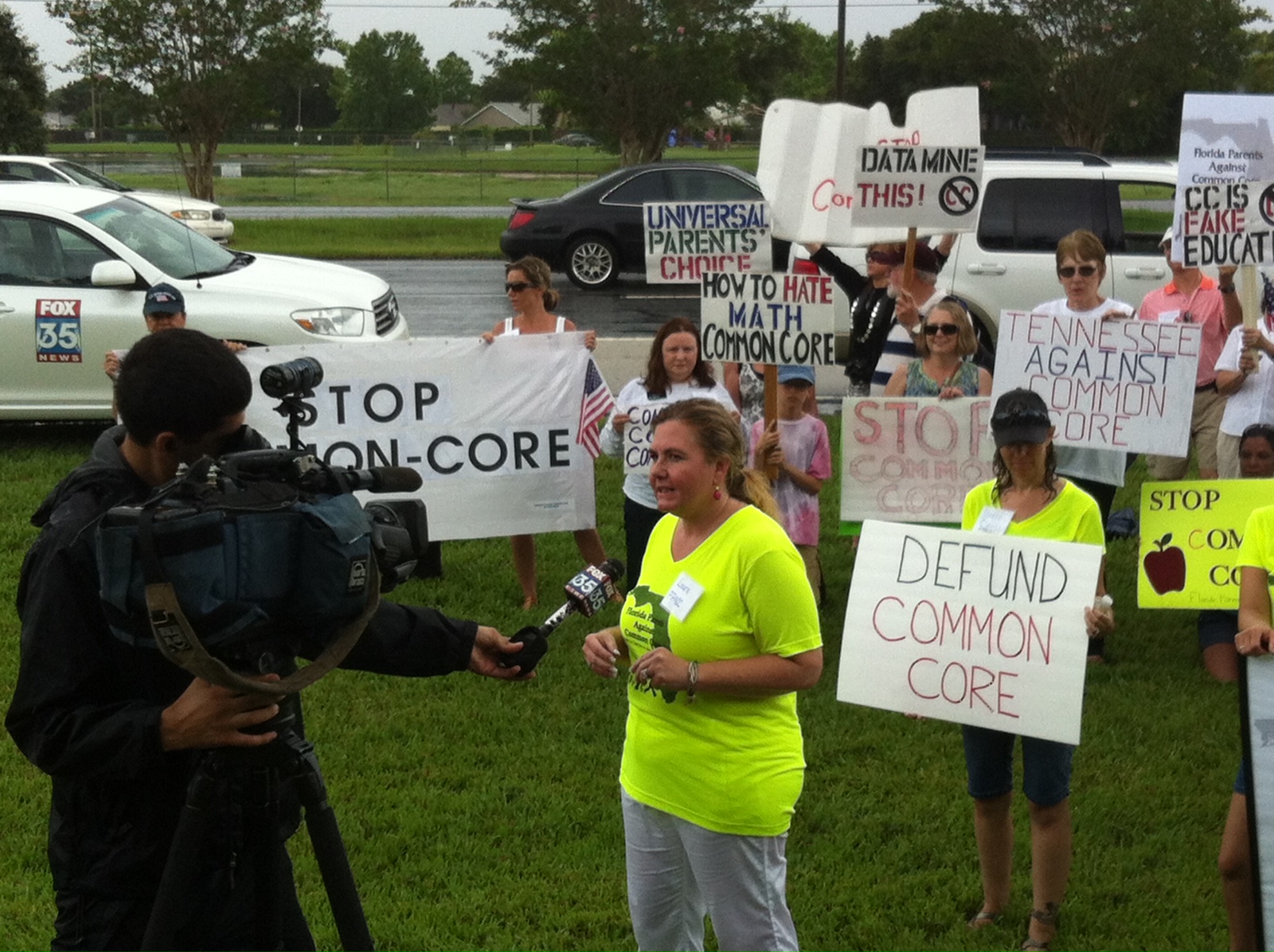
Florida Parents Against Common Core protest at a national meeting discussing the standards in June in Orlando.
A coalition of groups opposing Florida’s use of new math and language arts standards say they will try to force the Legislature to call a special session to address two bills which would put the standards on hold.
The gambit is a long shot. Twenty percent of the Legislature must call for the special session, and a super majority must vote to approve it.
Activists are unhappy HB 25 and SB 1316 have yet to get a hearing with the 60-day legislative session winding down. The identical bills would halt implementation of the standards until the state completes an analysis of how much the standards will cost, and public hearings are held in every Congressional district. They say House and Senate leadership are blocking the bills.
“We worked so hard just to get that bill; find someone to carry the bill for us,” said Laura Zorc, a co-founder of Florida Parents Against Common Core. “They’re saying our concerns aren’t valid. Why not hear the bill? Why not let it go for a vote? If it was going to fail, then let it fail.”
StateImpact seeks to inform and engage local communities with broadcast and online news focused on how state government decisions affect your lives. Learn More »