Florida Taxwatch recommends the Bright Futures program be more selective in granting scholarships to college students.
Bright Futures money is being targeted again, this time by a government watchdog group that says the state should raise requirements for the merit-based scholarship program.
The lottery revenues which fund the scholarships aren’t stretching as far as they used to.
Now, Florida Taxwatch has released its annual list of recommended cost savings for the Legislature. The 25 recommendations add up to a potential savings of over $1 billion for the state.
The only item listed under “Education Reform” is Bright Futures.
Now, the state teachers union is blasting lawmakers for imposing what it calls a tax on working families.
The law has been in legal limbo since it went into effect a year and a half ago.
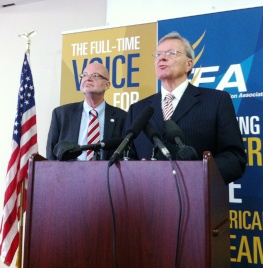
Speaking to reporters shortly after the ruling, Florida Education Association (FEA) President Andy Ford said his group has no further recourse.
“We believe that our arguments were correct and that the justices just didn’t understand what they were doing to a half a million Florida families,” Ford said.
BOG Chairman Dean Colson says the State University System is doing more with less, but the decline in state funding is not sustainable.
Florida Board of Governors Chairman Dean Colson had much to brag about in his State of the System address this morning.
He told the people who govern the State University System that Florida’s universities are affordable, a good value, and excelling in graduation rates.
But Colson said, “If you want our system truly to serve as an economic engine for the state, we must have the resources to recruit the best and the brightest. Simply being ‘good’ is not good enough.”
As state funding for universities has dropped by more than a billion dollars over the last six years, “System enrollment grew by 9% — an increase of over 35,000 students.” Colson said. “In essence, our System has grown by the equivalent of a sizable university while losing enough state funding to support an entire university.”
Colson said the universities are more efficient than ever, but the decline in funding is not sustainable.
Thursday's Florida Supreme Court decision could be cited in another legal challenge pushed by teachers.
In 2011 lawmakers approved a law requiring public employees — including teachers — pay 3 percent of their salary into their retirement account.
Public employee unions challenged the law, arguing it unconstitutionally changes a contract with workers and violates workers’ right to collectively bargain pay and benefits.
A circuit court overturned the law, but Thursday the Florida Supreme Court upheld the law in a 4-3 decision.
The decision is likely to set a precedent when a lower court issues its decision on another teacher-related lawsuit (A decision which is expected to be appealed to the Supreme Court).
That suit challenges a 2011 law, the Student Success Act, requiring teachers to be evaluated, in part, based on student standardized test scores, requiring district to design merit pay programs to pay better performing teachers more money, and ending long-term contracts for new hires.
Bennett began by telling the 13-member committee he has been an admirer from afar.
“I was taught at a very young age that you can always tell a person’s priorities if you would look at two things: their checkbook and their calendar,” Bennett said. “The forty-eight hours I have spent here, I have been amazed at the amount of time and discussion around how we make sure Florida’s children are the best educated in the United States.”
Florida’s education budget for the current fiscal year is about $20.3 billion dollars. That’s nearly a third of the entire state budget.
Veterans would have an easier time receiving in-state tuition at Florida colleges and universities if a bill introduced by Sen. Jack Latvala becomes law.
The Senate has also introduced a bill, SB 180, granting the U.S. citizen children of undocumented immigrants in-state tuition rates. Those students would have to attend school in Florida for four years and apply to college within twelve months of graduating from a Florida high school.
Charters are now serving a record 2.3 million students based on estimates from the current school year. But a pro-choice non-profit says Florida school districts are preventing more charters from opening.
Data collected by the Alliance show charter schools now make up more than five percent of public schools in the country.
It took two decades to get there. Most of the growth happened in the last five years.
Since 2007-08, the Alliance reports “the public charter sector has added 1,700 schools – almost a 50 percent increase – and is serving an additional one million students – an increase of 80 percent.”
And when StateImpact Florida asked him what he thinks about a growing conversation to arm public school teachers, he spoke as a former teacher.
“I’m not going to speak as the education commissioner, I’m going to speak as a former science teacher who loved what I did every day teaching science,” Bennett said.
“I didn’t get up in the morning to teach science with ever believing I would need to carry a gun. Okay?
“Now it pains me and it saddens me to think that the society we live in today is so drastically different than it was maybe when I was teaching, but I still hold that value,” he said.
Bennett was the state superintendent in Indiana from 2009-2012 before losing his re-election bid in November. Continue Reading →
About StateImpact
StateImpact seeks to inform and engage local communities with broadcast and online news focused on how state government decisions affect your lives. Learn More »