Private schools in Florida are coming together to create a school emergency plan, utilizing each school's existing resources.
Private schools in Florida are coming together to share their resources in case of a school emergency.
Dana Markham is the president of Pine Crest School in Fort Lauderdale. She says private, independent schools don’t have a support network the way public schools do.
Public middle and high schools, for example, share School Resource Officers — police officers who visit school campuses every day. Markham says if private schools want a police officer on their campuses, they have to pay an off-duty officer and hire them through a law enforcement agency.
She’s asked nearby private schools to create a crisis management plan together, utilizing each school’s existing resources. Continue Reading →
Education committees heard presentations this week by The Parthenon Group, the consulting firm hired by the BOG to come up with options for expanding online learning.
Rep. Cynthia Stafford, D-Opa Locka, doesn’t like the idea.
“I am very concerned with the concept of having a standalone online university,” Stafford said. “It could have the potential to have a negative impact on the other universities in that we would limit what they would be able to offer online.
Chancellor of Public Schools Pam Stewart explained how Common Core standards are different during a discussion Wednesday night at St. Petersburg College.
Florida is one of 45 states and the District of Columbia to adopt new, tougher education standards. The standards, known as Common Core, requires students to prove what they know — but also to show how they know it.
Educators across the state are preparing parents and students for the switch and trying to explain how the new standards will work. The new standards will be fully in place by the fall of 2014.
Pam Stewart, the chancellor of public schools at the Florida Department of Education, told a story Wednesday at a forum at St. Petersburg College to try to provide an example.
The law is slated for full implementation in the 2014-15 school year, the same year Florida fully transitions to Common Core standards.
Kathy Hebda, Deputy Chancellor for Education Quality, told the committee that all 67 school districts have requirements to follow, but they have a lot of flexibility in choosing how to evaluate teachers.
“One of things that we go back to all the time when we talk about evaluation systems is that…these are really supposed to support student learning and student learning growth,” Hebda said. Continue Reading →
Pinellas County school superintendent Michael Grego discusses the switch to new state education standards Wednesday night.
Florida schools are in the midst of switching to new, tougher education standards adopted by 45 states and the District of Columbia.
Known as Common Core State Standards, educators say the new requirements will not only ask students what they know but require them to demonstrate how they know it.
Wednesday night, St. Petersburg College hosted a discussion about the switch to Common Core and what it will mean for Florida students.
Here’s five things that jumped out to us as we listened:
1) Schools have a lot of public relations work to do.
Most public displeasure with Florida’s accountability system centers on the Florida Comprehensive Assessment Test — and the consequences of what test scores mean for students, teachers, schools and districts.
Between new technology needed for tougher state standards and Gov. Scott's proposed teacher raises, budget writers are looking at more than $1 billion in education budget requests.
The new standards include a new, computerized standardized test, so schools need the network infrastructure and computers or tablets to handle the annual testing rush.
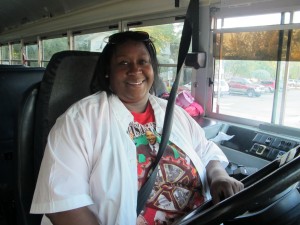
Miami-Dade school bus driver Sharayne Milton says she tries to work overtime weekends every day to earn more money than the $12.16 she makes an hour. Her day can start at 4 a.m. and end at 10:30 p.m.
Driver Gwendolyn Tillman doesn’t usually get between students fighting on the school bus.
“Usually if there are some other guys on the bus and the guys have respect for the bus drivers, the other young men on the bus will pull them apart,” Tillman said.
If nobody pulls the kids apart, bus drivers are instructed to call the district dispatcher — and not the police.
“Our drivers do not take actions against individual students,” said Jerry Klein. He’s in charge of school transportation in Miami-Dade County.
“There is a process for them to fill out a report and then the schools deal with it like any other misbehavior in the schools.”
Calling a dispatcher is the protocol for any emergency on a school bus. And that has sparked some controversy in Florida.
The Hillsborough County school district could not comment because they’re in the middle of a lawsuit over the circumstances surrounding Herrera’s death. But in Miami-Dade, Klein says calling a dispatcher is just as good as calling the police.
“We have access as quickly as they do to be able to call [the police], you don’t really save time,” Klein said. “But beyond that, the dispatcher can reach a wide variety of people and try to get the closest people there to be able to assist.” Continue Reading →
Commissioner Tony Bennett says his two main agenda items are the implementation of Common Core and teacher evaluations.
The Senate Education Committee peppered education commissioner Tony Bennett with questions today.
He was supposed to share the podium with Gov. Rick Scott, but the governor canceled his appearance at the last minute.
So Bennett got more attention than he probably anticipated.
He acknowledged that the only thing he has mastered in his eight days in Tallahassee is the route from his home to the office.
But Bennett stayed put until the committee was done with him. Here is a sampling of the question and answer session, greatly condensed.
Q: From Chairman John Legg, R-Lutz: Can you maybe just hit on some of your high level agenda points?
A: I can speak from experience that the one thing we have to get right is the implementation of Common Core because it will transform the way our children learn, transform the way teachers teach, transform the way we assess our children and know that they are college and career ready.
New federal data shows Florida's graduation rate is improving, but the state's national ranking has changed little since 2001-2002.
Florida’s graduation rate is increasing but the state still ranks among the nation’s lowest, according to new federal data.
Just six states and the District of Columbia had a lower graduation rate than Florida’s 70.8 percent, according to the National Center for Education Statistics for the 2010-2011 school year. In the 2001-2002 school year, just five states and the District of Columbia had a lower graduation rate than Florida.
However, Florida’s graduation rate has risen to 70.8 percent in the 2010-2011 school year from 63.4 percent in the 2001-2002 school year — a 7.4 percentage point increase. During the same period, the national rate increased to 78.2 percent from 72.6 percent — a 5.6 percentage point increase.
These figures use an older method for calculating graduation rates. The federal government has required states to use a new, standardized method. Those figures allow for a better comparison among individual state graduation rates.
StateImpact seeks to inform and engage local communities with broadcast and online news focused on how state government decisions affect your lives. Learn More »