The foundation saw a need to improve science, technology, math and engineering education, or STEM, in Sarasota and Charlotte counties, says Chris Pfahler, who manages the foundation’s STEMsmart program. So the Gulf Coast Community Foundation came up with a plan which will eventually renovate and equip 142 middle school classrooms.
The non-profit helped raise money for the $2.2 million project, which included securing pledges for equipment from Texas Instruments and Hewlett-Packard. They also guided the project through its conception, seeking out design tips from teachers and students.
School districts around the state may need to consider a similar transformation to their classrooms. That’s because lawmakers have required Florida school districts to deliver have of all instruction digitally by the fall of 2015.
“We had a guy from the state who talked about the technology issues,” Pfahler says of a recent meeting. “He said: ‘A third of the money is going to come from the state. A third of the money is going to come from the school district. And a third of the money is going to come from…wherever.’”
Actress Mayim Bialik works on math problems with Sarasota County middle school students (from left) Amanda Folsom, Daphne Waggener and Gracie Brasacchio.
The algebra problem asked the Sarasota County middle school students to figure out how much Sheldon, Amy and Howard – characters on the television show “The Big Bang Theory” – spent on tickets and popcorn while seeing “The Lord of The Rings.”
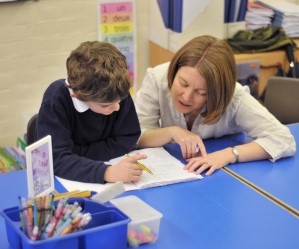
The students talked through their work in small groups around the room. A tutor helped them set up the equations.
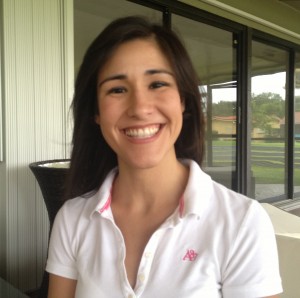
The tutor? Mayim Bialik, who plays Amy on “The Big Bang Theory.”
“We would usually set one equal to the other and then substitute it in,” Bialik said to Brookside Middle School math teacher Brenda Fuoco. “It’s the same concept, right?”
“Absolutely, I teach them three different methods,” Fuoco said. “That’s their least favorite method.”
“Why is that their least favorite?” Bialik asked. “That’s the most logical to me?”
Bialik, 37, is known her television roles, such as the title character on the 90s sitcom “Blossom.”
Bialik has also earned a Ph.D. as a neurobiologist, taught and now works with Texas Instruments to promote science, technology, math and engineering education. But the real star of her visit Tuesday to Sarasota Middle School were new high-tech science and math classrooms.
A new Florida law targets bullying, particularly online.
Last week Gov. Rick Scott signed a bill targeting bullying, HB 609, into law.
The law makes three big changes: Students can be bullied publicly or privately; defines cyberbullying as harassment using electronic means, such as email or impersonating someone online; and allows schools to get involved if off-campus bullying affects the targeted student’s on-campus education.
The law does not require school districts to monitor off-campus activity. The law also requires schools to teach staff and students about how to identify bullying and what to do if they see it.
We’ve posted the new law and noted some of the key changes, after the jump.
One of the responses came from Neyda Borges, a teacher at Miami Lakes Educational Center. She wrote this essay about what she learned in school this year:
In part, it’s because math lessons are more discrete. A quiz can tell you which math concepts a student is having problems with, as a teacher notes in the story.
But reading builds on many skills — vocabulary, grammar, contextual knowledge — and it is difficult to pinpoint just which one is the trouble spot. Reading deficiency may be more of a problem than math deficiency long term, educators say.
Orange County Superintendent Barbara Jenkins and Chairman Bill Sublette focused their State of the Schools speech on changes in curriculum and technology.
Orange County schools superintendent Barbara Jenkins says the district should be a leader as they switch to new education standards and add more required digital instruction.
“Orange County Public Schools intends to be at the forefront of that change,” Jenkins said during her “State of the Schools” address last week with school board Chairman Bill Sublette.
The two spoke about “schools of the future” and what it will take to make Orange County, one of the nation’s largest school districts, the “top producer of successful students in the nation.”
Tea Party members, Lois Miller, right, and Charlie Batchelder, left, hold signs to protest Common Core across the street from Marion Technical Institute where school administrators were meeting on Southeast Fort King Street in Ocala, Fla. on Wednesday, April 3, 2013.
Tea party groups see opposition to Common Core standards as the issue to revitalize a political movement which failed to defeat Democratic President Barack Obama in last year’s election and lost a court challenge to Obama’s health care law.
“This is the issue that could change things for the tea party movement,” said Lee Ann Burkholder, founder of the 9/12 Patriots in York, Pa., which drew 400 people — more than twice the usual turnout — to a recent meeting to discuss agitating against Common Core.
The standards have been fully adopted by Florida, 44 other states and the District of Columbia. Common Core lays out what students are expected to know in math and English language arts by the end of each grade.
The standards streamline the number of topics schools teach children in each subject. Common Core also requires teachers ask students what they know and to prove how they know it.
Orange County is planning to add up to five K-8 schools. Research shows students at those schools tend to perform better and have fewer discipline problems.
The popularity of K-8 schools is growing in one of Florida’s largest districts.
Orange County Public Schools will add up to five kindergarten through 8th grade schools to the three already in place.
These are traditional public schools, not charters or magnets. Kids will be zoned for them just like any other.
The average middle school in Orange County has 1,000 students. The new K-8 schools will have similar student populations.
“Our research has shown that the optimal size of a K-8 is 900 to 1,200 students,” Jenkins said. “Anything larger, and we need to build a traditional middle school. Anything smaller, and we cannot justify the operating costs.”
You can see a video of Holmes first grader Adam Redding and his mother, Lyndra Forbes, using one of the computers here: Continue Reading →
About StateImpact
StateImpact seeks to inform and engage local communities with broadcast and online news focused on how state government decisions affect your lives. Learn More »