In this case, the speakers were talking about Common Core State Standards – a new way of teaching that dives deeply into fewer subjects. The goal is to get more students college and career ready.
The Florida Department of Education is smarting from “unacceptable” FCAT results — they were flat — and they’re looking ahead to what Common Core will mean for student learning.
The analysis tracked fourth and eighth grade math and reading scores on the National Assessment of Educational Progress, considered the model test for comparing student performance across state lines. The purpose was to check differences in student gains now that states have been released from some federal No Child Left Behind law requirements — as Florida has been.
Overall, the improvement in Florida student scores was the equivalent of more than half a year’s worth of learning averaged over the four subjects tested during the eight-year period. Twelve states and the District of Columbia showed more improvement than Florida.
But Florida’s improvement ranked eighth nationally for students who qualify for the federal free and reduced price lunch program, an often-used proxy for poverty. Those students’ scores improved by the equivalent of a full year’s worth of learning for each of the four subjects tested over the period studied.
Those results place Florida among what Education Sector authors John Chubb and Constance Clark call “high-performing states.” And the authors say those high-performing states share some common policies: They set high expectations, have developed their own systems to measure school performance and assist low-performing schools and are trying to measure and support effective teaching and leadership.
It’s finals week at Park Vista Community High School and a small group of students buzzes over an assembly line of used Dell computers that lie cracked open with all their electronic guts exposed.
Sammy Mack / StateImpact
Students at Park Vista Community High School refurbish computers for donation.
“Right now it’s kind of messy,” says Park Vista junior Jonathan Stabio. “But essentially what we do is take a computer out of the pile that has all the components, we open it up, make sure it has everything necessary to make it run… and get them ready to be shipped off.”
Many of the donated computers that Stabio refurbishes in class will be given to families who don’t have computers at home. It’s part of a Palm Beach County program aimed at closing the digital divide.
The state already requires high schoolers to take at least one online course. By fall 2015 half of all classroom instruction will need to be digital, and students will take the standardized test that replaces the Florida Comprehensive Assessment Test on a computer.
Kids like Stabio—kids fluent in technology, with access to the Internet at home and school—are well positioned to make the transition to a more digital learning environment.
But many students don’t have that advantage. By one estimate from a survey of school administrators and technology specialists, a third of Florida students don’t have a computer at home. And even if they did, it wouldn’t guarantee they would land on the right side of the digital divide. Continue Reading →
Florida students showed greater improvement on end-of-course exams than FCAT 2.0 in results released today.
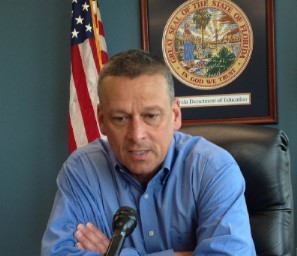
Education Commissioner Tony Bennett is responding like a disappointed dad to news that Florida students did a little bit better on their standardized tests this year, but not as well as he would have liked.
They show across-the-board improvement on EOC assessments, particularly in Biology 1 and Geometry.
In a press release, DOE said FCAT 2.0 Reading scores increased in grades 6, 8, 9 and 10. For FCAT 2.0 Mathematics, grade 4 showed improvement. In FCAT 2.0 Science, grade 5 showed improvement and grade 8 remained the same.
But the scores didn’t move enough to appease Bennett.
“The FCAT results are flat, and I find that personally unacceptable,” Bennett said. “I think we have to refocus our efforts on reading and making sure our students have the foundational skills necessary in mathematics.”
Bennett said the FCAT scores weren’t disastrous; they simply looked unimpressive compared to EOC assessment results that were very good.
“The biggest lesson that I personally have learned is what accountability means. And what transparency means. And having the correct information.
“We just came out of a season where we had a superintendent that did not keep us informed and we didn’t have correct information, even when we asked for it.
“I started my term in 2010. The numbers that I had, that I was reviewing, didn’t add up. And when I would ask questions or for documentation I was considered a bad board member because I wasn’t going along and I wasn’t being a good team member.
(Florida Polytechnic University – the 12th in the system – doesn’t begin classes until August 2014.)
The American Council of Trustees and Alumni (ACTA) and The James Madison Institute are the groups behind the assessment.
“Overall, Florida public universities are on a prudent and successful course during these difficult economic times,” researchers wrote. “Significant challenges and difficult decisions over priorities remain. It is clear, however, that Florida has high potential to be a model for other states.”
While state funding for the system fell from $2.6 billion to $1.7 billion between 2007 and 2012, the report finds a six-year graduation rate of 66 percent – putting Florida in the top ten nationally.
Advocates for new science standards are asking Florida supporters to speak up.
Advocates for new science standards are urging Florida residents to voice their support.
The concept for the science standards is separate, but similar to that of the math and English language arts standards which comprise the Common Core. Florida, 44 other states and the District of Columbia have fully adopted the Common Core standards.
The California-based National Center for Science Education is urging Florida members to voice their support for the standards, known as the Next Generation Science Standards, during a comment period this month. Supporters are worried the Florida Department of Education might back away from the science standards the public response is negative.
The standards include teaching students about evolution and human-caused climate change. State education leaders are reviewing the standards across the country and deciding whether they want to adopt them.
“We understand that the NGSS isn’t perfect and some folks have legitimate concerns about them,” three members of Florida Citizens for Science wrote in an email to members. “But overall, the NGSS are a significant improvement over our current state standards. Quite frankly, it’s unlikely that any future state-level effort could match the effort and resources that went into the NGSS.”
The foundation saw a need to improve science, technology, math and engineering education, or STEM, in Sarasota and Charlotte counties, says Chris Pfahler, who manages the foundation’s STEMsmart program. So the Gulf Coast Community Foundation came up with a plan which will eventually renovate and equip 142 middle school classrooms.
The non-profit helped raise money for the $2.2 million project, which included securing pledges for equipment from Texas Instruments and Hewlett-Packard. They also guided the project through its conception, seeking out design tips from teachers and students.
School districts around the state may need to consider a similar transformation to their classrooms. That’s because lawmakers have required Florida school districts to deliver have of all instruction digitally by the fall of 2015.
“We had a guy from the state who talked about the technology issues,” Pfahler says of a recent meeting. “He said: ‘A third of the money is going to come from the state. A third of the money is going to come from the school district. And a third of the money is going to come from…wherever.’”
Actress Mayim Bialik works on math problems with Sarasota County middle school students (from left) Amanda Folsom, Daphne Waggener and Gracie Brasacchio.
The algebra problem asked the Sarasota County middle school students to figure out how much Sheldon, Amy and Howard – characters on the television show “The Big Bang Theory” – spent on tickets and popcorn while seeing “The Lord of The Rings.”
The students talked through their work in small groups around the room. A tutor helped them set up the equations.
The tutor? Mayim Bialik, who plays Amy on “The Big Bang Theory.”
“We would usually set one equal to the other and then substitute it in,” Bialik said to Brookside Middle School math teacher Brenda Fuoco. “It’s the same concept, right?”
“Absolutely, I teach them three different methods,” Fuoco said. “That’s their least favorite method.”
“Why is that their least favorite?” Bialik asked. “That’s the most logical to me?”
Bialik, 37, is known her television roles, such as the title character on the 90s sitcom “Blossom.”
Bialik has also earned a Ph.D. as a neurobiologist, taught and now works with Texas Instruments to promote science, technology, math and engineering education. But the real star of her visit Tuesday to Sarasota Middle School were new high-tech science and math classrooms.
StateImpact seeks to inform and engage local communities with broadcast and online news focused on how state government decisions affect your lives. Learn More »