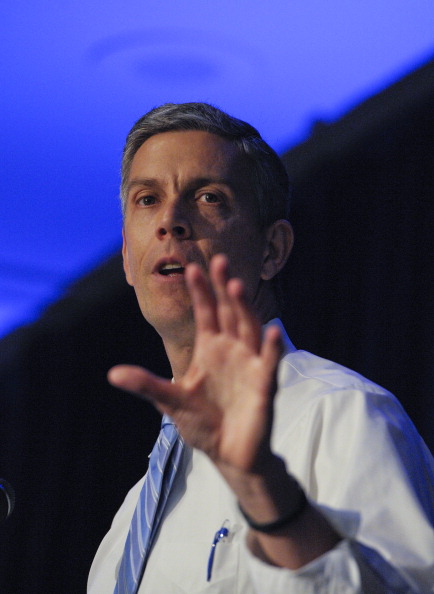
House Majority Leader Eric Cantor after meeting with the GOP caucus
A $17 billion increase to a college aid program for low-income students is one reason U.S. House Republicans are balking at plan to raise the federal debt limit, according to The Hill newspaper.
Republicans are asking House GOP leadership why they are growing the Pell Grant program in a bill designed to cut the federal budget deficit?
The program is critical in Florida, whose students received $1.93 billion in grants — up to a maximum of $5,350 — during the 2009-2010 school year according to U.S. Department of Education data. Only students in California and Texas received more in Pell Grant money.
Five of the top 20 public colleges for Pell Grants in 2009-2010 are in Florida, including the nation’s largest in Miami-Dade College, Valencia Community College, Broward College, Florida International University and University of Central Florida.
Two years ago the non-profit group that oversees Florida’s tax credit scholarship program for low-income students cut off applications in December.
Last year the cut off came in October.
This year Step Up for Students ran out of space on May 22 — after just seven weeks of enrollment. Last year the program provided 34,600 scholarship — up 5,700 students from the year before.
Why? A viral marketing campaign among parents, said Step Up for Students President Doug Tuthill.
“Parents are very aggressive about seeking out information,” Tuthill said, noting his group does little scholarship marketing. “They have their own social network.”
Teachers rally against proposed budget cuts in March
Teachers are saying they have had enough of the politicization of their profession and are retiring in numbers this year, a trend reported across the state in recent weeks.
Palm Beach County teacher Margot Collins told the Palm Beach Post why she is leaving after 32 years:
“The whole thing is just overwhelming me these days,” said Collins, 61. “I see what people are going through, and it’s not getting better. There’s so much politics these days, with all the hoopla about the state passing Senate Bill 736, and all the stuff they’re doing to our retirement.”
The retirements follow a year in which lawmakers mandated pay-for-performance statewide, stripped teacher tenure and required teachers to take a 3 percent pay cut in order to contribute more to their pensions. Many of the teachers are entering an early retirement program so they can keep working but avoid the additional 3 percent pension contribution.
The state is stepping up its standards on the written portion of the Florida Comprehensive Assessment Test to prepare for coming tougher national standards and to weed out essays that seem coached for better scores, according to the Orlando Sentinel.
Finally, the department doesn’t want to see evidence that students have memorized phrases to use on their FCAT essays.
“Rote memorization or overuse of compositional techniques, such as rhetorical questions, implausible statistics, or pretentious language is not the expectation for quality writing at any grade level,” the memo stated.
The use of memorized phrases, or what the department calls “template writing,” is one the state has been trying to stamp out for several years.
The practice, state officials have said, involves students at the same school using the same phrases in their essays, suggesting they’ve been “coached” to employ them. The phrases include over-the-top language such as “a potpourri of iridescent colors surrounded me,” and similar, contrived story conventions such as writing, “POOF!” and then describing the character suddenly being in a land of dragons, pirates or fairies.
“Teaching to the test” is a common complaint about standardized tests such as the FCAT, where teachers spend classroom time prepping students for a test that, in part, determines an educator’s performance. What does it say that the state has to revamp its grading to counteract “coaching” by schools?
The state plans to release examples of the new essay scoring system later this month.
New Mexico Democrats are skeptical of Hanna Skandera, candidate for the state’s top education post, and her ties to the Foundation For Excellence in Education founded by former Florida Republican Gov. Jeb Bush, according to the Albuquerque Journal.
Several legislators were concerned Jeb Bush’s Foundation for Excellence in Education has too much influence.
“It sounds like, to me anyway, that the Foundation for Excellence in Education sort of is driving the ship here, in terms of the kinds of reforms that are going to be taking place in New Mexico,” said Rep. Eleanor Chavez, D-Albuquerque.
Skandera worked on Jeb Bush’s education team, and aspects of her reform agenda are from the “Florida model.”
Anytime a possible presidential candidate mixes with an early primary state, such as Iowa, national news is guaranteed. New Jersey Gov. Chris Christie, a Republican, knows this and said at a stop in Des Moines he wanted to use his bully pulpit to push for education reform — his last agenda item this year.
Much of what Christie is proposing has already been adopted in Florida — performance pay for teachers, eliminating tenure, tax breaks for companies that fund scholarships — but Christie, like Republican former Florida Gov. Jeb Bush, is a growing national voice in education reform after his well-publicized May confrontation with a teacher complaining about pay.
From the Philadelphia Inquirer:
“Maybe we can stop the arguing and bickering for a while,” he said. “Maybe we can put aside the personal self-interests of unions and politicians and start to figure out what unites us, and start to take some risk…
“Every major news service in America will cover the fact that I’m here to talk about education reform, and it’s the last of the big things I want to accomplish this year,” Christie said in an interview before the speech. “In the end, what I’m going to get from coming out here is attention for our ideas and plans for New Jersey on a national stage and I think that’s really advantageous for the state.”
That’s the question the Wall Street Journal asks in their weekend interview with the Microsoft founder and education philanthropist. Gates admits a $100 million program to create smaller high schools did not work as well as hoped:
“But the overall impact of the intervention, particularly the measure we care most about—whether you go to college—it didn’t move the needle much,” he says. “Maybe 10% more kids, but it wasn’t dramatic. . . . We didn’t see a path to having a big impact, so we did a mea culpa on that.” Still, he adds, “we think small schools were a better deal for the kids who went to them.”
The Gates interview raises questions about failed education experiments. Gates’ said his smaller high school initiative did not work, so, similar to dropping a computer operating system that fails to meet expectations, he tried something new despite students seeing slight performance gains. But what if the next experiment has an adverse effect on students? Or what if Hillsborough County’s Gates-funded initiative to evaluate teachers serves only to frustrate and drive educators from the profession?
Gates clearly believes more education research and development money is needed, but where should communities draw the line between the need to innovate and a failed experiment’s detrimental effect on students?
Federal officials are concerned too many disruptive students are winding up in the juvenile justice system — and therefore not completing their education, according to Education Week‘s Politics K-12 blog. U.S. Secretary of Education Arne Duncan describes what he saw leading Chicago schools:
“A small group of principals were calling the police too often to deal with minor disciplinary issues, he said, while schools with similar demographics handled the same behavior problems in other ways. ‘People wanted to do the right thing. They just didn’t know better,’ he said. ‘So many of these children need assistance. What they don’t need is to be pushed out the door.'”
Florida has had a zero tolerance policy since 2001 that requires student expulsion for bringing a weapon to school or making a threat towards school events, property or officials. The federal initiative could provide guidance for districts drafting additional discipline policies.
Where should the line be drawn? How should schools balance student safety against trying to graduate as many students as possible?
Pinellas County teachers are worried about next year’s vote to renew a $30 million tax increase for salaries, arts, music and technology.
“I’m very concerned,” union president Kim Black told the St. Petersburg Times editorial board.
Black noted the anti-tax mood, then added: “When all of this turmoil is happening — whether it’s the budget, negotiations (between the district and the union), the issues with the superintendent — all of those things create a lack of confidence, I believe, in the public school system.”
About StateImpact
StateImpact seeks to inform and engage local communities with broadcast and online news focused on how state government decisions affect your lives. Learn More »