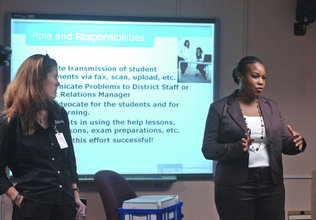
Felicia Brunson, (right), Liason between Florida Virtual School and Miami-Dade County Schools, talks to a group of instructors who will be running the labs along with Jeannine Schloss, a Virtual School instructional leader during an orientation on the virtual classes that will be required of students who enter ninth grade this year to graduate.
When does heading back to class not involve a school? When students tick off Florida’s new graduation requirement for an online course.
Miami Herald reporter Laura Isensee examined the advantages and criticisms of online schooling Sunday.
More than 150,000 Florida students will take virtual courses this year. Students told Isensee they liked the ability to work at their own pace, whenever and wherever they were ready to study.
Teachers rally in March to protest budget cuts, including requiring teachers to take a three percent pay cut to pay for pensions.
First grade teacher Elton Wright feels powerless.
He and his wife, also a teacher, are absorbing a 3 percent cut in pay required earlier this year by the Florida Legislature.
“People are angry,” said Wright, who teaches at Eagle’s Nest Elementary School in Orange County. “They feel as though this was forced on them. There were no options.”
Wright says he didn’t get into teaching for the money. He was willing to sacrifice take-home pay in exchange for benefits, such as a pension and good health insurance.
President Barack Obama shakes hands after speaking about immigration in El Paso, Texas in May.
President Barack Obama’s administration announced it would prioritize deporting people convicted of crimes, while putting a lower priority on undocumented children who came to the U.S. when very young, military veterans and spouses of active duty military.
The announcement follows StateImpact Florida’s story Wednesday about students who have been granted a temporary reprieve from deportation by federal officials.The policy could allow more undocumented students to attend U.S. colleges.
Thursday’s White House announcement formalizes a policy already applied by Immigration and Customs Enforcement, giving local offices more say in which cases to pursue.
Melissa, 18, fled gang violence in her native Honduras when she was 7-years-old. Because she has attended U.S. schools and has no criminal record, her deportation has been deferred for one year.
When a local immigration field office in northern Florida tried to deport an 18-year-old girl in Quincy, Fla. a powerful South Florida advocate intervened.
Advocates on both sides of the immigration debate say that a lack of clear federal law on how to treat undocumented students leaves the process open to influence peddling.
President Obama gave local Immigration and Customs Enforcement (ICE) offices authority to choose which undocumented students can stay and who must go when Congress failed to pass the DREAM Act—a law that would allow some undocumented school-aged kids to stay in the country.
The battle over union rights in Wisconsin are reflected in the results of a national education survey.
A new nationwide education survey released this morning has some interesting implications in Florida, namely that the state sometimes disagrees with the national view on education.
The biggest difference between Florida and the nation in the Phi Delta Kappa/Gallup Poll phone survey of 1002 people is on class sizes. The poll sets up a choice between classes “with fewer students and less effective teachers” or “larger classes with more effective teachers.” The question assumes a limited number of quality teachers, and about two-thirds of those polled favored larger classes.
A similar question was put to Florida voters last year, asking whether the state should relax its class size limits. The measure required approval from 60 percent of Florida voters to amend the Florida constitution, but only 54.5 percent approved.
Journalist Steven Brill was on “The Diane Rehm Show” this morning discussing New York City schools’ “Rubber Rooms,” where teachers facing disciplinary action sit and wait — collecting pay checks and taking summers off — in what Brill wrote can be an endless process.
Brill is also the author of “Class Warfare: Inside the Fight to Fix America’s Schools.”
Teachers protest budget cuts and Senate bill 736 -- now law -- in Miami in March.
The new teacher evaluations and merit pay plans school districts are rolling out this year that StateImpact Florida reported yesterday are just a portion of a broad education reform package lawmakers approved last spring.
College tuition in Florida is already among the least expensive in the country. And it’s lowest for Florida residents who attend state colleges. But some residents are being charged the out-of-state rate.
Florida is the only state known as a “receiver state” for immigrant families that does not offer in-state tuition to U.S.-born students with undocumented parents.
Caroline, who requested we only use her first name because her father is undocumented, got a full scholarship to cover the in-state fees at Miami Dade College. But three weeks before the start of school, she learned she has to pay the out-of-state rate.
One class at Miami Dade College costs $315 for in-state students. Its $950 for out-of-state students. That’s three times more expensive because Caroline’s dad is not a legal Florida resident. And in Florida, college tuition is based on a parent’s residency for unmarried students under age 25.
Pinellas County school board members are trying to move up a hearing on Superintendent Julie Janssen’s future with the district, according to the St. Petersburg Times. Board members declined to say whether they would support Janssen staying on at the proposed Aug. 23rd meeting.
“‘We need to have, I don’t want to say closure, but a definite decision about Dr. Janssen’s employment situation,’ said board member Linda Lerner, who declined to say whether she felt Janssen deserved to keep her job as leader of the state’s seventh-largest school system.
Lerner and board member Robin Wikle, who also has called for the special meeting, said they didn’t want to wait until the board’s next scheduled meeting — Sept. 13 — to make a decision.
‘Whatever may happen on the 23rd, we need the ability to take action,’ said Wikle, who also declined to say if she wanted Janssen to remain.”
The timing could be difficult for the district, which starts classes next week and, like all Florida school districts, is in the midst of implementing state-mandated reforms such as teacher evaluations and pay-for-performance.
About StateImpact
StateImpact seeks to inform and engage local communities with broadcast and online news focused on how state government decisions affect your lives. Learn More »