Florida students’ math skills rank just below Latvia and slightly better than Lithuania, according to a new state-by-state comparison of international math and reading tests.
The U.S. ranks 17th in the world on the Program for International Student Assessment tests, according to the analysis by Harvard University’s Program on Educational Policy and Governance.
Florida students scored below U.S. averages on both math and reading tests. Florida ranked 36th among the U.S. states on math, with 27.4 percent of students proficient. In reading 28 percent of students were proficient, ranking 31st among U.S. states.
The U.S. economy could grow more quickly if U.S. students scored as high as some of their foreign counterparts, the Harvard researchers concluded.
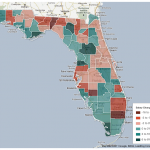
How much has the average teacher's salary changed since the 2007-08 school year? We've visualized the changes in an interactive map. Continue reading →
Education bills await lawmakers' January return to Tallahassee.
Education-related bill are stacking up in Tallahassee, four months before lawmakers return for the 2012 session.
Yesterday we wrote about Sen. Joe Negron’s bill that would allow voters to once again choose the state education commissioner. Here are other topics that will be on the calendar come January.
School Funding
At the top of the House heap is HB 1, sponsored by Rep. Michael Weinstein, R-Jacksonville, which requires state analysts to determine how much Florida should spend on education and report back to the legislature.
A similar bill in the Senate, SB 142 sponsored by Sen. Anitere Flores, R-Miami, would earmark $100,000 to hire an outside company to study and report back on state education funding.
Voters would once again choose Florida’s top education official if a bill proposed by a state senator becomes law.
Stuart Republican Sen. Joe Negron introduced the constitutional amendment to elect the Commissioner of Education Monday.
The commissioner has been appointed since voters amended the state constitution in 1998. Negron’s bill would also dissolve the state Board of Education.
“I think its time to restore public education to its proper place of stature along with agriculture, finance and our legal system which are the other Cabinet positions,” Negron told The Florida Current. “The current education system is confusing and ambiguous. I think it’s an unworkable structure and results in a diminution of focus on education in Florida.”
Are college reforms Gov. Rick Perry pushed in Texas coming to Florida?
The Texas model is doing to higher education what the Florida model did for K-12, at least according to supporters of the seven-point reform plan.
Gov. Rick Scott, a Republican, has been passing the plan around to higher education officials and has tentatively signaled his support in interviews. The reforms are a hallmark of Republican presidential candidate Rick Perry’s term as governor.
But just what do the “Seven Breakthrough Solutions” do?
In general, they would ask colleges to quantify their performance by calculating a cost-benefit analysis of instructors, offering bonuses for the best-performing professors and disclosing all of that data for students and the public.
The number of Hispanic college students increased 24 percent in one year, according to a Pew Hispanic Center report released Thursday.
Hispanics age 18-24 now outnumber black students of the same age on college campuses. Nearly 350,000 more Hispanics were enrolled in college 2010 than in 2009, according to U.S. Census Bureau Data analyzed by Pew.
Pew attributed the gains more to rising educational attainment than population growth.
However, Hispanics earn bachelor degrees at a lesser rate than other ethnic and racial groups. Just 13 percent of Hispanic 25- to 29-year-olds had earned a bachelor’s degree, compared to 53 percent of Asians, 39 percent of whites and 19 percent of blacks in the same age group.
Hispanic graduation rates have reached an all-time high of 85.1 percent, Pew noted.
That’s a choice Florida budget writers face, according to state Rep. Jeff Brandes, a Pinellas County Republican.
Brandes told WUSF’s Florida Matters that growth in Medicaid, the state-run health care program for the poor and disabled, was limiting the state’s ability to spend more on education. Medicaid has grown to 30.7 percent of the budget in the current spending plan from 22.2 percent of the budget in 2008.
That’s an increase of more than one-third in four years.
“How do we fund anything if 50 percent of the budget is Medicaid and education?” Brandes asked, noting the Legislature may have to take from public safety, transportation and other quality of life items.
Brandes’ numbers need some context if lawmakers’ decisions are being cast as health care versus education.
The Lake County teacher suspended over his Facebook comments critical of a New York law allowing gay marriage is back at work today, according to the Orlando Sentinel.
Jerry Buell chairs the social studies department at Mount Dora High School and was the school teacher of the year. Buell was suspended last week when he posted on social networking site Facebook that he “almost threw up” after hearing about a New York law allowing gay marriage.
District officials said at the time of Buell’s suspension that they were investigating whether he violated a district ethics policy to respect the “worth and dignity of every person.”
District officials would not say if Buell was reprimanded. That information will be available next week.
Do you agree with the decision? Should limits be placed on school district employees’ use of social media sites?
Florida State Rep. Jeff Brandes, a St. Petersburg Republican.
Technology could provide low-cost solutions for school districts struggling with tight budgets.
That’s what Pinellas County state Rep. Jeff Brandes, a Republican, said at a taping of WUSF’s Florida Matters this week. The show is looking at school issues as students head back to class.
Brandes believes schools can use technology to stretch their budgets. New revenue is unlikely because a tax increase is off the table, he said, and the economy is still slowly recovering from the Great Recession.
Brandes sits on the policy-setting House education committee, and said he favored both virtual charter schools and more widespread use of Apple iPads.
Hillsborough County has won another national education grant, this time to improve principal training.
The Wallace Foundation announced Hillsborough was one of six districts to share a $75 million, six-year grant. Districts will receive $7.5 million to $12.5 million to develop programs in four areas: rigorous job requirements, high-quality training, selective hiring, and on-the-job evaluation and support.
The six districts are urban with a significant low-income population: Charlotte-Mecklenburg in North Carolina; Denver; Gwinnett County, Ga. in the Atlanta suburbs; New York City; and Prince George’s County, Md. in the Washington, D.C. suburbs.
Wallace will cover two-thirds of the funding, while the districts must cover the final third. Hillsborough won a $100 million Gates Foundation grant in 2009 to design teacher and administrator evaluations and a pay-for-performance system. Wallace officials said in a press release they chose the six districts because they already had programs to groom principals.
About StateImpact
StateImpact seeks to inform and engage local communities with broadcast and online news focused on how state government decisions affect your lives. Learn More »