
What Makes Wet Gas Wet?
-
Scott Detrow

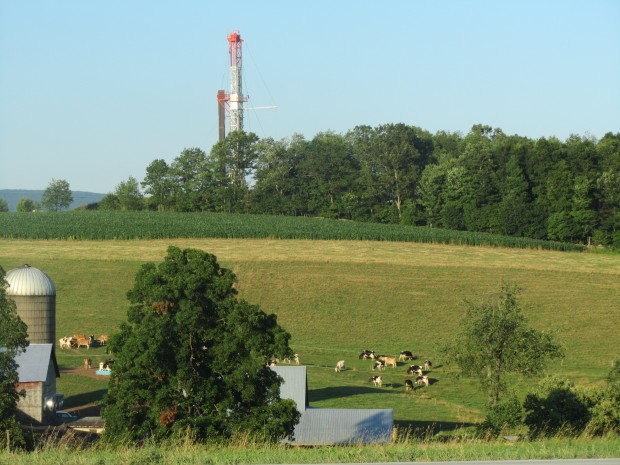
Kim Paynter / WHYY
A drill site looms above a cow pasture in north central Pennsylvania.
There’s been a lot of conversation lately about “wet gas” and “dry gas,” and the growing price disparity between the two.
What’s the difference? Mike Knapp of Knapp Acquisitions And Production explains in an informative blog post:
First of all, we have to define “natural gas” Natural gas is a gas comprised of multiple hydrocarbons, the most prevalent being methane. The higher the methane concentration, the “drier” or “colder” the gas is. Other constituents of natural gas are evaporated liquids like ethane and butane, pentane, etc. We refer to these collectively as natural gas liquids (NGLs), or “condensates”. The higher the percentage of NGL’s, the “hotter” or “wetter” the gas is. NGL’s must be stripped out of the gas before it can be put in a pipeline and used. Ethane, which is prevalent in Western PA wet gas, is the feedstock for Ethylene, which is what we use to make plastics.
…Whether you are in a wet gas or dry gas area is going to have a huge impact on the value of your lease. Right now, the NGL’s are worth considerably more than dry gas. In some areas, the value of the gas is more than doubled because of the NGL’s. Right now, the commodity price for natural gas is very low due to an oversupply situation. Companies in dry gas areas are LOSING money because of this, while companies in areas with large amounts of NGLs are doing much better. Dry gas areas are dead as a doornail right now for leasing, but wet gas areas are seeing nice offers. With the impressive (read: jaw-dropping) results companies have been having in the Utica in Ohio with oil production (which is far more profitable than wet or dry gas) dry gas areas have been reduced to a distant third tier. Dry gas areas will not be in high demand for a long time, possibly decades. That is not to say that they will not be drilled. There is a boatload of gas there, but companies will not be competing and landowners shouldn’t expect to see the huge up front bonuses (that they did a few years ago) again any time soon. With the low price of gas, it’s simply not economical to pay out thousands of dollars per acre just to be able to pull a rig on the property to spend millions to drill a well that will barely make a profit at these prices.
Editor's Picks
PARTNERS



FUNDERS




Climate Solutions partners