
Dead Calves and Hairless Puppies
-
Susan Phillips

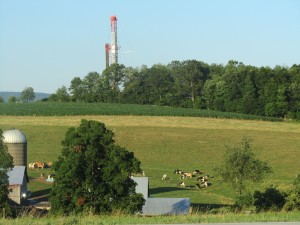
Kim Paynter / WHYY
A drill site looms above a cow pasture in north central Pennsylvania.
Two scientists have tracked the impacts of shale gas drilling on animals and recently published an article in New Solutions: A Journal of Environmental and Occupational Health Policy. The piece details farmers’ experiences when their livestock and pets came in contact with drilling waste water. In “Impacts of Gas Drilling on Human and Animal Health,” Michelle Bamberger and Robert Oswald conclude the most common health impacts involve reproduction, including stillborn calves and hairless puppies.
Bamberger and Oswald write that animals provide the best predictions on what may also occur when humans come in contact with the toxins used in gas drilling.
“Because animals often are exposed continually to air, soil, and groundwater and have more frequent reproductive cycles, animals can be used as sentinels to monitor impacts to human health.”
In other words, cows grazing on the bucolic landscape of Bradford County may be Queen Shale’s version of the canary in a coal mine. A cruel reality in a world where science is playing catch up to the shale gas boom. But what’s more interesting about this study is not so much what the two scientists documented, as what they didn’t document.
“This study is not an epidemiologic analysis of the health effects of gas drilling, which could proceed to some extent without knowledge of the details of the complex mixtures of toxicants involved. It is also not a study of the health impacts of specific chemical exposures related to gas drilling, since the necessary information cannot be obtained due to the lack of testing, lack of full disclosure of the International Union of Pure and Applied Chemistry (IUPAC) names and Chemical Abstracts Service (CAS) numbers of the chemicals used, and the industry’s use of nondisclosure agreements.”
For more information on why Bamberger and Oswald had such a tough time learning about the specific chemicals used, read our piece on the so-called “Halliburton Loophole.” State Impact recently reported on how Pennsylvania Governor Tom Corbett has slashed funding for Marcellus Shale research, much of it on the impact to wildlife.
Even without detailed information on the toxins resulting from gas drilling, the authors of the study say they have no doubt natural gas drilling operations killed or injured the animals they reference. And, they say the gaps in their research should serve as its own canary when it comes to good science on the public health implications of shale gas development.
“…our study illustrates not only several possible links between gas drilling and negativehealth effects, but also the difficulties associated with conducting careful studiesof such a link.”
The study points out another research obstacle. Animal owners who have reached a financial settlement with an energy company often have to sign a non-disclosure statement, which prevents them from discussing the case. Their conclusion? Halt drilling until more data can be collected, and the health impacts could be better documented.
Editor's Picks
PARTNERS



FUNDERS




Climate Solutions partners