5 Things You Need To Read In Governor Corbett’s Shale Commission Report
-
Scott Detrow

Scott Detrow / StateImpact Pennsylvania
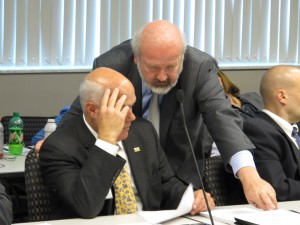
Commission members Jeff Wheeland (l) and Dave Sanko (r) during the panel’s July 15 meeting
137 pages can be a lot to read through, especially when they’re inside a government report, and not a summer beach novel.
To guide you through the Marcellus Shale Advisory Commission‘s final report, StateImpact Pennsylvania put together a list of the document’s top five most interesting sections.
(Read the full report here.)
Pooling? What Pooling?
Last Friday, commission member Terry Engelder predicted the section on “pooling” would be the report’s most controversial recommendation. The panel voted to suggest revising a 1961 law, so that gas in the Marcellus Shale formation could, under certain circumstances, be extracted from under a person’s land against his or her will. That situation can happen – with full compensation – in nearly every other geological formation, but the legislation excluded the Marcellus.
If you missed this controversial segment on your first pass through the document, you’re not alone. “I went through it and I was trying to find the word pooling, or even reference to the act it comes out of, and I couldn’t find it,” said PennFuture president Jan Jarrett. “They did everything but say pooling.”
In fact, they didn’t say pooling at all. Here’s the recommendation’s text:
Pennsylvania’s statutes should be modernized in a timely manner to:
–Include the Marcellus Shale and other deep unconventional geologic formations currently excluded from existing conservation statutes;
–Conform with the best practices for shale gas development in the great majority of states with said production,
–Ensure the protection of property rights for both surface and mineral rights owners;
–Account for the opportunities afforded by advances in technology of natural gas extraction practices,
-Ensure the minimization of surface impact through the proper placement and spacing of well pads;
-Prevent the waste of stranding of natural gas so as to maximize job and revenue-generating opportunities for the Commonwealth and its citizens.
Ensure the protection of property rights! Conform with the best practices…in the great majority of states! Maximize job and revenue-generating opportunities! What’s controversial about that?
It’s certainly different wording than what Corbett used in April, saying, “It’s private eminent domain. I don’t think that’s right. If I see a bill that contains forced pooling, I won’t sign it.”
Stepping Up Enforcement
Given the way Democrats and environmental groups have characterized the commission and its recommendations – the left-leaning Budget and Policy Center called them an “industry wish list” today – you might be surprised to see the number of increased penalties and regulations suggested in the report.
The commission wants to steepen “penalties for violations of the Oil and Gas Act….from $25,000 to $50,000,” and up the daily penalty from $1,000 to $2,000.” (Recommendation 9.2.1). The report also suggests “expand[ing] an operator’s presumed liability for impaired water quality from within 1,000 feet of a well to within 2,500 feet of a well, and from 6 months to 12 months of completion or alteration of the well.” (Recommendation 9.2.6). The commission is calling for more transparency, with detailed well reports posted on the DEP website listing chemicals used during fracking, identification of sources used to extract drilling water, and “whether methane was encountered…other than target formation during drilling.” (9.2.14).
The report also suggests statewide standards for newly constructed private drinking wells. Right now, no such guidelines exist.
On top of that, the commission recommends increasing the distance between wells and streams (9.2.24) and the creation of a “population-based health registry with the purpose of characterizing and following over time individuals who live in close proximity to gas drilling and production sites.” (9.2.40)
Speeding Things Up
Ever since hydraulic fracturing moved into Pennsylvania, critics’ biggest complaint has been the speed at which the drilling industry has expanded. They’ve worried Pennsylvania’s regulators are playing catch-up, and the proper restrictions aren’t yet in place.
While the report does suggest those tighter regulations, it also offers several recommendations meant to expedite – not slow down – drilling. Take 9.1.13: “A lead state agency should be designated to alleviate delays in linear pipeline project development and approval; to identify redundant (state and federal) natural and cultural resource reviews which should be eliminated…” This is in an area where there the state doesn’t have any regulatory oversight – in fact, six recommendations earlier, the commission suggests putting the Public Utility Commission in charge of pipeline oversight. (9.1.7).
The report also recommends “state agencies should offer accelerated permit reviews within guaranteed time frames, provided any incremental costs associated with the accelerated review shall e paid by the permit applicant.” (9.1.14). The recommendation comes a few weeks after DEP promised to slow down its permitting process, under certain circumstances.
Kicking The Can Down the Road?
The commission had 120 days to “identify, prioritize and craft” its recommendations. Given the amount of time and energy spent on the subject, there sure are a lot of suggestions that boil down to, “this issue needs to be studied a bit more.” For example:
-“PennDOT should calculate and evaluate increased traffic volume to continuously calculate impacts…” (Recommendation 9.1.10)
-“The Commonwealth…should undertake a detailed assessment of air service and infrastructure needs…” (Recommendation 9.1.8)
-“Conduct an engineering analysis of spill containment systems at unvonventional shale gas well sites…” (Recommendation 9.2.27)
-“The Department of Health should collect and evaluate clinical data provided by health care providers.” (Recommendation 9.2.38)
-“PennDOT, or an independent consultant, should evaluate the future rail needs necessary for maximizing shale development…” (Recommendation 9.4.3)
-“A comprehensive evaluation of Pennsylvania’s competitive business climate should be conducted…” (Recommendation 9.4.4)
Additionally, the commission suggests Governor Corbett create a permanent committee charged with studying the drilling industry, and recommends the Department of Conservation and Natural Resources create its own natural gas advisory committee.
Given the fact Corbett essentially halted all drilling-related legislation until the commission had a chance to weigh in, you could forgive skeptics for wondering, “We waited all this time for what? A commission to recommend more commissions should look into this?”
Cawley’s spokesman, Chad Saylor, said that misses the point. “There’s a level of detail in the report on a number of things,” he explained. “…But there are other areas where there was, by design, some flexibility. Less specific [recommendations]. The goal of that was, this is the beginning of the process. The governor will be taking it from here, and he needs to work it out with legislators.”
A “Really Really Bad” Proposal
Beyond the report’s two “big ticket” items – the impact fee and “pooling” – the most heated reactions from environmental groups centered on recommendation 9.4.9, which reads, “The Alternative Energy Portfolio Standards Act should be amended to include natural gas as an eligible Tier 2 fuel source.” PennFuture president Jan Jarrett called it, “really, really bad.”
She continued:
That includes stuff like coal waste plants, it includes municipal waste incinerators like Harrisburg. It includes large hydroelectric projects. 10 percent of our electricity must come from those sources by 2020. Well natural gas, right now, generates about 25 percent of our electricity. So number one, it doesn’t need it. And number two…if natural gas takes up the whole thing, the utilities aren’t beholden to buy anything else, and it would reduce the value of that credit to nothing. It’s a bad proposal. It’s bad for alternative energy in Pennsylvania, and it would be bad for the city of Harrisburg.
Jarrett’s colleague, former DCNR Secretary John Quigley, added he “strongly disagree[d]” with the suggestion.
Other recommendations aimed at incentivizing the natural gas industry include, “develop[ing] ‘green corridors for natural gas fueled vehicles…located every 50 miles and within 2 miles of designated highways” (9.4.5).
Editor's Picks
PARTNERS



FUNDERS




Climate Solutions partners