Meridian-based Scentsy has landed a spot on Forbes Magazine’s list of America’s Most Promising Companies. The only other Idaho company to join the no-flame scented candle maker on this year’s list is Idaho Falls-based Deer Valley Trucking, which transports water and oil on North Dakota’s Bakken shale formation.
Scentsy stands out on the Forbes ranking for having the greatest revenue — $381.8 million in the most recent fiscal year. Like Tupperware, Scentsy relies on a direct-sales distribution model. Founded in 2004, the company boasts more than 140,000 home-based independent sales consultants worldwide. In September, Inc.com counted Scentsy among the fastest growing U.S. companies.
Kelly Barker, a single mother from Meridian, has been out of work since April.
Name: Kelly Barker
Age: 46
Unemployed since: April 2011
“Every day that I get in my car to go volunteer, I pray and cross my fingers that it starts, because I don’t have anything to fall back on.”
The Idaho Department of Labor estimates nearly 70,000 people in the state don’t have jobs. That doesn’t include thousands more who are underemployed or have stopped looking for work. This is the latest story in our “Jobless in Idaho” series, that follows several Idahoans in their search for work.
Kelly Barker remembers pleading for her first job. She was twelve years old, and she wanted to buy a Pentax camera. “It was very expensive, and I remember begging for that job at a Tastee-Freez,” she said. “Finally, when the owner got tired of me begging every day, he gave me the job. I’ve worked ever since.”
New data from the Idaho Department of Labor confirms what many people have suspected. The number of people who are underemployed continues to grow. In 2010, 14.2 percent of the workforce was underemployed, compared with 12.7 percent back in 2009. Statistics show most of the underemployed worked part-time or temporary jobs when they wanted and needed full-time work.
The Department reports 97,000 Idahos were considered underemployed in 2010, the official number of people without work hit a record 70,000 that same year. Labor Department spokesman Bob Fick says the underemployment number could be even higher because the recession has forced some workers to take part-time jobs for longer than five months because they can’t find anything better.
This chart breaks up the data by regions. Notice Southwestern Idaho saw a decrease in the official underemployment rate:
The Idaho Department of Commerce has named Gynii Gilliam as its new chief economic development officer. Here’s the press release from the Department:
Gilliam will lead the agency’s economic development team and will be responsible for creating economic growth, across all industry sectors, for the state of Idaho.
“Ms. Gilliam will be an excellent addition to our team,” said Commerce Director Jeffery Sayer. “Her strong leadership, her proactive and partnership-focused approach, and her experience will be a great asset for our team and for our state. We are excited to have her join our effort to accelerate employment growth and business creation for our great state.” Continue Reading →
We’ll be at the Boise Centre tomorrow (8:30-3:15) liveblogging the Associated Taxpayers of Idaho’s 65th annual conference. This year’s theme: “Niching Idaho in Uncertain Economic Times.”
A prominent DC-based think-tank says real growth in U.S. jobs is attributed primarily to new startup companies, not existing small businesses. The Brookings Institution, a nonprofit public policy organization, reports most jobs created in the last 30 years have come from young, new enterprises. In the video below, Brookings Senior Fellow Robert Litan says the age of a business is a better predictor of its job-creating potential than the size of that business. Many successful startups began during periods of economic trouble, he adds.
On Rock Center with Brian Williams this week, a Nampa woman went grocery shopping in the middle of the night, when her monthly food assistance money was deposited.
Two families from Nampa were featured in an NBC piece this week about the high demand for food assistance and the rush to purchase food on the first of the month, when money is deposited into recipients’ accounts. What the piece doesn’t detail is the number of Idahoans enrolled in the Supplemental Nutrition Assistance Program (or SNAP, formerly known as food stamps), and how much that number has grown in recent years.
According to this study from the Urban Institute, Idaho saw its SNAP enrollment go up by 123 percent between 2007 and 2010. Idaho’s increase in SNAP rolls was second only to Nevada’s, where use of the program grew by 128 percent over the same period.
Idaho Department of Health and Welfare spokesman Tom Shanahan confirms that Idaho has watched demand for SNAP benefits rise steadily, month by month, since September 2007. State enrollment totaled 87,232 that month. In September of this year, it stood at 234,523, an increase of nearly 170 percent. Continue Reading →
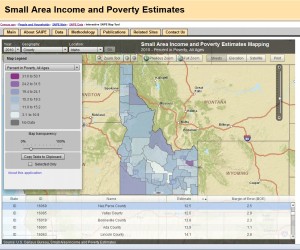
Idaho’s poverty rate has increased 1.4 percent from 2009 to 2010. The U.S. Census Bureau released new poverty and income estimates for 2010 today. The data includes Idaho’s state poverty and income estimates, plus, rates on a county-by-county level and for each school district.
The annual estimates are based on a combination of data from the American Community Survey, federal tax information, records on food assistance participation, Census statistics and annual population estimates.
U.S. Census Bureau
Click on the image to see the interactive Census map
In 2009, the percentage of Idahoans living in poverty was 14.4. The 2010 estimate shows 15.8 percent of Idahoans are in poverty. The counties with the highest rates include Lemhi, Owyhee and Madison Counties. The percent of people living in poverty has steadily increased since 2008, the official start of the latest recession. That same measure of poverty back in 2007, before the recession, was 12.1 percent. Continue Reading →
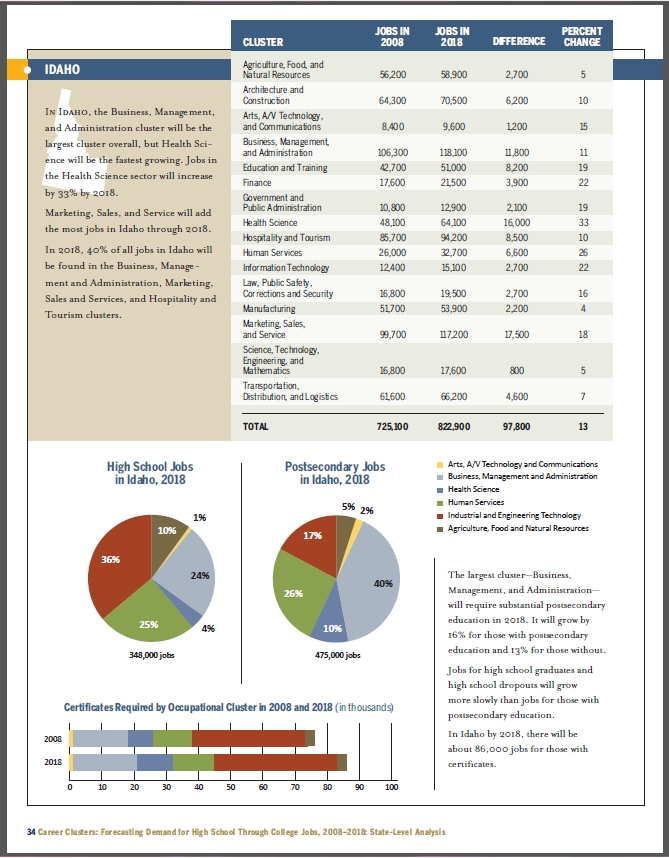
Georgetown University / Center on Education and the Workforce
Click the image to enlarge
A recent study finds Idaho will lead the nation in the creation of new jobs in the health sciences sector. Georgetown University’s Center on Education and the Workforce published this study earlier this month. The report forecasts job demand. More specifically, it looks at the kinds of jobs that will be available for high school graduates, college grads and those with advanced degrees.
Here’s an excerpt from the study:
The key for students, workers, job counselors and educators will be knowing where to find these opportunities and then matching the right job with the right applicant. That is where this report can help. In the full version of the report, we present forecasts on job opportunities and skill requirements through 2018, broken down by the 16 career and technical education (CTE) clusters by the Carl D. Perkins Act of 2006. The Perkins Act is a federal program aimed at improving technical education in the United States, and its clusters are widely used by vocational programs and counselors to assist students in preparing for and then finding jobs. Using our forecasts, we identify the most promising clusters for three categories of job seekers. Those are workers with:
High School Jobs: For those with a high school diploma or less.
Middle skill jobs: For those with some college but no degree (including postsecondary vocational certificates) or an Associate’s degree.
BA plus jobs: For those with a Bachelor’s degree or better.
StateImpact seeks to inform and engage local communities with broadcast and online news focused on how state government decisions affect your lives. Learn More »