Remember the conversations with your parents or grandparents that began with, “When I was your age, I could buy a burger, a coke and a movie ticket for $5”?
And the typical response would go something like “I get it, Dad, (eye roll) things were cheaper back in the dark-ages.”
Bureau of Labor Statistics / U.S. Department of Labor
CPI Inflation Calculator
It all has to do with the value of the dollar and the changes in prices of all goods and services purchased. Here’s a fun tool from the U.S. Department of Labor that lets you see just how far $5, $100, $1000 could go back in the dark-ages (all the way back to 1913).
Idaho General Fund collections of $229.1 million in September 2011 were $0.1 million above the forecast amount.
Idaho’s Division of Financial Management released its latest revenue report today showing a slight uptick in individual income and corporate tax collections over what state economists had predicted.
“Idaho General Fund collections of $229.1 million in September 2011 were $0.1 million above the forecasted amount.” – Division of Financial Management
Still, Idaho sales tax collections were lower than expected.
“It was expected to contribute $93 million to the state’s General Fund in September. Instead, it added $91.6 million.” – Division of Financial Management
That $1.4 million gap is much smaller than August’s shortfall which came in at $6.8 million under what economists had forecast.
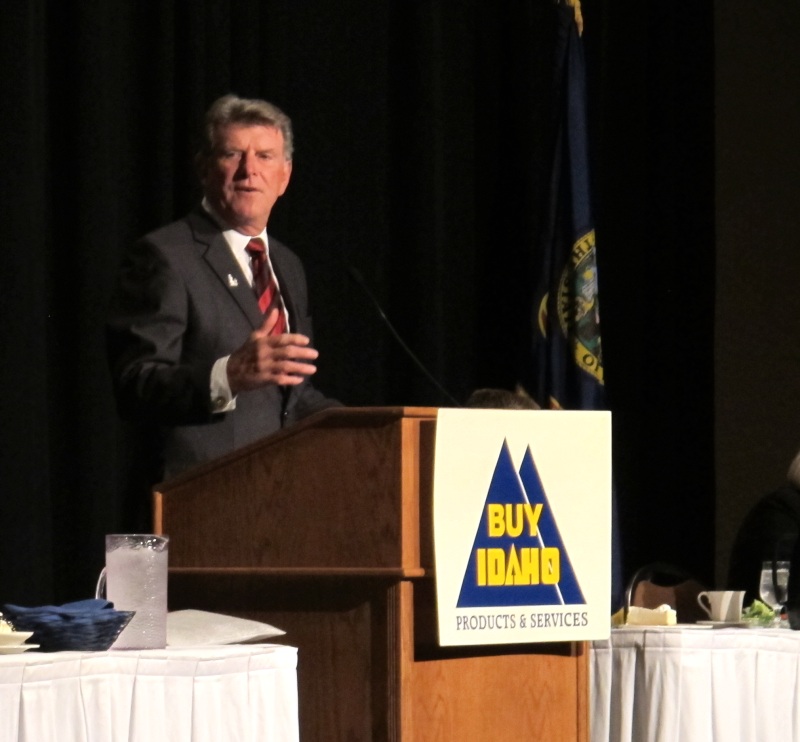
Governor Butch Otter speaking at the annual Buy Idaho conference, October 5, 2011
Buy Idaho launched in 1986, with support from then newly elected Lieutenant Governor Butch Otter, as a way to market Idaho-made products. The member driven marketing cooperative celebrated its 25th anniversary this week. Governor Otter calls the 1,100 member Buy Idaho effort a “great success”. Still, he told attendees at Buy Idaho’s annual conference the group needs to be more aggressive.
“We’re going to continue to go to those marketplaces, go to those buyers that are not only in the U.S. but around the world, and say, ‘Folks we have things we think you need, and we in Idaho would be more than happy to supply those for you.’ And you never know what these marketplaces are looking for until you start demonstrating your products and how it might be applicable to their operation,” said Otter.
The governor is also urging local companies to ramp up hiring. With about 70,000 Idahoans out of work, Governor Otter asked Buy Idaho members to look at the recently passed tax credit program known as the Hire One Act as an incentive to add new jobs. Continue Reading →
As many as 300 people showed up at the state capitol today for a protest march called Occupy Boise. The event was one of many across the country inspired by ongoing protests on Wall Street. Most demonstrators in Boise said they’re concerned about the economy and the distribution of wealth in the U.S.
Here is what a few of them had to say:
Nicholas Coutts is a 23-year-old retail clerk in Boise, ID “I’m frustrated. I don’t know what to do. I grew up in this country and I love it very much, but there’s some problems… I went to college for three years, couldn’t afford it. I’m halfway through a degree. I’m working at a retail store for minimum wage. Any chance to go back to college would just result in more debt, and from what I’ve been seeing people who’ve been graduating haven’t been getting jobs. I don’t know if it’s worth it.”
Lana Levy is a 64-year-old woman living in Boise, ID. “We need to unify as Americans, come together, work together, and not keep fighting each other… I grew up in the 60s, but I really wasn’t involved in that very much. I just lived my life and grew up. My perception is that it’s time for those of us who didn’t finish that job then to come back in and keep it going now, along with the young folks who are starting to get engaged.”
Kit Knox is a 55-year-old woman living in Boise, ID. “I would hope that by this movement spreading, politicians will begin to see that there are a lot of people who are feeling that they don’t have a voice. I have young grandchildren. I have elderly parents. I myself am aging. And I would like there to be some hope for us, and I don’t think people have any right now.”
Jerry Means is a 63-year-old retired plumber from Nampa, ID. “I’m not asking for any more than to help get our American families back to work. I personally am fortunate enough that I got to retire, but all my children – everybody in America – needs a job again. It’s very depressing to sit at home and not be able to provide for your family.”
Jennifer McCarter is a janitor in Boise, ID. “A couple of weeks ago, I heard what they were doing in New York, and I thought, “Finally.” Finally people are getting together, and saying, “Enough.” It’s like everybody’s waking up across the country.”
Similar protests and gatherings have already occurred across the northwest, and more are planned for communities in Idaho, Montana, Oregon and Washington.
Dairy was Idaho's top commodity in 2009 according to Idaho's Department of Agriculture
The Idaho Business Review is reporting the President of the Idaho Dairymen’s Association Mike Roth said without reforming the dairy industry it’s headed “for a serious wreck”. The Dairy Security Act of 2011 is being sponsored by Rep. Collin Peterson, D-Minn., and Rep. Mike Simpson, R-Idaho. Dairy is one of Idaho’s agricultural staples, the state is actually the third-largest dairy producing state in the country.
“Rep. Simpson has been a longtime advocate for business growth and Idaho’s livestock agriculture. He knows a new dairy policy is needed to address price volatility, create safety nets and to help move the industry future.” – Mike Roth
According to the Idaho Business Review, Idaho dairy producers have been working to change federal dairy policy for some time. Last March, producers voted to recommend the Foundation for the Future reform package, which served as the model for the Dairy Security Act of 2011.
A job seeker clutches a training program catalog at a job fair in Illinois this month.
As this article and others have explained in recent days, many states are struggling to repay the federal government for loans it made to help cover unemployment benefits as joblessness surged during the recession.
“More than 30 states have had to borrow billions from a federal fund to cover unemployment benefits for their jobless residents in recent years.” – CNN Money
More than $1 billion in interest is due to the federal government by tomorrow. The Idaho Department of Labor says the state’s share of those interest payments — $5.5 million — has already been sent. “We paid it on Monday,” said spokesman Bob Fick.
The state also paid off the more than $202 million balance of the loan, money borrowed in 2009 and 2010 when Idaho’s Unemployment Insurance Trust Fund went broke. It financed both payments by issuing bonds this summer, a move that won approval from the Idaho Legislature earlier this year.
Idaho’s repayment means that employers will not face higher federal unemployment taxes come January. By contrast, some states are turning to employers and asking them to pony up.
Spokesman Fick says the Idaho Department of Labor has not had to borrow money from the U.S. Department of Labor since July of 2010. The state’s Unemployment Insurance Trust Fund currently holds $139 million. That amount should rise under the measure signed by Gov. Otter in March.
Valley County's Tamarack Resort, viewed from above.
According to this article in The Idaho Statesman today, a potential buyer of Tamarack Resort is backtracking on an announced $40 million offer. The would-be buyer, Matthew Hutcheson of GV Capital Holdings Inc., reportedly said in a letter to state officials that the local economy needs jobs and infrastructure first, and a resort second. Here’s the key excerpt.
“We cannot in good faith pursue the acquisition of the resort believing, knowing, that without an increase in 1,500 well-paying jobs first, the resort is doomed to continued failure and destruction of the local economy,” Hutcheson wrote to Gov. Butch Otter and Idaho Attorney General Lawrence Wasden in a Sept. 19 letter obtained by the Idaho Statesman. “We must bring in jobs that are sustainable and independent of Tamarack first.” – The Idaho Statesman
Job creation in rural Valley County, Idaho, where Tamarack is located, is no easy thing. In August, the county’s unemployment rate was 16.6 percent. Most of the jobs the county does have are in government or tourism and leisure.
Asked what he thinks about the prospects for creating 1,500 jobs in a county where the workforce now totals just over 4,400, Department of Labor Regional Economist Andrew Townsend didn’t mince words. “I’d love to see 1,500 jobs in Valley County,” he said. “I think everyone would. It’s just how to get from point A to point C on that one. What’s the step B? I don’t think I know.”
Entrepreneur Hutcheson has long been regarded as an unlikely buyer for Tamarack. And this is, of course, only the latest development in the resort’s troubled history.
Job seekers met with recruiters at a California job fair this summer.
This series of maps from the New York Times illustrates Idaho’s hard reality, with respect to the jobless rate. While most states have seen unemployment drop since the end of the recession, Idaho is among the handful that have watched unemployment rise. In June of 2009, Idaho’s rate stood at 7.6 percent. Last month, it was 9.2 percent.
As the Times reports, economists wonder whether the slow recovery in parts of the West and South constitutes a lasting shift in the nation’s economic landscape.
“Unemployment remains high across much of the country — the national rate is 9.1 percent — but the regions have recovered at different speeds.
Now, with the concentration of the highest unemployment rates in the South and the West, some economists wonder if it is an anomaly of the uneven recovery or a harbinger of things to come.” – The New York Times
Mike Ferguson, Idaho’s former chief economist, says it’s painful to acknowledge the reality of the state’s predicament. “Idaho is characterized by having turned down earlier and deeper,” he said, “and it’s turning around more slowly than other states.”
Ferguson doesn’t see signs of a rally ahead. He looks at the national numbers, which show job growth has stalled, and says Idaho’s situation is even more dire. “In Idaho,” he said, “it looks like it’s slipping.”
Each week, Tom Birch spends hours meeting with homeowners who know they’re falling behind. Many of them are beset with worry. At no charge, Birch talks to them about their finances. He gives them handouts with titles like, “What to Do When You Default on Your Mortgage.”
Birch worked in the mortgage business for 35 years, but he’s now the Director of Homeownership Counseling for Neighborhood Housing Services, Inc., a nonprofit community development organization in Boise. Foreclosure prevention counseling is one of his chief responsibilities. It sounds like an important service, but we here at StateImpact wondered: when a family is deep in the hole and in danger of losing a home, how much can someone like Birch do? As it turns out, quite a lot.
Molly Messick
Neighborhood Housing Services, Inc. offers free foreclosure prevention counseling to Idaho homeowners.
Q: First, what does foreclosure prevention counseling consist of?
A: It’s awareness of where the borrower really is. Borrowers that I see, about 99 percent of them, have lost a job. They had high credit scores when they got their loans, but they are in a new situation, because of job loss or a reduction in wages or hours, and they don’t know what to do. They’ve tried to make their payments. They wish they could make their payments. And when they come to see us, they basically are paralyzed.
Q: When someone sits down across from you and says, “This is the predicament I’m in, and I have never dealt with this before,” what’s the first thing you say?
A: You are not alone. You’re just like people that I talk to every day. There are some options, and the first step is to know where you’re at. Continue Reading →
The Idaho Nonprofit Center is holding its annual conference in Boise this week. University of Idaho economist Steve Peterson gave one of the headline presentations this morning, unveiling the preliminary results of his Idaho Nonprofit Sector Economic Impact report.
According to Peterson’s study (funded, in part, by the Idaho Nonprofit Center) nonprofits are a big deal to the state economy. Here are some key findings, so far: Continue Reading →
About StateImpact
StateImpact seeks to inform and engage local communities with broadcast and online news focused on how state government decisions affect your lives. Learn More »