Topics

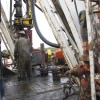
Twenty three percent of of natural gas reserves in the nation are located in Texas. Photo by Gretch Sanders for KUT News.

A Look At Natural Gas Production In Texas

Background

Texas leads the nation in natural gas production, holding around 23 percent of the nation’s natural gas reserves. Natural gas is primarily methane (CH4) and is considered to be a more environmentally friendly fuel than oil. Methane is a nonreactive hydrocarbon, which means its emissions do not react with sunlight to create smog.

Natural gas is used for heating, generating electricity and making transportation fuel. It is also a raw material found in plastics, medicines, fertilizers and dyes. According to the U.S. Department of Energy, 22 percent of energy consumption in America comes from natural gas.

Natural gas in Texas was first discovered as a by-product of oil. As oil production and exploration increased, gas production began to rise, peaking in 1972 with a total of 9.6 trillion cubic feet produced annually in Texas. Texas has maintained a steady level of natrual gas production with the help of the discovery of major natural gas fields such as Newark, East field in North-Central Texas, the Carthage field in East Texas, the Panhandle, West field in the Anadarko Basin, and the Giddings field in the Gulf Coast Basin. Texas natural gas production levels have also been maintained by an increasing number of production wells, which are now at an all-time high. Today many of the new exploration and production activities in Texas involve natural gas rather than oil.

Most of the natural gas production in the U.S. is concentrated around Texas and the Gulf of Mexico. A study by the U.S. Energy Information Administration (EIA)Oil and Gas Journal and World Oil showed that the U.S. contains 3 percent of the world’s total natural gas reserves. Of this 3 percent, nearly half of the production occurs in Texas and Louisiana. The largest onshore natural gas field in Texas is the Barnett Shale field in the Bend Arch-Fort Worth Basin in north central Texas.

The EIA found that between 2004 and 2009 the number of natural gas production plants in Texas decreased (contrary to the national increase) while the average capacity per plant increased. Texas has a total of 163 natural gas production plants with an average of 19.7 billion cubic feet of natural gas produced per day, making it the state with the largest processing capacity in the nation.

Natural gas distributors in Texas include the Texas Gas Service, the Gateway Energy Corporation, and the West Texas Gas, Inc.

Natural gas remains an important contributor to Texas’ economy. In 2006, more than 312,000 Texans (3.1 percent of the state’s workforce) were employed by the oil and natural gas industry. The industry accounts for 14.9 percent ($159.3 billion) of Texas’ gross state product.


Latest Posts

An Unusual Search Warrant and What It Says About How Texas Regulates Drilling

The Texas Environmental Enforcement Task Force affidavit for a warrant to search the Houston office of the Texas Railroad Commission in 2010

As the legislature considers making changes to the Railroad Commission of Texas in the future, a search warrant is now shedding light on how the Railroad Commission interacted with criminal investigators in the past. An affidavit for the warrant, obtained by StateImpact, shows that during a 2010 investigation of a state-regulated site used for disposing [...]

Mapped: Disposal Wells in Texas

Map by Ryan Murphy, Texas Tribune As the drilling process known as hydraulic fracturing, or “fracking,” has rapidly spread across Texas, so has the demand for disposal wells, where wastewater from oil and gas drilling is sent deep underground. In this new interactive map from Ryan Murphy of the Texas Tribune, you can see where [...]

Fracking Disposal Wells Pose Challenges In Texas

Each day, dozens of trucks hook up to the Gulf Coast-run fracking fluid disposal well site near Gonzales, TX.

This article is part of an occasional series on water and hydraulic fracturing by StateImpact Texas and the Texas Tribune. GONZALES, Tex. — In a dusty lot off the main highway in this South Texas town, Vern Sartin pointed to a collection of hose hookups and large storage tanks used for collecting wastewater from hydraulic fracturing jobs. [...]

Coming Soon to the TCEQ: Greenhouse Gas Permits?

An oil refinery is pictured in Texas City, Texas. A new billed could help streamline the greenhouse gas permitting process.

Update: HB 788, which would put greenhouse gas permitting into the hands of the Texas Commission on Environmental Quality (TCEQ), passed out of the House this week. No amendments to the bill were added. Mike Heim, a Texas oil and gas executive, previously told the House Natural Resources Committee that moving the permitting process to [...]

Ambiguities Persist in Regulating Water Withdrawals for Fracking

Texas’ water code was written well before the spread of fracking. As a result, some groundwater authorities require companies using water for fracking to obtain a permit, while others do not.

From the Texas Tribune:  In Karnes County, at the heart of the Eagle Ford Shale, oil and gas drillers seeking to use water for hydraulic fracturing must get a permit from the local groundwater authority. They can pump only a certain amount of water, and they must report how much they use. In Dimmit County, [...]

In Texas, Water Use for Fracking Stirs Concerns

A water truck parked near a West Texas drilling rig. Oil and gas companies' use of water for hydraulic fracturing has sparked growing concerns.

From the Texas Tribune: CARRIZO SPRINGS — In this South Texas stretch of mesquite trees and cactus, where the land is sometimes too dry to grow crops, the local aquifer is being strained in the search for oil. The reason is hydraulic fracturing, or fracking, a drilling process that requires massive amounts of water. “We [...]

Fracking Goes to the Texas Legislature

Four lawmakers sat down to talk drilling, legislation and the oil and gas boom with StateImpact Texas Mose Buchele.

Update/Correction: 03/08/13 The original version of this story reported that Rep. Van Taylor’s HB 100 would reduce methane flaring by encouraging the capture of more methane gas. In a subsequent interview, Rep. Taylor clarified, saying it reduce Co2 emissions by making carbon gasses more valuable to drillers looking to extract more oil and gas from [...]

Higher Penalties for Oil and Gas Industry Have Bipartisan Support in Legislature

Freshman State Representative Gene Wu, D-Houston, introduced a bill this week that would substantially increase many penalties oil and gas companies would have to pay for violating state rules. HB1863 would increase the maximum fines The Railroad Commission of Texas, the agency that oversees the state’s oil and gas industry, could impose on rule-breaking drillers and [...]

About StateImpact

StateImpact seeks to inform and engage local communities with broadcast and online news focused on how state government decisions affect your lives.
Learn More »

Education