Background
What is the Pipeline exactly?
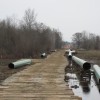
The Keystone Pipeline already exists. What doesn’t exist fully yet is its proposed expansion, the Keystone XL Pipeline. The existing Keystone runs from oil sand fields in Alberta, Canada into the U.S., ending in Cushing, Oklahoma.
The 1,700 new miles of pipeline would offer two sections of expansion. First, a southern leg would connect Cushing, Oklahoma, where there is a current bottleneck of oil, with the Gulf Coast of Texas, where oil refineries abound. That leg went into operation in January 2014. Second, the pipeline would include a new section from Alberta to Kansas. It would pass through Bakken Shale region of eastern Montana and western North Dakota. Here, it will pass through a region where oil extraction is currently booming and take on some of this crude for transport.
The southern leg of the Keystone XL ties into the existing Keystone pipeline that already runs to Canada, bringing up to 700,000 barrels of oil a day to refineries in Texas. At peak capacity, the pipeline will deliver 830,000 barrels of oil per day. While the pipeline is initially carried U.S. light crude, it is expected to carry more heavy Canadian oil harvested from tar sands over the next year.
TransCanada has been attempting to get a permit for the pipeline project for more than five years. Since the northern leg of the pipeline crosses international borders, TransCanada needs to obtain a Presidential Permit through the State Department for construction of the portion of the pipeline that goes from Canada to the U.S. “Quite frankly, we need a Presidential Permit for about 50 feet of pipe. If we weren’t crossing that border then we wouldn’t be having this conversation,” TransCanada representative Jim Prescott told StateImpact Texas in 2012.
The northern segment, from Alberta to Texas, is the section that has run into several points of opposition. Most recently, in mid-April 2014, the Obama administration postponed again a decision on a Presidential Permit, citing uncertainty about a court case in Nebraska over the pipeline’s route. While the northern leg stalled, TransCanada went ahead on the southern leg.
The specific states the line would travel through are Montana, South Dakota, Nebraska, Kansas, Oklahoma, and Texas. The line would cross through 16 counties in North and East Texas. This map lays out the existing and proposed routes:

Map by TransCanada of the existing and proposed Keystone XL pipelines
How Many Jobs Will the Pipeline Create?
It’s unclear exactly how many jobs the pipeline will create. Some estimates have gone as high as 500,000, which is highly unlikely. TransCanada’s own evaluation estimates the pipeline would bring 20,000 new jobs to the US. (Factors such as direct vs. indirect employment and short-term versus long-term job creation fuel the discrepancies.)
The State Department released a report in March 2013 stating that the pipeline could (directly or indirectly) create up to 42,000 jobs, including 3,900 construction jobs. But President Obama refuted that in July 2013, claiming “the most realistic estimates are this might create maybe 2,000 jobs during the construction of the pipeline, which might take a year or two, and then after that we’re talking about somewhere between 50 and 100 jobs in an economy of 150 million working people.”
What Kind of Environmental Impact Will the Pipeline Have?

Photo by Mladen Antonov/AFP/Getty Images)
Many critics of Keystone XL worry it will have harmful environmental impacts. The Sierra Club has said it opposes the specific use of tar sands, which is found in the deposits in Canada. The scientific name for tar sand is bitumen, a mixture of clay, sand, water, and oil that with modern technology can be refined into usable oil. Critics say that it is more corrosive than conventional oil. A report by a coalition of critics that include the Sierra Club and the Natural Resources Defense Council claimed that “bitumen blends are more acidic, thick and sulfuric than conventional crude” and “contain significantly higher quantities of abrasive quartz sand particles.”
It is this corrosiveness that has some concerned about leaks in the pipeline. A report by the State Department says that the Keystone Pipeline “has experienced 14 spills since it began operation in June 2010.” However, none of them were caused by corrosion of the pipeline but by faulty “fittings and seals at pump or valve stations.”
For evidence against the transport of tar sands crude, environmentalists point to an event in May 2011, when 21,000 gallons of oil leaked in North Dakota. This was also due to a faulty valve. The State Department says the maximum amount of spillage in a worst-case-scenario of a Keystone Pipeline leak is 2.8 million gallons spread throughout a 1.7 mile area. TransCanada points out that this is significantly smaller than the amount that escaped during the Deepwater Horizon disaster.
A March 2013 spill of tar-sands bitumen in Mayflower, Arkansas put the Keystone XL pipeline back in the spotlight. An ExxonMobil pipeline carrying tar sands oil from Canada burst, sending more than 12,000 barrels of oil down residential streets and through people’s yards. The pipe was decades old. The spill was categorized as “major” by the Environemntal Protection Agency (EPA) and the cleanup is ongoing.
The pipeline is often compared to another one built by the Canadian energy company Enbridge, which also transports tar sands crude into the U.S. Enbridge, a competitor of Transcanada, “has actually been transporting these types of products [tar sands crude] since 1999 in our pipelines,” said Denise Hamsher, Enbridge’s head of planning. Despite her claim, Enbridge is not without heavy public scrutiny. In July 2010, one of Enbridge’s pipelines ruptured in southern Michigan. Thousands of gallons of oil sands crude flowed into Talmadge Creek, a tributary of the Kalamazoo River. The event caused the EPA to recommend to the State Department that pipelines carrying tar sands be regulated differently than pipelines that carry other types of oil.
Industry expert Oliver Moghissi of DNV, a risk management company, acknowledges corrosion’s ability to cause a pipeline rupture. “Corrosion tends to be [the] number two” cause of pipeline failure, he told StateImpact Texas. (Number one being “outside force damage, usually by an excavator.”) But he contends there’s nothing in Canadian crude that makes it any more risky than conventional crude to the long-term reliability of a pipeline. “I don’t agree that it presents a unique kind of corrosion threat,” he said.
A November 2013 report by the environmental group Public Citizen alleges many issues and defects with the construction of the southern leg of the pipeline, also known as the Gulf Coast Project, saying that “construction problems and apparent engineering code violations along the Texas portion of the southern segment of the pipeline” should have delayed the start of that section.
Environmentalists also point to the process of refining tar sands oil, saying it will create large amounts of greenhouse gas emissions, though the exact percentage increase is debated.
On January 31, 2014, the State Department released a Final Supplemental Environmental Impact Statement for the Keystone XL pipeline. The report found that the pipeline would not have a significant impact on climate change because tar sands oil will be extracted regardless of whether or not the pipeline is built.
Now that the project has cleared this hurdle, the presidential permit process will consider if the Keystone XL pipeline is in the national interest, focusing on “energy security; environmental, cultural, and economic impacts; foreign policy; and compliance with relevant federal regulations and issues,” according to the State Department.
Where Will the Pipeline Go Through Texas?
Here is an interactive map showing where the Keystone XL pipeline would go through Texas:
Courtesy the Keystone Mapping Project. ©Thomas Bachand 2012.
Opposition from Landowners
Some Texans oppose the pipeline. One of them is farmer Julia Trigg Crawford. After Crawford declined to sign an agreement with the company, they used eminent domain to gain access to her land. She responded by filing a temporary restraining order.
Since then, Crawford’s restraining order has gone through a roller coaster of ups and downs. Here’s the timeline: Her first restraining order was dissolved by the courts in Feb. 2012. Shortly after that, TransCanada announced it would start construction on the southern leg of the pipeline from Cushing, Oklahoma to refineries on the Gulf Coast of Texas. Then in March 2012, an appeals court reinstated the restraining order after an appeal by Crawford, preventing construction from taking place. But it was later dissolved yet again for a final time.
Crawford was in Austin in April 2013 to testify before the State House Business and Industry Committee. Crawford’s testimony supported HB 3547, a bill by longtime state representative Rene Oliveira (D-Brownsville). The bill would have significantly changed how pipeline companies get eminent domain in Texas, with implications for both landowners and the oil and gas industry. Despite support by the Committee though, HB 3547 never made it out of committee.
In May 2013, construction on the Gulf Coast segment of the pipeline began on Crawford’s farm. In March 2014, the Supreme Court of Texas declined to hear Crawford’s case, marking the potential end of her long legal fight against the pipeline.
Why Was the Northern Leg of the Pipeline Delayed?
In the run-up to the State Department’s decision on the pipeline, environmentalists and private homeowners in Nebraska joined forces to oppose Keystone’s route through their state. They argued that the intended route would run through the Sandhills area of Nebraska. The Sandhills lie on top of the Ogallala Aquifer, where much of the Midwest gets its water.
The ground is so thin in some parts of this area that groundwater occasionally rises to the surface. This water there is used primarily for irrigation, but some 2 million people also use it for drinking water.
In October 2011, the Obama Administration attempted to delay a decision on granting the pipeline a permit until at least 2013. In its statement, the White House said the reason for the delay was environmental concerns.
The Department of State issued their own statement, saying they will conduct an in-depth review to consider alternate routes in Nebraska. The Nebraska legislature called for a special session to discuss rerouting the pipeline to avoid the Ogallala Aquifer. They also allotted up to $2 million to conduct an environmental impact study on the new route that will circumnavigate the state’s vulnerable Sandhills region.
The results of that report were included in a January 2013 statement issued by Nebraska Governor Dave Heinman. The statement informed President Obama and Secretary of State Hillary Clinton that Governor Heinman approved of a route that would avoid the Sandhills, but still clip a portion of the Ogallala Aquifer. The Governor’s statement also noted that the pipeline would “result in over $418.1 million in economic benefits,” and could generate nearly $20 million in tax revenue in its first year of valuation.
There has been criticism from some members of Congress regarding the State Department’s handling of the initial environmental impact inquiry. An environmental group obtained emails sent between TransCanada lobbyists and State Department officials, purporting to show an over-eagerness on the government’s part to grant TransCanada a permit. Others have alleged that TransCanada was allowed to choose which company would evaluate the pipeline’s proposed environmental impact.
What Happens Next?
President Obama is not altogether opposed to the construction of the pipeline. In 2012, he endorsed the building of its southern half that begins in Cushing, Okla. – an important hub for petroleum processing and transportation – and ends at the refineries on the Texas Gulf Coast. Noting that there’s a bottleneck of oil in Cushing, coming from places like the oil sands of Alberta and the Bakken Shale in North Dakota, the President said that he’s “directing [his] administration to cut through the red tape, break through the bureaucratic hurdles, and make this project a priority, to go ahead and get it done.”
That southern leg of the pipeline was constructed in 2013 and went into normal operations in early 2014.
According to Obama administration officials, a timeline for the president’s decision on the northern leg is still being determined. Another delay on that decision was announced in mid-April 2014, and a decision from the President. is not expected until litigation over the pipeline is settled in Nebraska. The Nebraska Supreme Court is expected to hear arguments by October regarding the ruling that rejected Governor Heinman’s authority to approve the pipeline.
A June 2014 study commissioned by billionaire Democratic donor Tom Steyer and conducted by former Navy SEAL David Cooper concluded that the pipeline was an attractive and vulnerable target for terrorism. TransCanada dismissed the study citing Steyer’s history of environmental activism and pointing out that the Keystone XL accounts for just 1,100 of 2.5 million miles of pipeline in the U.S.
Investigating the Keystone XL Pipeline
In April 2012, StateImpact reporters in Texas and Oklahoma launched a five-part collaborative series on the Keystone XL pipeline. StateImpact’s multimedia narrative includes the following reports by Mose Buchele, Dave Fehling, Terrence Henry, Logan Layden and Joe Wertz.
 Part 1 | StateImpact Oklahoma
Why Cushing is Bursting and Hurting Oklahoma’s Economy
Oklahoma is in an unlikely economic predicament: It has too much oil.
 Part 2 | StateImpact Texas
Will Canadian Crude Make the Keystone XL Pipeline Leak?
With the proposed Keystone XL pipeline has come the claim that the crude from north of the border is uniquely risky.
 Part 3 | StateImpact Texas
Life on the Line: Landowners Fight Keystone XL and Eminent Domain
The pipeline will cross the property of 850 landowners in Texas. And not all of them are happy about it.
 Part 4 | StateImpact Oklahoma
Meet the Woman Who Moved a Pipeline
Oklahoma landowner Sue Kelso fought TransCanada and won … sort of.
 Part 5 | StateImpact Texas
Pipeline or Not, TransCanada Could Leave Mark on Texas Property Rights
Texas politicians love giving lip service to the sanctity of private property. They also talk a lot about the benefits of the state’s robust oil and gas industry. But what happens when those two things come into conflict?