Workers check to make sure the food is not expired.
Sonia Perez is an employee of the West Texas Food Bank.
Campbell says the food bank distributes between four and five million pounds of food a year. tributes
The Permian Basin oil boom has brought jobs and wealth to West Texas, but it’s also brought something less expected: hunger. During a recent trip to Odessa, StateImpact Texas’s Mose Buchele sat down with Libby Campbell, director of the West Texas Food Bank, to learn how, as she puts it, “not all tides raise all ships.”
1) Increased Property Values. With people moving to the Permian Basin from all over the country, property values have skyrocketed. You often hear stories of rents doubling when the time comes for a tenant to re-sign a lease. That’s put a strain on budgets and led to more hunger in the region.
“Maybe their rent was six or eight hundred dollars three or four years ago, it’s currently twelve or fifteen hundred dollars,” says Campbell. “You’ve kind of already busted your budget before you even get to the point that you’re purchasing food.”
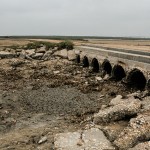
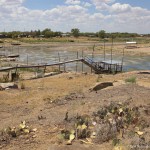
The Texas Water Development Board’s most recent drought report showed that 97 percent of the state is still experiencing some level of drought. So what does a state that parched look like?
Turn one, with its steep hill, was a big challenge for the racers
The shell of a solar racing car is lifted up after a car comes into the pit for repairs.
The race isn’t about speed, it’s about endurance. Whichever team does the most laps in 3 days, wins.
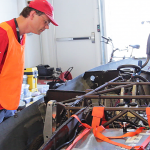
Taking a look inside the car
If the teams race too fast, the batteries will drain too quickly
A solar car approaches the pit
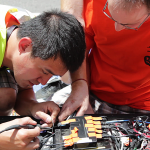
The battery, up close
It’s a sweltering Texas summer day in late June, and here at the Circuit of the Americas Formula 1 race track in Austin, the stands are empty. Just last fall, they were filled with fans witnessing the deafening roar of cars going upward of 200 miles an hour.
But if you were to listen closely this summer day, you’d hear a barely audible zooming on the track. Peek down from the stands, and you’d see little pods zipping along the track at a brisk 45 miles an hour. They’re solar-powered cars, part of the annual Formula Sun Grand Prix competition, where several teams of college engineering students race against each other, and the constant drain of batteries.
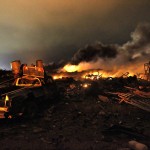
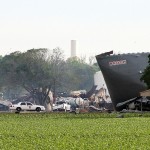
A damaged vehicle is seen after an explosion at the fertilizer plant.
The deadly explosion ripped through the fertilizer plant late on April 13, injuring more than 200 people, destroying 50 homes and damaging other buildings.
A chemical trailer sits among the remains of the burning fertilizer plant in April 2013.
A vehicle is seen near the remains of a fertilizer plant burning after the explosion.
Maria Galvin cleans up broken glass in the front of her business.
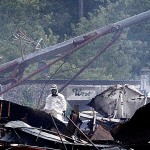
Searchers in protective suits walk through the blast zone of the fertilizer plant that exploded.
Meghan Clontz of Oklahoma City travelled to the town of West to be with family members after the massive explosion in the town
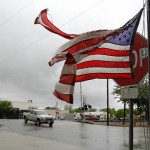
A tattered flag on the rainy morning of Thursday, April 18, in West, Texas.
Police and rescue workers stand near a building which was left destroyed.
An aerial view shows investigators walking through the aftermath of a massive explosion at a fertilizer plant in the town of West, near Waco, Texas April 18, 2013.
The apartment building where Darryl Garricks’ grandchildren were when the blast hit. The children are OK.
Residents of West gather for a candlelight vigil on Thursday, April 19.
A flag is flown at half staff in West, Texas, near the scene of the fertilizer plant that exploded Wednesday night in in the town of 2,8000 on Thursday, April 18, 2013.
KUT photographers Filipa Rodrigues and Jorge Sanhueza-Lyon traveled to the town of West with StateImpact Texas to document the story. You can see their images, along with photos from wire services and state officials, in the gallery above.
Generations of Plainview residents worked at the plant. Aubrey Rivera, Aliva’s daughter, told her her mom she wanted to work there when she grew up.
Criselda Avila lost her job at the Cargill Beef Processing Plant in Plainview. Now she’s unsure what she’ll do and what will happen to the Southern Plains town she calls home.
Jose Amaya and his wife Zuzema have relatives who have already moved away.
Images of cows can be found on the street signs of downtown Plainview
Ruben and Riene Olivas worry what will happen to their business now that the plant has closed.
The streets of Plainview.
Statues of cattle can be found throughout town. A nod to the local importance of the industry.
Johnny Ray Muniz leaves his last shift at the Cargill Beef Processing Plant.
As Mayor Wendell Dunlap plans for the city’s recovery, “your prayers are appreciated,” he said.
A group picture taken the day the last cow came through the Cargill Plant.
The Cargill Excel Beef Processing plant in Plainview, Texas.
Irene and Ruben Olivas say the ripple effect of the plant closure threatens the bakery where they work.
By the time the cows arrived at Criselda Avila’s work station at the Cargill Excel Beef Processing Plant in Plainview, they had already been slaughtered, skinned and gutted. The carcasses came in hanging from a long chain that ran over the plant floor. They were divided up and divided again. Avila worked on skirt steaks.
“You gotta spread it open and then cut the little skirt off, and then throw that on the table and then peeling and just trimming the fat off is what it was,” she remembered recently, sitting in her living room. “You know, fajitas.”
It was numbingly repetitive work. More than 4,500 cows went through the plant every day. So when Avila was done with one, there was always another behind it. Then, on the last day of January, she saw something she never expected to see.
Photo courtesy of Criselda Avila
A group picture taken the day the last cow came through the Cargill Plant.
“There were the last few cows, then the last cow was coming down the chain, and people there were just banging our hooks,” she said. “People started crying, like ‘oh my god this is the end of it.’”
That was how the city of Plainview lost over 2,000 jobs. After years of drought, the U.S. cattle herd is at its lowest level since 1952. Cargill Meat Solutions, the company that owns the plant, says there are simply not enough cows in existence to keep the plant running. For years ranchers across Texas have been cutting back their herds in response to the historically dry weather, but this is the first time those cuts have reached up the supply chain, to hit the industrial heart of a Texas city. The plant closure could have wide sweeping ramifications across the region. Continue Reading →
Owner of Evergreen Farms, Mike Walterscheidt, trims Fir tree branches to use for homemade wreaths.
Sprinklers at Evergreen Farms keep the pre-cut trees moist during Texas’ hot winter.
While owners Mike and Beth are hard at work, their dog rests on the cement porch at the farm.
Young Texas evergreens can still grow tall if rainfall increases in 2013.
Customers at Evergreen Farms ride the trailer to the tree fields where they can pick out and cut their own tree.
Evergreen Farms owners lined up northern Fir trees in the cutting field.
Drought takes no prisoners, and Christmas trees are no exception. The 2011 drought decimated Texas wildlife, and not even resilient evergreens could take the heat. This left Christmas tree farmers in Texas with little or no trees to sell during the holidays. Some farms, like Evergreen Farms in Elgin, shipped in trees from Washington State and North Carolina to sell instead. Other farms had no choice but to close their doors.
This year, things have changed.
“We didn’t lose any from the drought this year, and we lost hundreds and hundreds last year,” says Mike Walterscheidt, owner of Evergreen Farms.
This year’s wetter summer weather improved tree growth, so Evergreen Farms is back to cutting down trees in the field. Continue Reading →
In the Texas Hill Country, one landfill’s trash powers homes
New Braunfels is best known for its clear-running rivers, the Guadalupe and the Comal seen here behind a city waste container.
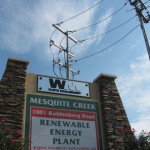
For over two decades, trash from New Braunfels headed to the Mesquite Creek Landfill on the edge of town.
Garbage rich in organic matter arrives by the ton.
Compacted by heavy equipment, each “cell” of trash covers some 15 acres and will eventually be covered with soil.
A gas recovery system is made up of 2.5 miles of pipe and 67 gas extraction wells.
Paul Pabor is Vice President of Renewable Energy for the site’s operator, Waste Management, a Houston-based nationwide disposal giant.
From the landfill, the methane gas is piped to a cement-block building across the road.
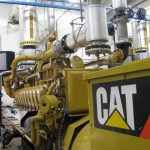
Methane powers two huge engines that produce electricity.
Each engine cranks out about 1500 kilowatts
The electricity is then sent to the electric grid, enough to power up to 1800 homes in New Braunfels.
Landfills keep on producing methane for decades. This is the entrance to a city landfill in Houston and though closed in 1970, it’s listed by the US EPA as a potential project to produce methane for nearby industries.
According to the Environmental Protection Agency (EPA), there are 27 landfills in Texas that are producing enough methane gas to make electricity or provide fuel to power industrial equipment. The agency says another 57 landfills are candidates for such projects.
“Texas is one of the few remaining states with a large number of landfills that don’t already have landfill gas energy projects and may have the potential to support them,” the EPA wrote in a lengthy statement emailed to StateImpact Texas.
‘For Rent’ and ‘For Sale’ signs are a common sight Spicewood Beach. The community had been without its own source of water since January 2012.
Wanda and Jim Watson retired to Spicewood Beach. They worry what lower lake levels will mean for the community’s future.
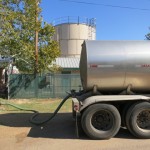
The LCRA trucks water into Spicewood Beach. The Agency came under fire for selling Spicewood Beaches water in the runup to the well failure early this year.
Now residents worry what will happen if the Agency sends water to rice farmers downstream, further lowering the lake levels.
One of the LCRA’s tanker trucks got into an accident recently on the road into town.
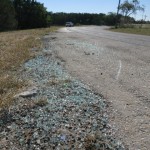
Glass is still visible from the accident.
Lakes in Spicewood Beach a sign reminds residents of wetter times.
Low reservoir levels, like here at the North end of Lake Travis, have some advocating for storing more water underground, where it won’t evaporate.
Lake levels are related to the levels of the water table in the area. If the lake goes down, more wells could go dry.
‘For Rent’ and ‘For Sale’ signs are a common sight Spicewood Beach. The community had been without its own source of water since January 2012.
Slide show compiled by Filipa Rodrigues
The first indication that things are still not right in Spicewood Beach comes as you reach town. You’re greeted with a welcome sign and a notice that stage four water restrictions remain in effect. It’s been nearly a year since the small Highland Lakes community earned the distinction of being the first town in Texas to run dry during the great drought. The situation remains much the same. In some ways it’s gotten worse.
For one thing, there are a lot more ‘For Sale’ signs in front of a lot more houses.
“There’s vacancies all through here and unbelievably low prices, but there’s not takers. Who wants a house with no water?” asks Jim Watson, sitting next to his wife Wanda in their two story home.
Leonid Multi-Instrument Aircraft Campaign captured this image during the 1999 Leonid meteor storm
AZRAK, JORDAN: Photo dated 18 November 1999 shows a Leonid meteor storm over the Azrak desert, 90km east of Amman. The storm packed up to some 1,500 meteros per hour visible with the eye. The Leonids – so called because they appear in the sky in the region of the constellation of Leo – are a stream of minute dust particles trailing behind the Tempel-Tuttle comet, which is visible from earth every 33 years.
Image was taken during the 1999 Leonid meteor storm as part of NASA’s Leonid Multi-Instrument Aircraft Campaign
Four Views Of The Leonid Meteor Shower Of 1966, A Peak Year For This Active Yearly Shower. The Next Leonid Peak Is In The Years 1998 To 2000. The Leonids Make Their Appearance, And Take Their Name, From A Point In The Constellation Leo. These Pictures Were Taken On November 18Th, 1966, From The Kitt Peak National Observatory Near Tucson, Arizona.
SHERBORN, UNITED STATES: The green streak of a meteor seen in the southern sky of New England photographed in Sherborn, Massachusetts early 18 November, 2001 and was one of thousands that entered the earth’s atmosphere during a major meteor shower. The shower, which occurs over several days every mid-November, is called the Leonids because it appears to come from the constellation of Leo.
This Bright Leonid Fireball Is Shown During The Storm Of 1966 In The Sky Above Wrightwood, Calif. The Leonids Occur Every Year On Or About Nov. 18Th And Stargazers Are Tempted With A Drizzle Of 10 Or 20 Meteors Fizzing Across The Horizon Every Hour. But Every 33 Years A Rare And Dazzling Leonids Storm Can Occur But, Astronomers Believe The 1999 Edition Of The Leonids Probably Won’T Equal 1966, Which Peaked At 144,000 Meteors Per Hour.
Stars of the racetrack won’t be the only lights in the firmament this weekend. It’s also peak time for viewing the Leonid meteor shower. “The shower should produce perhaps a dozen or so “shooting stars” per hour,” UT’s StarDate at McDonald Observatory writes. “The best view comes in the wee hours of the morning, as your part of Earth turns most directly into the meteor stream.”
Peak viewing times should be between midnight and dawn Saturday night.
“Just remember, a meteor shower peak prediction is not an ironclad guarantee,” EarthSky writes. “If it’s clear, you might see nearly as many meteors in the predawn darkness on Friday, November 16 or Sunday, November 18. The days before and after that might feature meteors as well, as we pass through the Leonid meteor stream in space.”
A young boy runs along Rockaway Beach as Hurricane Sandy begins to affect the area on October 29, 2012 in the Queens borough of New York City.
In this handout image supplied by the US Coast Guard, The HMS Bounty, a 180-foot sailboat, is submerged in the Atlantic Ocean during Hurricane Sandy approximately 90 miles southeast of Hatteras, North Carolina, on October 29, 2012. Of the 16-person crew, the Coast Guard rescued 14, recovered a woman who was later pronounced dead and are searching for the captain. The HMS Bounty was built for the 1962 film Mutiny On The Bounty and was also used in Pirates Of The Caribbean.
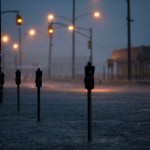
A couple walks in the rain as a darkened Manhattan is viewed after much of the city lost electricity due to the affects of Hurricane Sandy on October 30, 2012 in New York, United States.
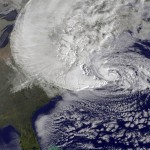
In this handout GOES satellite image provided by NASA, Hurricane Sandy, pictured at 1240 UTC, churns off the east coast on October 29, 2012 in the Atlantic Ocean.
The Empire State Building towers in the background of an apartment buliding in Chelsea, New York City, with the facade broken off October 30, 2012 the morning after Hurricane Sandy.
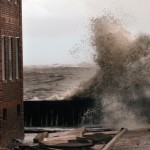
Waves break next to an apartment building which flooded from Hurricane Sandy on October 30, 2012 in Atlantic City, New Jersey.
Water floods the Plaza Shops in the wake of Hurricane Sandy, on October 30, 2012 in Manhattan, New York.
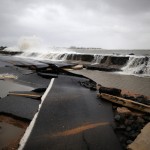
Heavy surf caused by Hurricane Sandy buckles Ocean Ave on October 30, 2012 in Avalon, New Jersey.
A flooded Brooklyn Battery park Tunnel October 30, 2012 as New Yorkers clean up the morning after Hurricane Sandy’s landfall.
Rising water, caused by Hurricane Sandy, rushes into a subterranian parking garage on October 29, 2012, in the Financial District of New York, United States.
Ocean Avenue is flooded caused by Hurricane Sandy, on October 29, 2012 in Cape May, The New Jersey coastline is feeling the full force of Sandy’s heavy winds and record floodwaters.
A photographer shoots waves generated from the remnants Hurricane Sandy as they crash into the shoreline of Lake Michigan on October 30, 2012 in Chicago, Illinois. Waves up to 25 feet high generated by winds up to 50 miles-per-hour were expected on the lake.
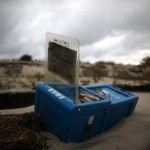
A newspaper cabinet is washed up on Ocean Ave., on October 30, 2012 in Cape May, New Jersey.
Some six million people were without power this morning because of Hurricane Sandy, and at least 33 are dead, many of them killed by falling trees. Travel and transportation has largely come to a standstill in many areas of the Northeast. In the photos above, you can see the impact of one of the most destructive storms in the area’s history.
And while the storm’s physical damage is limited to the East, that doesn’t mean it hasn’t been felt here in Texas. Many flights have been canceled at Texas airports. And several Texas utilities are sending staff East to help restore power in areas affected by Sandy.
Some thirty tree-trimming and eight distribution contractors from Austin Energy are headed Northeast to help, as are crews from Entergy, Oncor, and CenterPoint. AEP Texas is sending 81 employees to West Virginia to help AEP crews there restore power, and has released an additional 38 contact crews to help as well. And San Antonio’s CPS energy has a convoy of some 50 workers headed out to assist in restoring power in the Northeast.
StateImpact seeks to inform and engage local communities with broadcast and online news focused on how state government decisions affect your lives. Learn More »