
A new poll out Tuesday shows strong support for a moratorium on natural gas drilling in Pennsylvania, despite showing general support for gas extraction.
But almost two-thirds support a drilling moratorium in order to study the risks. Pollster and University of Michigan professor Barry Rabe says that’s not such a contradiction.
“A moratorium is not a ban,” says Rabe. “A moratorium is taking some time out and taking some time to develop a policy and process as opposed to completely prohibiting. So if there is a mixture of possible benefits and risks, support for a moratorium might be viewed as a way to view all those risks and minimize them before going forward.”
Most polled view Pennsylvania’s natural gas reserves as a public, rather than a private resource. And 59 percent of those polled view fracking as a major risk to water resources. When it comes to full disclosure of fracking ingredients, 81 percent of Pennsylvania residents “strongly agree.” Continue Reading →
The International Energy Agency reports today the boom in North American shale oil will displace the Organization of Petroleum Exporting Countries (OPEC) in the next five years.
“North America has set off a supply shock that is sending ripples throughout the world,” said IEA ExecutiveDirector Maria van der Hoeven in a statement.
North America will provide 40 percent of new supplies to 2018 through the development of light, tight oil and oil sands, while the contribution from the Organization of Petroleum Exporting Countries will slip to 30 percent, according to the International Energy Agency. The IEA trimmed global fuel demand estimates for the next four years, and predicted that consumption in emerging economies may overtake developed nations this year …
The development of U.S. shale resources, enabling the nation’s highest level of energy independence in two decades, is creating a “chain reaction” in the global transportation, processing and storage of oil that may escalate as other countries try to replicate the American oil boom, according to the IEA.
Between 2009 and 2012, radiation alarms went off 1,325 times in 2012, with more than 1,000 of those alerts just from oil and gas waste, according to data from the Department of Environmental Protection.
The state’s landfills have to one day be fit for people to live on after they close, so the state has to make sure they aren’t allowing a dangerous build-up of radioactivity, officials said.
Oil and gas waste can contain naturally occurring radioactive materials (NORM). The concern has prompted the state Department of Environmental Protection to begin a year-long study of the NORM associated with drilling wastes.
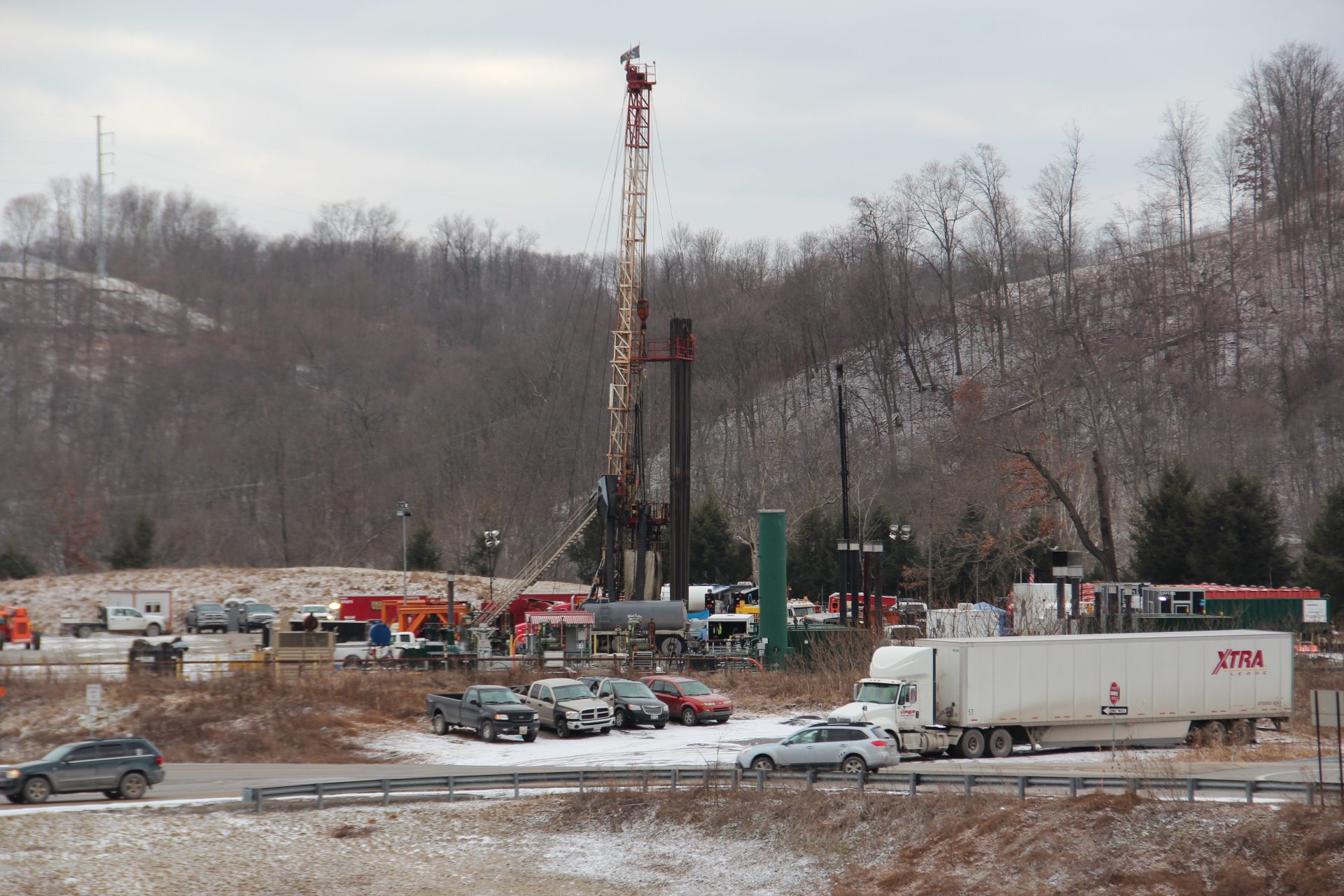
A natural gas drilling rig outside Rifle, Colorado.
The Obama Administration is expected to release new regulations for hydraulic fracturing on public lands soon.
Reuters reports Interior Secretary Sally Jewell told a Senate Appropriations subcommittee last week the Department of Interior is “very close” to releasing the new rules:
“The fracking rules are not bowing to industry pressure or environmental pressure,” Jewell told reporters after her first hearing since assuming the top post at Interior in April.
Jewell said the proposed regulations would use the “best science” and take into account modern technologies and practices. The former oil company engineer noted that she had “fracked a well before.”
The initial draft rules included new reporting standards and a requirement that companies reveal chemicals they use in fracking only after they complete drilling.
The AP says its review comes to the same conclusion as an analysis by the Pennsylvania Budget and Policy Center, a progressive research group based in Harrisburg:
Pennsylvania’s effective tax rate on gas production could drop to as low as 1.3 percent over the next few years.
The AP found that at the current pace production could grow to about 4 trillion cubic feet in 2015. That’s the equivalent of $16 billion in company revenue if wholesale prices are at $4, which is the current range. At West Virginia’s 5 percent tax rate, that would generate about $800 million.
But the policy center estimates that the Pennsylvania impact fee will generate $237 million to $261 million in 2015, depending on the number of wells drilled and prices.
The Mauna Loa Observatory in Hawaii has been a key spot for monitoring global carbon dioxide levels.
The New York Times reports scientific monitors reveal the average daily level of carbon dioxide in the air has surpassed the long-feared milestone of 400 parts per million:
The best available evidence suggests the amount of the gas in the air has not been this high for at least three million years, before humans evolved, and scientists believe the rise portends large changes in the climate and the level of the sea.
“It symbolizes that so far we have failed miserably in tackling this problem,” said Pieter P. Tans, who runs the monitoring program at the National Oceanic and Atmospheric Administration that reported the new reading.
Ralph Keeling, who runs another monitoring program at the Scripps Institution of Oceanography in San Diego, said a continuing rise could be catastrophic. “It means we are quickly losing the possibility of keeping the climate below what people thought were possibly tolerable thresholds,” he said.
Natural gas in Brazil is three times more expensive than it is here, so their officials came for advice on how to safely manage their own shale resources and find American ingenuity to help.
“It’s a great opportunity for your country here and for our country there,” said Luciano Pizzatto, president of Compagas, which distributes natural gas in the Brazilian state of Paraná. “You have a good technology, you pay attention to environmental problems and you have a social return. This technology can transfer immediately to countries like Brazil with little adjustment.”
Today the federal Environmental Protection Agency (EPA) weighed in, and agreed with the DEP. The river will not be designated as impaired.
EPA Region 3 spokesman David Sternberg explained in an email to StateImpact Pennsylvania:
Although we share the continuing concerns about the health of the smallmouth bass population, we do not have sufficient data at this time to scientifically support listing the main stem of the Susquehanna as impaired.
We support the continuing studies being conducted by the Commonwealth to determine both the cause of the declining health of the smallmouth bass population, and to make a determination as to whether or not the main stem of the Susquehanna is impaired.
According to the Post-Gazette, this is the second year in a row the company has kept its doors closed to the media:
The practice is not illegal, but “it’s not appropriate,” said Lev Janashvili, managing director at GMI Ratings, a corporate governance research firm in New York. “What does that decision reveal and suggest about the quality of leadership at the company?”
Shareholder meetings in Pittsburgh and across the country have taken on a charged tenor since the recession compelled many investors to raise questions about executive pay and corporate governance.
The west branch of the Susquehanna River in Clinton County.
When it comes to Marcellus Shale Gas development, the differences between the Delaware River Basin Commission and its central Pennsylvania counterpart, the Susquehanna River Basin Commission, are stark. The DRBC has been the force behind a drilling moratorium in Northeast Pennsylvania and southern New York. But the Susquehanna River Basin Commission has not weighed in on shale gas regulations, aside from monitoring water withdrawals.
For the past several years, environmentalists have put heavy pressure on the SRBC to change that. They argue that, like the DRBC, the SRBC should view its role as protecting water quality as well as quantity. These groups want the SRBC to do a cumulative environmental analysis of the impact of shale gas development on the river basin.
StateImpact seeks to inform and engage local communities with broadcast and online news focused on how state government decisions affect your lives. Learn More »